Category:
RegulationCLARITY Act Delay Sparks Industry Backlash Ahead of September Vote

The cryptocurrency industry is bracing for a pivotal moment as regulatory uncertainty looms over the Digital Asset Market Clarity Act (CLARITY Act). After the U.S. Senate failed to advance this transformative legislation before its August recess, prominent crypto leaders and policymakers are expressing deep frustration over delays that could reshape the entire digital asset landscape. 🚀
Understanding the CLARITY Act's Significance
The CLARITY Act represents one of the most ambitious attempts to establish comprehensive federal oversight of cryptocurrency markets in the United States. This market structure bill aims to create a unified regulatory framework that would clarify the jurisdictional boundaries between the Securities and Exchange Commission (SEC) and the Commodity Futures Trading Commission (CFTC)—a distinction that has plagued the industry for years.
For context, the crypto market has grown exponentially, with total market capitalization exceeding $2 trillion in recent years. Yet regulatory ambiguity has remained a persistent challenge, with different agencies often issuing conflicting guidance on digital asset classification and oversight. The CLARITY Act seeks to eliminate this confusion by establishing clear rules that would benefit both institutional and retail participants. 💡
The September 15 Procedural Vote: What's at Stake
Senate Majority Leader John Thune filed cloture on the motion to proceed to the CLARITY Act just before the Senate began its month-long recess. This procedural maneuver positions the legislation for a critical initial test when senators return to Washington on September 14.
The cloture vote scheduled for September 15 will determine whether the Senate formally begins considering the bill. However, this is merely the first hurdle—the legislation would still require debate, potential amendments, and a separate approval vote. If the Senate passes a version differing from the House measure, the bill must return to the lower chamber before reaching President Trump's desk. ⚖️
Why the 60-Vote Threshold Matters
The CLARITY Act faces a significant procedural challenge: it requires 60 votes to clear the Senate's cloture threshold. Since Republicans cannot reach this number independently, the legislation's fate depends entirely on bipartisan cooperation. This requirement has become increasingly contentious as Democratic and Republican priorities diverge on key provisions.
The House already demonstrated substantial bipartisan support, approving the CLARITY Act by a 294–134 vote on July 17, 2025. Notably, 78 Democrats voted in favor, signaling that consensus exists among crypto advocates across party lines. The Senate Banking Committee similarly advanced its portion by a 15–9 vote in May 2026, with Democratic Senators Ruben Gallego and Angela Alsobrooks joining Republicans in support. 🤝
Industry Leaders Voice Frustration Over Delays
The pre-recess failure to advance the CLARITY Act has sparked vocal criticism from prominent figures in the cryptocurrency space. Senator Cynthia Lummis, a key Republican advocate for crypto regulation, expressed her disappointment bluntly: "You can imagine how frustrated I am." She emphasized that negotiations had consumed months of effort, particularly around CFTC provisions and other contentious issues.
Lummis pledged to continue working with colleagues and stressed that the effort remains "far from over." Her commitment reflects the reality that September offers lawmakers another opportunity to advance the legislation—though with Election Day approaching, the political landscape could shift dramatically. 📅
Coinbase CEO Brian Armstrong also weighed in, calling the delay disappointing but maintaining an optimistic perspective on the broader crypto adoption trajectory. Armstrong highlighted stablecoin adoption, tokenization initiatives, and expanding digital asset markets as evidence that industry momentum would continue regardless of Congressional timelines. Coinbase Chief Policy Officer Faryar Shirzad echoed this sentiment, framing September as another chance for lawmakers to "finish the job."
Interestingly, the delay hasn't triggered market panic. Coinbase shares (COIN) actually gained approximately 5.7% on the Friday following the announcement, closing at $153.60. Market analysts suggest that investors are focusing more on macroeconomic factors—particularly softer inflation and employment data—than on immediate regulatory setbacks. 📈
The Ethics Restrictions Debate
One of the most significant obstacles to CLARITY Act passage involves Democratic demands for stronger ethics restrictions. Several lawmakers want the bill to address cryptocurrency investments and business interests held by senior federal officials and their families.
These concerns have crystallized around specific high-profile cases, including former President Trump's association with World Liberty Financial and the Official Trump memecoin. Senator Elizabeth Warren, while supporting the creation of a federal crypto framework, has rejected the current CLARITY Act version, citing corruption, consumer protection, national security, and financial stability concerns.
This ethical dimension reflects broader public anxiety about potential conflicts of interest in crypto regulation. The debate essentially asks: Can lawmakers fairly regulate an industry in which they or their associates have financial stakes? The answer will likely shape the final form of any legislation that emerges from September negotiations. 🔍
The Stablecoin Rewards Controversy
Another contentious issue involves stablecoin yield provisions that have divided senators and sparked banking industry opposition. The current framework distinguishes between interest paid simply for holding a stablecoin and rewards connected to specific activities like trading, payments, or loyalty programs.
This distinction has placed companies like Coinbase directly in the crosshairs of the debate. Banking associations argue that the CLARITY Act could still allow crypto companies to provide stablecoin rewards under certain conditions, potentially drawing deposits away from community banks and regional financial institutions.
Crypto advocates counter that the legislation already prevents stablecoin issuers from paying deposit-like interest and that broader restrictions would simply protect established banks from legitimate competition. This fundamental disagreement reflects the tension between preserving financial stability and fostering innovation—a tension that will likely persist in September negotiations. 💰
The Election Year Timeline Pressure
The September vote schedule creates an interesting political dynamic. Lawmakers will have approximately seven weeks between the Senate's return and the November 3 midterm elections. This compressed timeline significantly limits available floor time for a complex bill involving multiple regulatory agencies and competing interests.
Election year politics typically make controversial legislation more difficult to advance, as lawmakers worry about voting records that opponents might weaponize in campaign messaging. The CLARITY Act's technical complexity and partisan divisions over ethics provisions could make it particularly vulnerable to last-minute obstructions or strategic delays.
Conversely, some observers argue that the election timeline could create urgency among bipartisan supporters who want to demonstrate legislative accomplishment before voters head to the polls. The political calculus remains genuinely uncertain. 🗳️
What Prediction Markets Reveal About CLARITY Act Odds
Decentralized prediction markets offer fascinating insights into how sophisticated traders assess the CLARITY Act's prospects. A Kalshi contract with approximately $1.23 million in trading volume placed the probability of a Senate vote before October 1 at 88%—closely aligning with the September 15 procedural schedule.
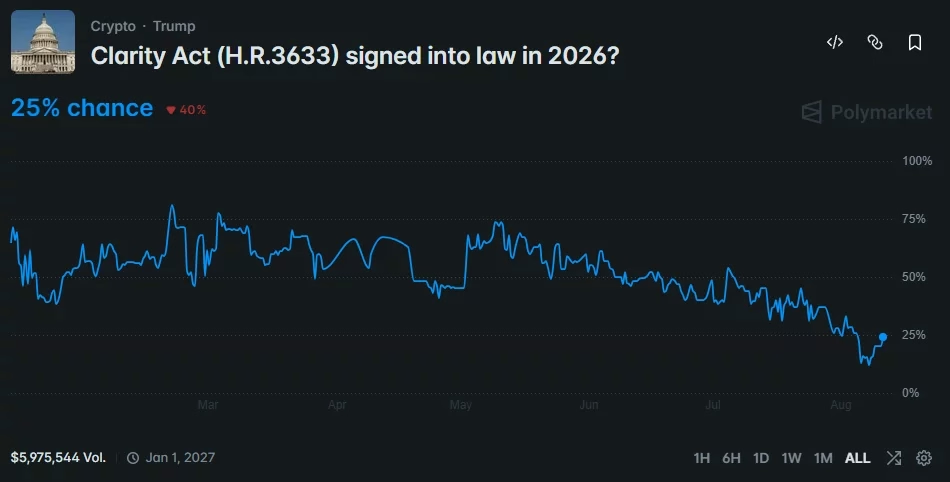
However, a separate Polymarket contract assigned only a 25% probability that the CLARITY Act would be signed into law during 2026, despite more than $5.79 million in traded volume on that market. This significant gap between the probability of a Senate vote and the probability of final passage reflects the additional hurdles the legislation must clear.
These prediction markets essentially price in the likelihood that procedural votes might succeed while the bill still faces defeat on final passage or gets stalled in subsequent legislative steps. The market's skepticism suggests that even sophisticated observers doubt the CLARITY Act will become law this year. 📊
Broader Context: Why CLARITY Matters for Crypto's Future
The CLARITY Act debate occurs against a backdrop of explosive cryptocurrency market growth and increasing institutional adoption. Stablecoins have emerged as critical infrastructure for decentralized finance (DeFi), with total stablecoin market capitalization exceeding $150 billion globally.
Tokenization initiatives—converting traditional assets like real estate, bonds, and commodities into blockchain-based tokens—represent another frontier that regulatory clarity could unlock. Industry analysts estimate that tokenization could eventually represent trillions of dollars in value transfer from traditional systems to blockchain networks.
Without clear federal guidance, this growth occurs in a regulatory gray zone that creates uncertainty for both investors and institutional participants. The CLARITY Act's passage would provide the certainty needed to accelerate adoption across multiple sectors. 🌐
What Happens If CLARITY Fails?
If the CLARITY Act fails to advance in September, the cryptocurrency industry would face continued fragmentation under multiple regulatory agencies with sometimes contradictory approaches. The SEC would likely continue pursuing its aggressive enforcement strategy against digital asset platforms, while the CFTC would maintain its more accommodative stance toward crypto derivatives.
This regulatory inconsistency would particularly harm smaller exchanges and blockchain platforms that lack the resources to navigate conflicting guidance from multiple agencies. Institutional adoption could slow as sophisticated investors remain uncertain about regulatory risk exposure.
Conversely, failure might also prompt industry participants to pursue alternative strategies—perhaps through state-level regulation, international jurisdictions, or technological innovations that circumvent regulatory ambiguity altogether. The regulatory landscape would remain dynamic and contested. ⚡
Key Takeaways and What's Next
The CLARITY Act represents a genuine opportunity to establish the regulatory framework that cryptocurrency markets need to mature. Despite frustration over the August delay, September offers lawmakers another chance to advance this transformative legislation.
Critical points to monitor:
- September 15 procedural vote: Watch whether the Senate achieves the 60 votes needed to advance formal consideration
- Ethics negotiations: Track whether Democrats and Republicans can resolve disputes over federal officials' crypto investments
- Stablecoin provisions: Monitor whether banking industry concerns influence final language around stablecoin yield mechanisms
- Election year dynamics: Assess whether midterm politics accelerate or obstruct legislative progress
- Prediction market signals: Pay attention to how sophisticated traders adjust their probability assessments as September approaches
The cryptocurrency industry's maturation depends on regulatory certainty. While the CLARITY Act's passage remains uncertain, the September vote will provide crucial clarity about whether Congress can overcome partisan divisions and industry lobbying to establish coherent digital asset oversight. The outcome will shape blockchain innovation, institutional adoption, and consumer protection for years to come. 🎯
You May Also Like

Regulation
SEC Regulation Crypto Assets: New Rules Explained
August 26, 2026

Regulation
Trump's CLARITY Act: Reshaping Crypto Regulation in America
August 24, 2026
Regulation
South Korea Strengthens Crypto Oversight with New FIU Investigation Powers
August 23, 2026

Regulation
Reg Crypto Framework: End of Token Legal Ambiguity
August 23, 2026