Category:
RegulationCLARITY Act Faces Critical Wednesday Deadline for Friday Vote

The cryptocurrency industry is holding its breath as the Digital Asset Market Clarity Act (CLARITY Act) approaches a pivotal moment in Congress. ⏰ With lawmakers racing against the clock before the Senate's summer recess, the legislative landscape for digital assets hangs in the balance, and Wednesday's filing deadline could determine whether a procedural vote happens this Friday.
The Timeline Crunch: Understanding the Senate's Schedule 📅
As of early August, the CLARITY Act remains conspicuously absent from the U.S. Senate's official floor schedule. The Monday legislative calendar listed only a spending vote, with no mention of H.R. 3633—the formal designation for the market-structure legislation that has garnered significant attention from both industry advocates and regulatory skeptics.
This absence doesn't necessarily spell doom for the bill, but it does create urgency. Under standard Senate Rule XXII procedures, lawmakers must file a cloture petition by Wednesday, August 5th, to enable a Friday, August 7th vote on whether to proceed with debate. Missing that window would require either expedited bipartisan cooperation or additional Senate session days—both increasingly difficult to secure.
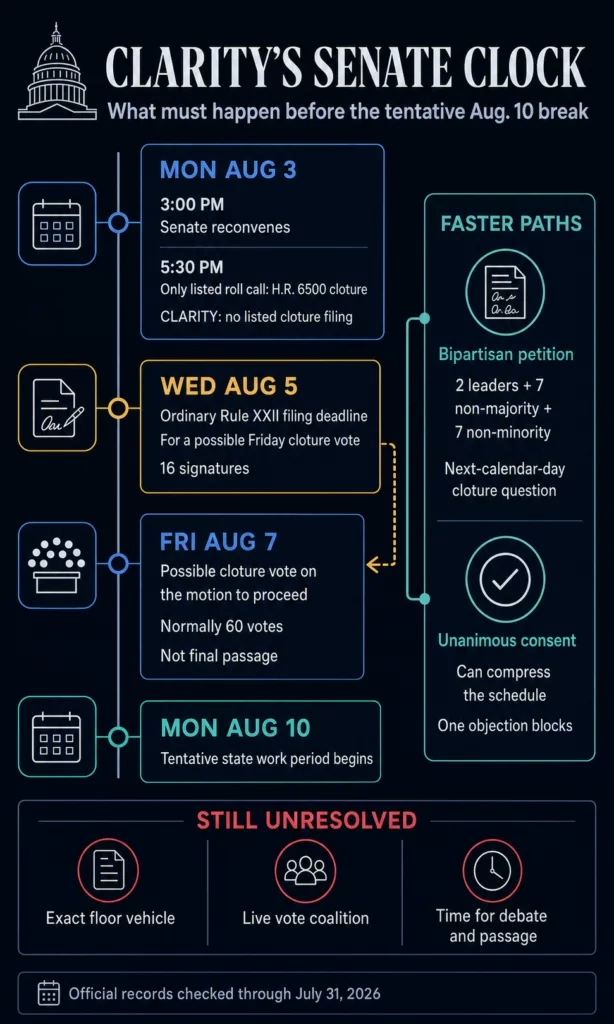
The Senate is scheduled to begin its summer recess on August 10th, with the break extending through September 11th. This compressed timeline means lawmakers have mere days to navigate complex procedural requirements and negotiate contentious policy differences.
How Senate Cloture Rules Work: The Procedural Pathway 🏛️
Understanding Senate procedure is essential to grasping why Wednesday's deadline matters so much. The ordinary cloture process requires signatures from at least 16 senators to initiate proceedings. Once filed, the Senate must wait one full calendar day before presenting the cloture question—typically one hour after the chamber convenes.
A Wednesday filing would trigger a Friday vote, but here's the crucial distinction: this vote wouldn't pass or reject the CLARITY Act itself. Instead, it would determine whether the Senate can end debate on the motion to proceed to the legislation. Invoking cloture typically requires 60 votes—three-fifths of the full Senate when all seats are filled.
Even after successfully ending debate on the motion to proceed, Senate rules permit up to 30 additional hours of consideration before the actual legislative vote. This means the timeline could extend well beyond Friday, potentially stretching into the recess period or requiring post-Labor Day action.
The Bipartisan Cooperation Factor: Why Seven Democrats Hold the Keys 🔑
Republicans currently control 53 Senate seats, meaning they'll need support from at least seven Democrats to reach the 60-vote threshold for cloture—assuming unanimous Republican backing. This mathematical reality has become the central focus of legislative negotiations.
Seven Democratic senators have emerged as key negotiators: Catherine Cortez Masto, Angela Alsobrooks, Cory Booker, Ruben Gallego, John Hickenlooper, Mark Warner, and Raphael Warnock. On July 22nd, this group stated that the Republican-drafted legislation "falls short" of their standards.
Their concerns center on several critical areas:
- Ethics provisions: Stronger language needed to address potential conflicts of interest
- Consumer protection: Enhanced safeguards for retail investors in digital asset markets
- Illicit finance restrictions: Robust anti-money laundering frameworks
- Market integrity: Comprehensive oversight mechanisms for digital asset trading
Senate Banking Committee ranking member Elizabeth Warren has taken an even harder stance, calling the updated version "dead on arrival." Warren specifically argues that ethics provisions don't adequately restrict what she characterizes as President Trump's crypto interests, though these remain her political assessments rather than regulatory findings.
Expedited Routes Require Unprecedented Cooperation 🚀
Senate leaders could theoretically accelerate proceedings through faster cloture procedures, but these require extraordinary bipartisan alignment. An expedited petition must include the majority leader, minority leader, seven senators from the non-majority party, and seven from the opposition—a total of 16 signatures representing both parties' leadership.
Under this expedited process, the cloture vote occurs just one hour after the Senate meets the next calendar day. If successful, senators would immediately vote on proceeding without additional debate. While this could compress the timeline significantly, assembling such a bipartisan coalition would itself signal that substantial negotiating progress had occurred.
Alternatively, a unanimous-consent agreement could bypass many procedural requirements entirely by establishing debate limits and scheduling votes through mutual agreement. However, any single senator can object to such agreements, making them difficult to secure when significant disagreements exist.
The Merged Proposal and Ongoing Negotiations 💼
Senator Cynthia Lummis released a merged proposal on July 22nd that combines work from both the Senate Banking and Agriculture committees. This legislative vehicle reflects months of cross-committee negotiation aimed at addressing concerns from multiple constituencies within Congress.
The Senate Banking Committee had previously advanced its version by a 15-9 vote in May, demonstrating meaningful support but also revealing significant partisan divisions. Lummis has publicly stated that lawmakers remain committed to reaching agreement with Democratic colleagues, though recent statements from Democratic negotiators suggest substantial gaps remain.
In a potential compromise development, Senators Thom Tillis and Ruben Gallego reportedly proposed allowing state authorities to enforce restrictions on federal officials issuing or sponsoring digital assets. This provision directly addresses concerns about executive-branch conflicts of interest, particularly regarding presidential involvement in cryptocurrency. However, the White House has not publicly endorsed final language, leaving this compromise's status uncertain.
What a Friday Vote Would—and Wouldn't—Accomplish ✅
It's crucial to understand that a successful Friday cloture vote would represent just the opening move in a longer legislative process. The vote would permit debate to proceed, but senators would still need to consider amendments, potentially invoke cloture again on the bill itself, and ultimately vote on final passage.
If the Senate advances the motion to proceed before the August recess, lawmakers could continue consideration after returning in September. However, they'd face a significantly crowded calendar with numerous competing priorities. Additionally, any amended version would need to return to the House for approval, since the chamber passed its version (H.R. 3633) by a 294-134 margin in July 2025—notably including support from 78 Democrats.
The Electoral Dimension: 2026 Midterms Loom Large 🗳️
Beyond the legislative mechanics lies a political reality: procedural votes create public records that campaigns and advocacy groups will scrutinize heading into the 2026 midterm elections. Senators voting on whether to proceed with CLARITY Act debate will establish a clear position on cryptocurrency regulation that constituents and political opponents can reference.
Without a procedural vote before the recess, crypto political groups and campaigns would have less concrete evidence for evaluating whether lawmakers genuinely supported advancing digital asset legislation. This electoral consideration adds urgency to both supporters and opponents of the bill.
Industry Impact and Regulatory Implications 📊
The CLARITY Act represents the most comprehensive attempt to establish federal regulatory clarity for digital asset markets. The legislation aims to delineate jurisdictional boundaries between the SEC, CFTC, and banking regulators while establishing baseline consumer protections and market-integrity standards.
Industry observers note that continued regulatory uncertainty costs the U.S. economy billions in lost innovation and competitiveness. Other nations, including Singapore, Switzerland, and the United Arab Emirates, have established clearer digital asset frameworks, attracting blockchain companies and talent that might otherwise base operations domestically.
Conversely, critics argue that premature legislation could entrench regulatory gaps or create compliance burdens that disadvantage smaller market participants. This fundamental disagreement between industry advocates and consumer-protection advocates explains much of the Democratic resistance to the current proposal.
What Comes Next: Watching for Signals 🔍
The next verified indicator of progress will be an official cloture filing, leadership floor notice, or unanimous-consent request identifying the legislative vehicle and timeline. An ordinary filing by Wednesday keeps Friday proceedings possible. A later filing would require either expedited agreements or additional Senate session days—both increasingly unlikely given the recess schedule.
Market participants, industry lobbyists, and advocacy groups are monitoring Senate leadership offices closely for any indication of procedural filings or negotiations. The absence of official announcements as of early August suggests that negotiators haven't yet achieved the consensus necessary for expedited procedures.
Key Takeaways: What This Means for Crypto 🎯
The CLARITY Act's fate hinges on whether seven Democratic senators can be satisfied with ethics and consumer-protection provisions. Wednesday's filing deadline will indicate whether leadership believes it can assemble 60 votes for cloture. A Friday vote would force a public record on digital asset regulation before the midterm elections, regardless of whether it succeeds.
Regardless of the immediate outcome, this legislative battle demonstrates that cryptocurrency regulation remains a contested issue where partisan divisions, consumer-protection concerns, and industry interests continue to clash. The coming weeks will reveal whether Congress can find common ground on digital asset markets or whether uncertainty will persist into the next legislative session. 🚀
For the crypto community, the stakes couldn't be higher—this vote represents a critical juncture in the long journey toward comprehensive federal digital asset regulation.
You May Also Like

Regulation
SEC Regulation Crypto Assets: New Rules Explained
August 26, 2026

Regulation
Trump's CLARITY Act: Reshaping Crypto Regulation in America
August 24, 2026
Regulation
South Korea Strengthens Crypto Oversight with New FIU Investigation Powers
August 23, 2026

Regulation
Reg Crypto Framework: End of Token Legal Ambiguity
August 23, 2026