Category:
RegulationCLARITY Act Gains Police Support Amid Regulatory Hurdles

The cryptocurrency regulatory landscape continues to evolve as major law enforcement organizations throw their weight behind the CLARITY Act, even as significant obstacles threaten its passage before the Senate recess. 🚔 This development marks a turning point in how the crypto industry and government agencies are finding common ground on digital asset oversight.
Police Organizations Rally Behind CLARITY Act Framework
The Major Cities Chiefs Association recently endorsed the latest version of the CLARITY Act, signaling a major shift in how law enforcement views cryptocurrency regulation. 📋 This endorsement came after lawmakers incorporated new enforcement provisions specifically designed to address concerns raised by police and prosecutors over the past several months.
In their letter to Senate Banking Committee Chair Tim Scott and ranking member Elizabeth Warren, the MCCA highlighted how recent revisions directly responded to law enforcement priorities. The organization emphasized that the inclusion of state and local agencies in key sections of the legislation "represents a meaningful step toward improving the ability of law enforcement to investigate financial crimes involving digital assets."
The MCCA's backing joins a growing coalition of law enforcement groups supporting the framework. The National Organization of Black Law Enforcement Executives became the first major police association to endorse the bill, followed by conditional support from the Federal Law Enforcement Officers Association. Most notably, the National Fraternal Order of Police—representing over 382,000 officers—reversed its previous opposition after reviewing revised provisions.
Even organizations that haven't formally endorsed the legislation are softening their stance. The Major County Sheriffs of America withdrew its formal opposition and adopted a neutral position, though it continues advocating for a larger role for state and local agencies in Treasury studies and advisory panels.
Why Law Enforcement Initially Resisted 🛑
Understanding the journey to police support requires examining the original concerns that sparked resistance. Early versions of the Blockchain Regulatory Certainty Act provisions included protections for non-custodial cryptocurrency developers—language designed to prevent programmers from facing prosecution simply because criminals used their open-source software.
However, police organizations and prosecutors argued that this language was dangerously broad. They feared that decentralized finance operators, cryptocurrency mixers, and other services could exploit these exemptions to avoid registration and accountability requirements. This regulatory gap, they warned, would make it substantially harder to trace illicit funds, recover stolen assets for victims, or prosecute money laundering schemes.
The core tension centered on balancing developer protection with law enforcement's need to combat financial crime. How could policymakers shield legitimate programmers without creating safe harbors for bad actors? This question dominated debates throughout 2025 and into 2026.
Key Revisions That Changed the Equation ✅
Lawmakers addressed law enforcement concerns through several critical modifications to the legislation. The updated CLARITY Act draft now clarifies that developers may still face prosecution when they knowingly or intentionally facilitate money laundering, sanctions violations, and other serious crimes.
These revisions also preserve existing criminal-enforcement powers and expand the role of state and local agencies in oversight and investigation. The legislation now includes specific enforcement provisions in Sections 10203, 10204, and 10309 that give police organizations the tools they requested.
However, not everyone is satisfied with these changes. Democrats led by Senator Catherine Cortez Masto and several prosecutors continue pushing for additional modifications. Their proposal would narrow or potentially eliminate certain protections that could shield some crypto service providers from prosecution, reflecting ongoing concerns about potential loopholes.
Banking Industry Demands Tighter Stablecoin Rules 🏦
While law enforcement has largely come to the negotiating table, the banking industry is raising new concerns about specific provisions. A coalition of 134 banking association officials and senior bank executives has formally requested that the Senate strengthen Section 10404, which governs stablecoin issuance and rewards.
The current language restricts stablecoin issuers from paying interest but permits certain rewards tied to payments, memberships, and other activities. Banks argue this creates a problematic loophole. They contend that cryptocurrency exchanges could use these exceptions to offer returns that functionally resemble interest on stablecoin balances, potentially pulling deposits away from traditional financial institutions.
This regulatory arbitrage concerns bankers significantly. If deposits migrate from regulated banks to cryptocurrency platforms offering stablecoin rewards, it could reduce funding available for mortgages, agricultural credit, and small-business loans—the lifeblood of traditional banking operations.
The American Bankers Association and five other financial trade groups have called for Congress to prohibit passive returns tied to stablecoin holdings while preserving legitimate transaction-based rewards. They frame this as necessary consumer protection, though critics see it differently.
The Competition Argument 💼
White House crypto adviser Patrick Witt has disputed the banking industry's framing, arguing that established financial institutions are seeking protection from competition rather than genuine consumer safeguards. This perspective reflects a broader philosophical divide about how to approach cryptocurrency regulation—should policy protect existing financial institutions or enable market innovation?
This debate extends beyond stablecoins. It touches on fundamental questions about whether traditional finance should maintain its regulatory advantages or whether emerging digital asset platforms should operate under equivalent rules. The resolution of this tension will shape cryptocurrency policy for years to come.
Ethics Disputes Create Biggest Hurdle 🚧
Despite growing police support and ongoing negotiations over specific provisions, one issue looms larger than all others: political ethics. This has emerged as perhaps the single biggest barrier to Senate agreement on the CLARITY Act.
Democrats want the legislation to include restrictions addressing financial interests in cryptocurrency held by elected officials and their families. This reflects broader concerns about potential conflicts of interest—should lawmakers voting on crypto regulation be permitted to hold significant crypto assets? Republican Senator Thom Tillis has also signaled that he will not support the bill without an acceptable ethics provision.
Thom Tillis reportedly plans to send a bipartisan ethics proposal to the White House for President Donald Trump's approval. This suggests that ethics language might be negotiable, but it also indicates that no agreement currently exists on what form such provisions should take.
Democrats have not ruled out supporting a vote before the Senate recess scheduled for August 7, but they are unlikely to back the current text without further changes addressing ethics concerns.
What the Odds Tell Us About Passage 📊
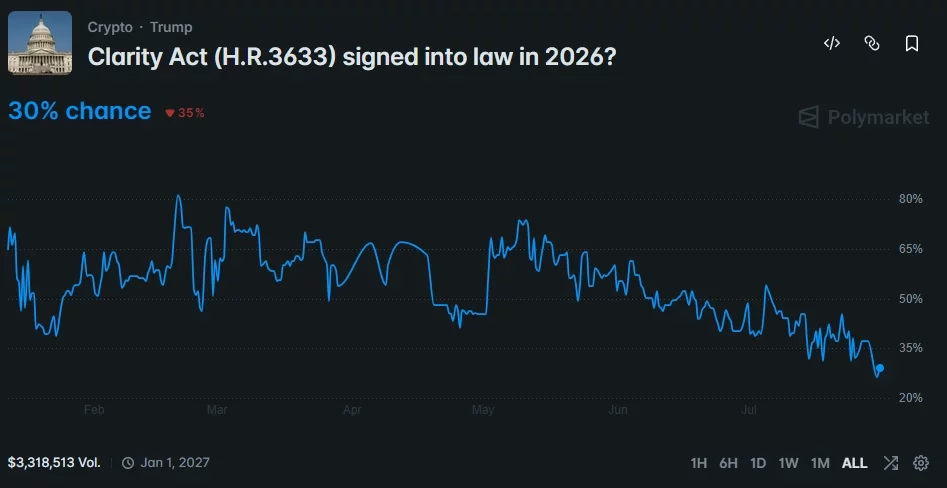
Prediction markets provide a revealing snapshot of how informed observers assess the CLARITY Act's prospects. Polymarket traders currently place the probability of Trump signing the CLARITY Act into law during 2026 at just 30%. This relatively low probability reflects the genuine uncertainty surrounding whether all stakeholders can reach consensus before the August 7 recess.
These odds incorporate several factors:
- Unresolved ethics disputes between Democrats and Republicans
- Ongoing DeFi protection disagreements between law enforcement and crypto advocates
- Banking industry demands for stricter stablecoin restrictions
- Democratic concerns about developer liability protections
- The compressed timeline before the Senate recess
While 30% might seem low, it represents meaningful progress. Earlier in the legislative process, many observers considered passage unlikely at any point in 2026. The fact that major law enforcement organizations now support the framework has shifted the conversation significantly.
The Path Forward 🛤️
For the CLARITY Act to advance during the current legislative window, several conditions must be met. First, stakeholders must reach consensus on ethics language that satisfies both Democratic and Republican concerns. Second, they must resolve disputes over DeFi developer protections that balance innovation with law enforcement needs.
Third, the banking industry and crypto advocates must find middle ground on stablecoin rewards provisions. Fourth, any agreement must command sufficient bipartisan support to overcome a Senate filibuster, requiring 60 votes.
The Major Cities Chiefs Association's endorsement removes one significant institutional barrier, but it does not resolve the fundamental disputes threatening passage. Law enforcement support is necessary but not sufficient for the bill to become law.
Broader Implications for Crypto Regulation 🌐
The CLARITY Act represents the most comprehensive attempt to establish federal cryptocurrency regulation in the United States. Its success or failure will signal how Congress approaches emerging financial technologies and whether it can balance innovation, consumer protection, law enforcement, and industry concerns.
If the bill passes, it would establish clear frameworks for crypto asset classification, stablecoin issuance, and developer liability. If it fails, the regulatory landscape will remain fragmented, with different agencies and states pursuing inconsistent approaches.
The police organizations' support demonstrates that law enforcement no longer views cryptocurrency as inherently lawless. Instead, they recognize that proper regulation can actually enhance their ability to combat financial crime. This represents significant progress in the broader conversation about digital assets.
Key Takeaways 🎯
The CLARITY Act has achieved a significant milestone with Major Cities Chiefs Association backing, but substantial hurdles remain before passage. The 30% probability assigned by prediction markets reflects genuine uncertainty about whether stakeholders can resolve outstanding disputes before the August 7 Senate recess.
Law enforcement support has shifted from opposition to endorsement, but ethics concerns, DeFi protections, and stablecoin provisions continue threatening the bill's advancement. The coming weeks will be critical in determining whether Congress can forge a compromise that satisfies diverse constituencies or whether the CLARITY Act will join the long list of stalled financial legislation.
For cryptocurrency advocates, this represents both progress and caution—progress that major law enforcement organizations now support comprehensive regulation, but caution that political obstacles remain formidable. The outcome will reshape how digital assets are regulated in America for years to come.
You May Also Like

Regulation
SEC Regulation Crypto Assets: New Rules Explained
August 26, 2026

Regulation
Trump's CLARITY Act: Reshaping Crypto Regulation in America
August 24, 2026
Regulation
South Korea Strengthens Crypto Oversight with New FIU Investigation Powers
August 23, 2026
Regulation
Reg Crypto Framework: End of Token Legal Ambiguity
August 23, 2026