Category:
BlockchainCrypto Card Spending Surges 2.5x to $759M in July

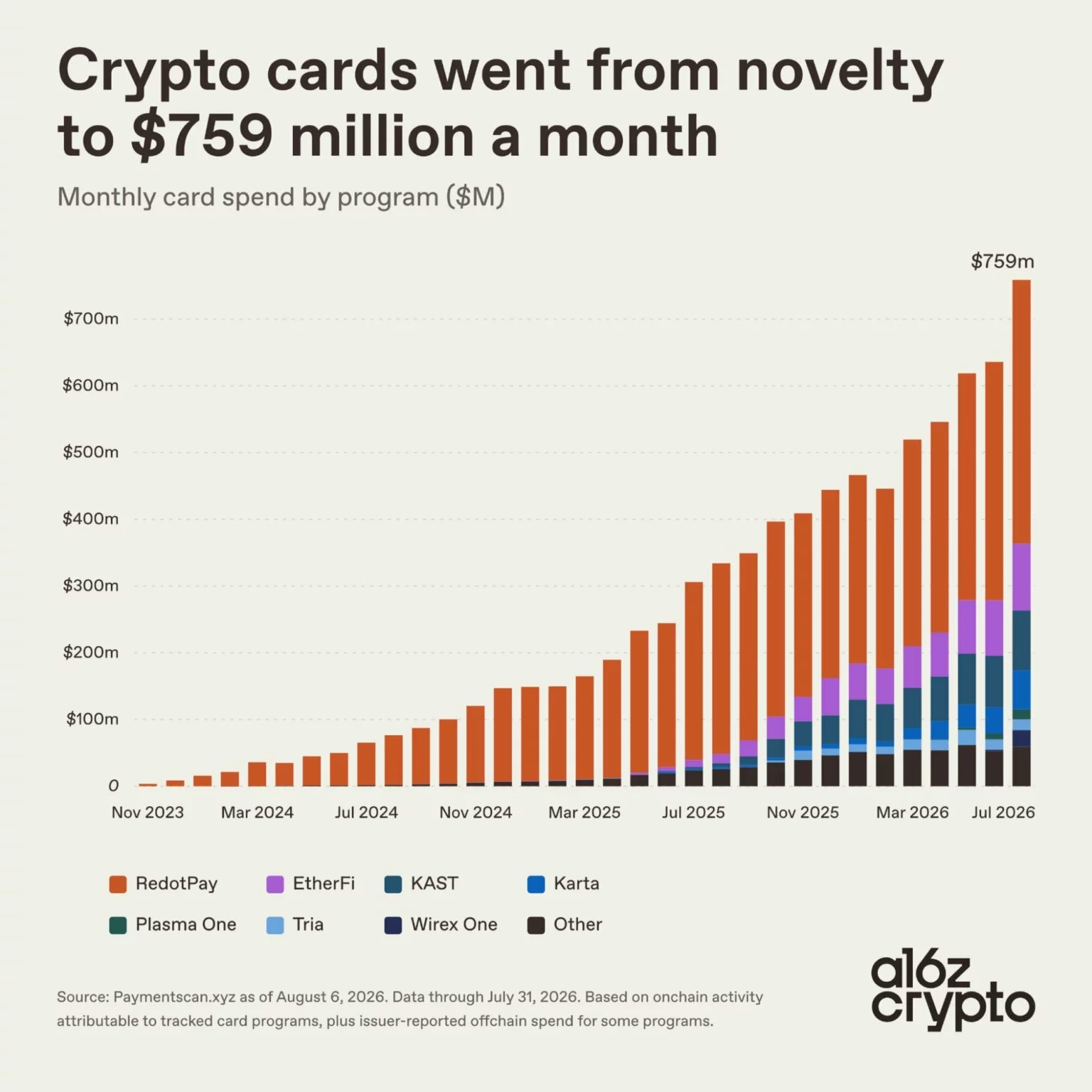
The cryptocurrency payment ecosystem is experiencing remarkable momentum, with crypto card spending reaching unprecedented levels. 🚀 In July alone, transaction volumes hit $759 million—a staggering 2.5x increase compared to the same period just one year prior. This explosive growth signals a fundamental shift in how digital asset holders are converting their cryptocurrency holdings into real-world purchasing power.
The Explosive Growth of Crypto Card Transactions 📈
The trajectory of crypto payment card adoption tells a compelling story about mainstream acceptance. When payment tracking services began monitoring this sector in October 2023, monthly spending barely registered at under $1 million. Fast-forward to July 2024, and the market has grown nearly 760-fold in less than nine months. This isn't merely incremental growth—it represents a fundamental validation that digital asset holders are ready to spend their crypto in everyday transactions.
The volume metrics paint an equally impressive picture. Nearly 9 million individual purchases were settled through crypto payment cards in July, compared to approximately 5.2 million transactions during the same month the previous year. This 73% increase in transaction count, combined with the 2.5x surge in total spending, demonstrates that adoption is expanding both in breadth (more users making purchases) and depth (higher spending per user).
The average transaction value hovered around $86, suggesting that crypto card users are conducting meaningful purchases rather than trivial spending. This figure indicates that cardholders view these payment instruments as legitimate tools for everyday commerce, from groceries to online shopping to service payments.
Stablecoins Dominate the Payment Landscape 💰
The overwhelming preference for dollar-backed stablecoins reveals important insights about how cryptocurrency holders think about spending. USDC and USDT combined to account for 84% of all tracked crypto card spending in July—a dramatic consolidation around two major players in the stablecoin ecosystem.
USDC captured 58% of the market share, while USDT claimed an additional 26%. This represents significant growth for both tokens over the past year. USDC's share increased by approximately 10 percentage points, while USDT's more dramatic 19-point gain underscores the growing adoption of Tether's stablecoin for payment purposes. These figures align with broader payment trends, as independent data from major payment networks shows similar concentration among dollar-backed digital assets.
What's particularly noteworthy is the decline of alternative stablecoin options. Euro-backed tokens like EURe, which dominated nearly 88% of crypto card spending in early 2024, have plummeted to just 2% market share by July. This shift reflects both the global preference for dollar-denominated transactions and the practical advantages of USDC and USDT in terms of liquidity, exchange support, and merchant compatibility.
Blockchain Settlement: Optimism Leads the Pack ⛓️
The distribution of crypto card spending across different blockchain networks reveals the competitive dynamics shaping the payment infrastructure landscape. Optimism, an Ethereum Layer 2 solution, emerged as the leading settlement network with approximately 29% of tracked spending volume.
Solana and Base followed closely behind, each capturing roughly 19% of the market. This near-parity between Solana and Base is particularly significant given Base's relatively recent emergence as a major blockchain platform. As Coinbase's Layer 2 solution, Base has rapidly attracted payment-focused development and partnerships, demonstrating the power of institutional backing in blockchain adoption.
Together, Optimism and Base accounted for nearly 48% of all measured crypto card spending—a clear indication that Ethereum's scaling solutions and adjacent networks are becoming the backbone of digital asset payment infrastructure. Gnosis, which served as the primary settlement network in crypto card adoption's early stages, has seen its share decline to approximately 2% as payment activity dispersed across multiple blockchain options.
The Mechanics Behind Crypto Card Transactions 🔄
Understanding how crypto cards function reveals why their adoption is accelerating. These payment instruments create a seamless bridge between digital assets and the existing Visa payment infrastructure that billions of merchants already accept worldwide.
When a consumer uses a crypto card, several things happen in the background:
- Asset Holding: Users maintain stablecoin balances either through custodial services managed by the card provider or in self-custodial wallets they control directly
- Real-Time Conversion: At the point of sale, the payment processor converts the stablecoin amount into the merchant's local fiat currency
- Network Settlement: The transaction routes through established Visa infrastructure, appearing to merchants as a standard card payment
- Merchant Experience: Retailers receive payment in conventional currency without any need to understand or manage cryptocurrency
This architecture is elegant because it preserves the benefits of cryptocurrency—programmability, transparency, and direct control—while eliminating friction for merchants and end consumers. The merchant ecosystem, comprising trillions of dollars in monthly transaction volume, continues operating normally without requiring any integration of blockchain technology.
Market Context and Regulatory Considerations ⚖️
The growth of crypto card spending occurs within an evolving regulatory environment, particularly in the United States. Federal frameworks for stablecoin issuance and management continue developing, establishing clearer rules for how dollar-backed digital assets can be created and maintained.
For U.S. users, crypto cards represent a novel intersection of traditional payment infrastructure and emerging digital asset regulation. Card issuers must navigate requirements around stablecoin backing, reserve management, and consumer protection while maintaining the speed and efficiency that makes cryptocurrency attractive in the first place.
The fact that crypto card spending is expanding despite regulatory uncertainty suggests that both users and service providers view this market as having genuine long-term potential. Many major payment companies and fintech firms are investing in crypto card infrastructure, betting that regulatory clarity will continue improving rather than deteriorating.
The Scale Perspective 📊
While $759 million in monthly spending represents explosive growth from a starting point near zero, it remains modest compared to the broader payment ecosystem. Visa alone processes trillions of dollars monthly across billions of transactions. Traditional debit and credit card networks dwarf crypto card activity by several orders of magnitude.
However, this perspective shouldn't diminish the significance of current growth rates. Industries that grow 2.5x year-over-year from a larger base would be considered mature. For crypto cards to achieve similar growth from a negligible starting point suggests we're witnessing the early stages of a technology adoption curve rather than a mature market.
Looking Forward: What's Next for Crypto Payments? 🔮
Several trends suggest the momentum in crypto card spending will likely continue accelerating:
Expanding Blockchain Support: As more Layer 2 networks and alternative blockchains add payment infrastructure, users gain more options for settlement and potentially lower transaction costs.
Institutional Integration: Major fintech companies and payment processors continue launching or expanding crypto card offerings, bringing institutional credibility and distribution scale.
Stablecoin Maturation: As stablecoin issuers improve reserve transparency and regulatory compliance, consumer confidence in using these assets for everyday purchases should increase.
Geographic Expansion: Crypto card programs are expanding into emerging markets where traditional banking infrastructure is less developed, potentially unlocking significant user bases.
Business Payment Solutions: New platforms enabling direct business-to-business payments through cryptocurrency are emerging, potentially creating an entirely new payment category beyond consumer spending.
Key Takeaways 🎯
The 2.5x surge in crypto card spending to $759 million in July represents far more than a statistical milestone. It demonstrates that cryptocurrency holders are ready to spend their digital assets in everyday commerce, that stablecoins have achieved sufficient maturity for payment purposes, and that blockchain infrastructure can support real-world transaction volume.
The dominance of USDC and USDT shows that dollar-backed assets have won the payment wars, at least for now. The distribution across multiple blockchains indicates that payment infrastructure is becoming increasingly decentralized and competitive. Most importantly, the trajectory from near-zero to three-quarters of a billion dollars in just nine months suggests we're witnessing the beginning of a fundamental shift in how digital asset holders interact with the global payment system.
As regulatory frameworks solidify and institutional adoption accelerates, crypto card spending could transition from a niche novelty to a meaningful component of the broader payment ecosystem. For now, the momentum is unmistakable. 💫
You May Also Like

Blockchain
The Sandbox Bridge Exploit: $49B Phantom SAND Tokens Explained
August 26, 2026

Blockchain
MANTRA Chain Resumes Blocks After Critical Cosmos-EVM Fix
August 24, 2026

Blockchain
African Financial Company Issues Historic $431M Digital Bond
August 17, 2026

Blockchain
Crypto VC Shifts Focus to Quantum-Ready Infrastructure by 2027
August 16, 2026