Category:
EthereumEthereum Foundation Hires AI Security Researcher
The Ethereum Foundation is actively strengthening its security infrastructure by recruiting a specialized protocol security researcher with expertise in artificial intelligence and vulnerability detection. This strategic hiring move underscores the organization's commitment to maintaining robust defenses across its core network infrastructure, particularly as Ethereum continues to support critical financial applications and institutional infrastructure. 🔐
The Role: Bridging AI and Manual Security Testing
The newly opened position represents a sophisticated approach to protocol security that combines cutting-edge artificial intelligence tools with traditional manual auditing methodologies. The ideal candidate will investigate weaknesses spanning multiple critical layers of Ethereum's architecture, including the execution layer that processes transactions and smart contracts, the consensus layer that coordinates validator participation, peer-to-peer networking infrastructure, technical specifications, and the various client implementations that enforce protocol rules.
This comprehensive scope reflects the complex security landscape facing modern blockchain networks. Rather than relying solely on automated systems, the role acknowledges that effective security requires human expertise to validate AI-generated findings, assess their real-world impact, and distinguish between genuine vulnerabilities and false positives. 🎯
Key Responsibilities: From Fuzzing to Disclosure
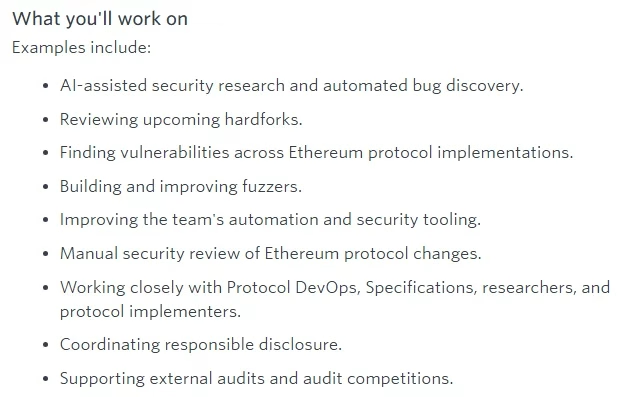
The researcher's daily work will encompass several interconnected security functions:
- AI-assisted vulnerability mining using automated systems to identify potential protocol weaknesses
- Fuzzing tool development to stress-test protocol implementations under unusual conditions
- Hard fork reviews examining proposed network upgrades for security implications before deployment
- Manual protocol audits providing human verification of technical specifications and implementation details
- Vulnerability disclosure coordination managing the responsible reporting process for confirmed security issues
This multifaceted approach recognizes that protocol security operates across multiple dimensions. AI excels at generating large volumes of potential findings and identifying patterns humans might miss, but human researchers provide irreplaceable judgment about impact assessment, reproducibility verification, and strategic prioritization. ✨
Why AI Security Matters for Ethereum
The Ethereum Foundation's recent experiments with coordinated AI agents demonstrated tangible results. In July 2026, the Protocol Security team published technical findings showing that AI systems had successfully identified genuine protocol bugs affecting Ethereum's infrastructure. The most notable discovery was a remotely triggered panic vulnerability in libp2p's gossipsub component, which operates as part of the peer-to-peer layer used by Ethereum consensus clients. This flaw, eventually disclosed as CVE-2026-34219, was patched by developers before public disclosure. 🛡️
What surprised the security team wasn't simply that AI found bugs—researchers expected that capability. Rather, the insight came from understanding the actual work distribution: while AI agents efficiently generated potential findings, the overwhelming majority of human effort involved determining which AI-generated alerts represented real vulnerabilities versus false alarms. This realization shaped the job description for the new position, formalizing a workflow that integrates automated discovery with rigorous manual verification.
Technical Requirements and Candidate Profile
The Ethereum Foundation seeks engineers with extensive, hands-on knowledge of Ethereum's protocol architecture. Ideal candidates have directly contributed to protocol development or demonstrate deep understanding of execution-layer and consensus-layer specifications. This requirement ensures that successful applicants can immediately assess the significance of security findings and contextualize them within Ethereum's broader technical landscape.
Programming proficiency in Go, Rust, Java, C#, Nim, and Python provides candidates with the toolkit necessary for working across Ethereum's diverse client implementations. These languages represent the primary development environments for Ethereum infrastructure, from consensus clients like Prysm and Lighthouse to execution clients such as Geth and Erigon. 💻
The position operates as a global remote opportunity, welcoming applications from candidates throughout Europe and other regions worldwide. This geographic flexibility enables the Foundation to attract specialized talent regardless of location, addressing a persistent challenge in recruiting experts with deep protocol security expertise.
Context: Restructuring and Strategic Refocus
The security researcher opening arrives amid significant organizational changes at the Ethereum Foundation. Approximately one month prior, the organization completed a restructuring that eliminated 54 positions, representing roughly 20% of its total workforce. The Protocol Support team, which previously coordinated core developer meetings, tracked network upgrades, and operated training programs for emerging protocol developers, was dissolved as part of this consolidation. 📊
However, the Foundation's decision to hire for specialized security roles even during workforce reductions signals a clear strategic priority. Security remains non-negotiable for Ethereum's governance and operational integrity. This selective hiring approach reflects a broader industry trend: while organizations streamline administrative and coordination functions, they're simultaneously expanding capabilities in areas directly affecting network resilience and vulnerability management.
Several former Foundation researchers have transitioned into independent organizations since the restructuring. Mo Jalil, Oskar Thorén, and Aaryamann Challani co-founded EthSystems, a for-profit venture developing confidential Ethereum infrastructure for regulated institutions, backed by prominent investors including Consensys CEO Joe Lubin. Francesco D'Amato joined independent protocol research group Ethlabs. These transitions demonstrate that protocol expertise continues flowing into specialized organizations, even as the Foundation itself evolves its structure. 🌍
Security Leadership and Governance
Reinforcing its commitment to security, the Ethereum Foundation appointed renowned security researcher Pascal Caversaccio to its board on July 29, 2026, for an initial one-year voluntary term. His appointment expanded the board to four members and explicitly centered the organization's governance around security, privacy, and censorship resistance priorities. For institutional stakeholders and U.S. investors, this focus carries direct relevance: Ethereum supports spot exchange-traded funds, stablecoins, tokenized real-world assets, and financial applications relied upon by American institutions. Any protocol vulnerability affecting consensus mechanisms or client implementations could cascade far beyond Ethereum itself, disrupting infrastructure supporting billions in institutional capital. 🏛️
The Broader Implications for Ethereum Security
This hiring initiative doesn't indicate discovery of new vulnerabilities requiring emergency response. Rather, it represents proactive expansion of the team responsible for reviewing upcoming hard forks and identifying weaknesses before protocol changes reach the main network. As Ethereum matures and assumes greater importance in institutional finance, security teams must operate at increasing levels of sophistication.
The combination of AI-powered discovery with human expertise addresses a fundamental challenge in modern security: the volume of potential issues exceeds human capacity for manual analysis, yet automated systems generate unacceptable false-positive rates. By formalizing this hybrid approach through dedicated staffing, the Foundation acknowledges that protocol security requires both technological innovation and experienced human judgment. 🔬
What This Means for Ethereum's Future
The recruitment of an AI security researcher represents more than a single job opening—it signals the Foundation's strategic direction for maintaining Ethereum's security posture in an increasingly complex threat landscape. As the protocol evolves, supporting additional functionality and serving more diverse use cases, security mechanisms must scale accordingly.
The emphasis on combining AI tools with manual verification also reflects lessons learned from the Foundation's recent coordinated AI agent experiments. Effective security requires recognizing both the capabilities and limitations of automated systems. AI excels at pattern recognition and generating hypotheses about potential vulnerabilities, but human expertise provides irreplaceable judgment about real-world impact, attack feasibility, and strategic prioritization.
For the Ethereum ecosystem, this investment in specialized security talent reinforces the network's commitment to maintaining the trust and resilience that institutional participants require. As Ethereum continues supporting critical financial infrastructure, regulatory compliance systems, and institutional applications, the security research team's work becomes increasingly consequential. ⚡
Key Takeaways
The Ethereum Foundation's recruitment of an AI security researcher reflects several important trends:
- Hybrid security approaches combining AI automation with human expertise are becoming industry standard for protocol-level security
- Specialized hiring continues even during organizational restructuring, indicating clear strategic priorities
- Proven AI capabilities in vulnerability detection are driving formal integration into security workflows
- Institutional requirements for Ethereum's security infrastructure are intensifying as the network supports greater financial responsibility
- Remote talent acquisition enables access to specialized expertise regardless of geographic location
As blockchain technology matures and assumes greater importance in institutional finance, organizations like the Ethereum Foundation must continuously evolve their security capabilities. This position represents a meaningful step toward that evolution, combining cutting-edge technology with proven security expertise to protect one of the world's most significant decentralized networks. 🚀
You May Also Like
Ethereum
ZK Proving Beyond GPUs: The Hardware Evolution Ethereum Needs
August 23, 2026
Ethereum
Whitechain Relaunches as W Group's Distribution-First Ethereum Layer 2
August 20, 2026
Ethereum
BitMine Adds 9,926 ETH as BMNR Stock Surges 3.7%
August 18, 2026
Ethereum
Ethereum Surges Past $1,900 Amid Rising ETF Inflows
July 29, 2026