Category:
RegulationKalshi Faces Michigan Ban on Sports Contracts

A Temporary Setback for Kalshi 🛑
Kalshi, a leading player in the prediction market industry, has recently encountered a significant hurdle. A Michigan court has imposed a temporary ban on Kalshi's sports event contracts, marking another chapter in the ongoing legal saga surrounding prediction markets. This decision underscores the complex regulatory landscape these platforms must navigate to operate within the United States.
The Legal Battle Unfolds ⚖️
The Ingham County Circuit Court's ruling, led by Judge Rosemarie Aquilina, temporarily restricts Kalshi from offering sports event contracts to Michigan residents until July 13. This move is part of an escalating legal conflict over prediction markets, which are often caught between state gambling laws and federal regulations. If Kalshi fails to adhere to geolocation requirements, it faces a daunting fine of $120,000 per day.
This decision is the result of a lawsuit initiated by Michigan Attorney General Dana Nessel. The lawsuit claims that Kalshi's activities violate the Lawful Sports Betting Act by operating as unlicensed gambling products disguised as investment opportunities. Michigan's stance reflects a broader trend of states scrutinizing prediction markets more closely.
A Growing Trend of State-Level Challenges 📈
Michigan is not alone in its legal pursuit. Earlier this year, Nevada secured a similar temporary injunction against Kalshi. Kentucky also joined the fray, filing lawsuits against Kalshi, Polymarket, and other platforms for allegedly operating without proper licenses. These actions highlight a growing trend of states asserting their authority over prediction markets, challenging their classification as federally regulated financial instruments.
The Federal vs. State Jurisdiction Dilemma 🌐
The clash between federal oversight and state regulations has intensified. The U.S. Commodity Futures Trading Commission (CFTC) argues that federally regulated event contracts fall under its exclusive jurisdiction, conflicting with state gambling laws. Kalshi has responded by filing a federal lawsuit against Illinois, contending that the Commodity Exchange Act grants the CFTC sole authority, thus exempting it from state-imposed licensing requirements.
Kalshi's legal filings emphasize the financial burden state restrictions could impose, such as developing costly geofencing systems that may violate its federal obligations to maintain a uniform national market.
Surging Market Activity Amid Legal Challenges 🚀
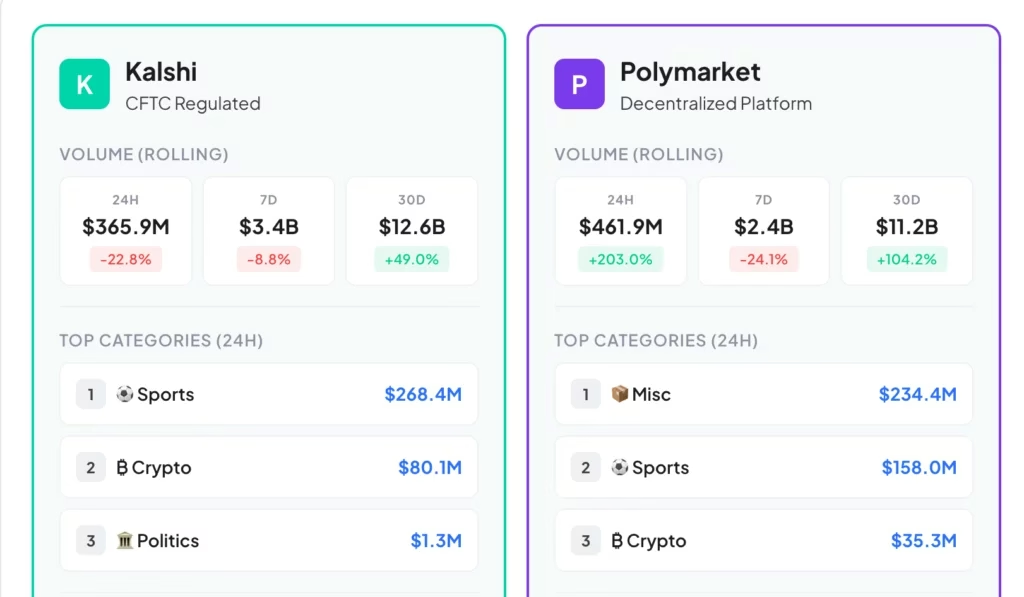
Despite legal hurdles, prediction markets have experienced a surge in activity, particularly during the 2026 FIFA World Cup. According to data, Polymarket's daily taker volume reached a record $713 million on June 20. Meanwhile, Kalshi saw its sports prediction volume climb by 40% to $9.5 billion, showcasing the sector's resilience and growth potential.
A report from Bernstein projected that the World Cup could generate over $3 billion in additional sports betting handle and between $5 billion and $10 billion in new prediction market volume. These figures highlight the robust demand for sports-related trading, even as operators face increasing regulatory scrutiny.
Key Takeaways and Future Outlook 🔍
The temporary ban on Kalshi's operations in Michigan is a microcosm of the broader regulatory challenges facing prediction markets. As states continue to question the legality of these platforms, the tension between state and federal jurisdictions is likely to persist.
For Kalshi and similar platforms, navigating this complex legal landscape will be crucial. The outcome of these legal battles could shape the future of prediction markets, influencing how they operate and expand in the United States. As the industry evolves, stakeholders and regulators must find a balance that protects consumers while fostering innovation.
In conclusion, while the road ahead may be fraught with legal challenges, the potential for growth in prediction markets remains significant. As the industry adapts, market participants and policymakers alike will need to engage in constructive dialogue to ensure a sustainable and compliant future.
You May Also Like

Regulation
SEC Regulation Crypto Assets: New Rules Explained
August 26, 2026
Regulation
Trump's CLARITY Act: Reshaping Crypto Regulation in America
August 24, 2026
Regulation
South Korea Strengthens Crypto Oversight with New FIU Investigation Powers
August 23, 2026
Regulation
Reg Crypto Framework: End of Token Legal Ambiguity
August 23, 2026