Category:
RegulationOrbital Data Centers & Lightkeepers: The Future of Space Infrastructure 🛰️

The Evolution of Navigation: From Lighthouses to Satellites 🌊
When we think about humanity's greatest infrastructure achievements, our minds often drift to iconic lighthouses standing sentinel along coastlines. Yet today, we're witnessing a remarkable transformation in how we guide, power, and support our digital world. The convergence of maritime heritage preservation, environmental regulation, and cutting-edge space technology tells a compelling story about our collective future.
The National Lighthouse Museum on Staten Island recently hosted a significant broadcast celebrating this intersection of history and innovation. During a three-hour live CBS News feature in August 2026, meteorologist John Elliott highlighted not just the museum's rich collection of maritime artifacts—including vintage Fresnel lights and over 160 miniature lighthouse models—but also the broader implications of how technology continues to reshape our infrastructure needs.
Understanding the Data Center Crisis 🏢⚡
Hyperscale data centers represent some of the most resource-intensive facilities on Earth. These massive complexes typically consume 100 megawatts or more of electrical power and between 1 million to 5 million gallons of water daily for cooling and operations. As artificial intelligence and cloud computing demand explodes, data center proliferation has become a critical environmental and regulatory concern.
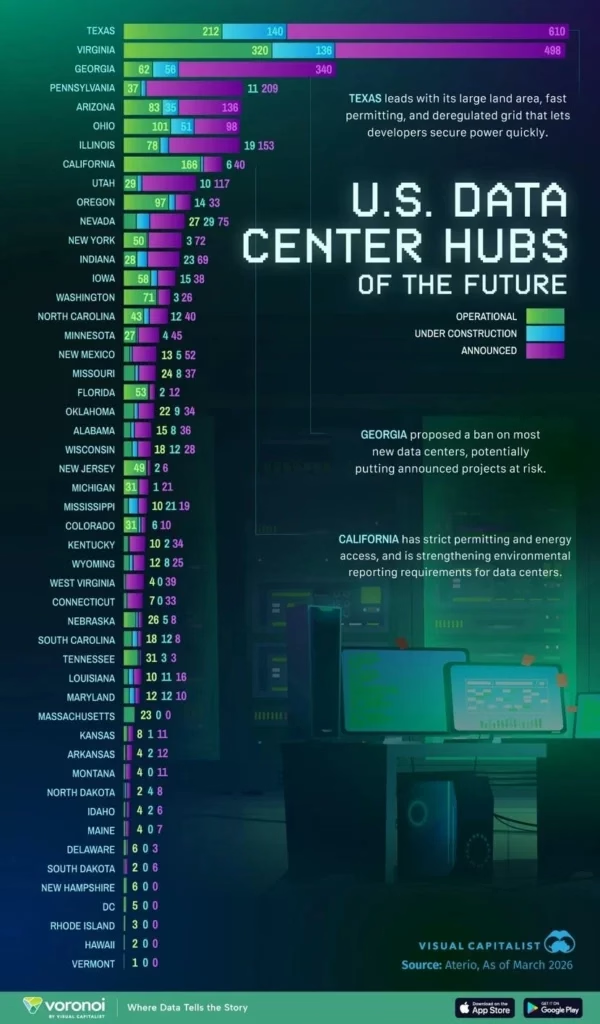
New York State, which currently hosts approximately 50 operational hyperscale data centers with 72 additional projects in the pipeline, recognized the urgency of this challenge. In July 2026, Governor Kathy Hochul signed an executive order imposing a one-year moratorium on new hyperscale data center permits (facilities drawing 50+ megawatts). This landmark decision reflects growing concerns about grid strain, water depletion, and environmental degradation.
The Global Data Center Landscape 🌍
The United States dominates global data center infrastructure, commanding over 40% of the world's 5,000+ facilities. This leadership stems from early investments by tech giants like Amazon Web Services (AWS), Microsoft Azure, Google Cloud, and Oracle in high-volume AI infrastructure. However, this dominance comes with environmental consequences that regulators can no longer ignore.
New York ranks 12th nationally in data center development, but its constitutional green amendment—one of only three states with such protections—mandates that environmental rights be treated as fundamental civil liberties. This legal framework explains why the state became the first and only U.S. jurisdiction to implement a comprehensive statewide moratorium on large data center construction.
Space-Based Solutions: The Orbital Revolution 🚀☀️
As terrestrial constraints tighten, innovative companies are exploring an audacious alternative: space-based data centers powered by continuous solar radiation. This approach addresses multiple challenges simultaneously—eliminating water consumption concerns, reducing terrestrial land demands, and leveraging the sun's uninterrupted energy supply beyond Earth's atmosphere.
PowerBank made headlines in December 2025 by launching the DeStarlink Genesis 1 satellite, marking the inaugural step toward Orbit AI's ambitious Orbital Cloud network. This initiative represents a paradigm shift in how we might distribute computing infrastructure across our solar system.
Meanwhile, technology leaders are taking notice. Meta has partnered with Overview Energy to secure access to up to 1 gigawatt of space-based solar power capacity specifically designated for its AI data center operations. This commitment signals that major corporations view orbital infrastructure not as science fiction but as practical business strategy.
Regulatory Innovation: The SUNNY Act 🌞
Regulation doesn't always mean restriction—sometimes it catalyzes innovation. New York's proposed SUNNY Act would authorize window solar panels for both commercial and residential buildings, including terrestrial data centers. This legislation represents a balanced approach: rather than simply prohibiting growth, policymakers are creating frameworks for sustainable expansion.
Window-integrated photovoltaic technology could transform data center energy profiles, allowing facilities to generate a portion of their power requirements from their own structural surfaces. Combined with space-based solar initiatives, this represents a comprehensive strategy for decoupling data center growth from grid strain.
The Lighthouse Museum's Role in Modern Conservation 🏛️
While discussing cutting-edge space technology, we shouldn't overlook the significance of preserving maritime heritage. The National Lighthouse Museum, originally built as the U.S. Lighthouse Service General Depot (1864-1939), serves as the central archive of American light station history and technology.
When satellite-based systems like GPS largely superseded physical lighthouses for marine navigation, the museum's mission evolved to encompass technical and social history preservation. Recent initiatives, including the Statue of Liberty Art Show featuring works by renowned artists Hunt Slonem and Selva Ozelli, celebrate both maritime heritage and cultural milestones.
The museum's ongoing restoration—including promenade repairs following Hurricane Sandy and recent flood damage—reflects broader climate resilience challenges affecting coastal infrastructure nationwide. These physical reminders of environmental vulnerability underscore why space-based alternatives warrant serious consideration.
Environmental Context: Why This Matters Now 🌪️
The urgency surrounding data center regulation intensified following severe environmental events. In mid-2023, massive Canadian wildfires created hazardous air quality across New York, followed by catastrophic torrential rains and flash floods that prompted federal disaster declarations. Similar patterns recurred in July 2026, with Canadian wildfires and European conflagrations (affecting France, Spain, Portugal, Italy, and Greece) forcing over 330,000 evacuations.
These climate crises aren't abstract—they directly impact infrastructure resilience and resource availability. Data centers' massive water consumption becomes problematic during droughts, while their electrical demands strain grids already stressed by extreme weather events.
The Path Forward: Integration and Innovation 🔮
The convergence of lighthouse preservation, satellite technology, space-based solar power, and regulatory innovation tells us something important: sustainable infrastructure requires integrated thinking. We cannot simply relocate problems—we must fundamentally reimagine how we power civilization.
The moratorium in New York isn't anti-technology; it's pro-sustainability. By pausing hyperscale expansion while studying environmental impacts, regulators create space for alternatives like orbital data centers and renewable-powered terrestrial facilities to mature. This measured approach allows innovation to flourish within environmental constraints.
Meta's commitment to space-based solar capacity, PowerBank's satellite launch, and New York's SUNNY Act represent different facets of the same transformation. Each initiative acknowledges that traditional terrestrial data center expansion cannot continue indefinitely without consequences.
Key Takeaways 📋
- Hyperscale data centers consume enormous resources: 100+ MW of power and millions of gallons of water daily
- New York leads with environmental protection: First U.S. state implementing comprehensive data center construction moratorium
- Space-based solutions are emerging: Orbital data centers powered by continuous solar energy offer compelling alternatives
- Major tech companies are investing: Meta's 1 GW space solar commitment signals industry recognition of orbital infrastructure viability
- Regulation can catalyze innovation: The SUNNY Act demonstrates how policy can encourage sustainable technology adoption rather than simply restricting growth
As we celebrate the lightkeepers who guided ships through darkness, we're simultaneously pioneering new navigation systems for our digital future. The challenge ahead isn't choosing between technology and environment—it's integrating both through innovative regulation, space-based infrastructure, and sustainable design. The next chapter of our infrastructure story is being written in orbit, powered by the sun, and guided by the lessons learned from centuries of maritime heritage.
You May Also Like

Regulation
SEC Regulation Crypto Assets: New Rules Explained
August 26, 2026
Regulation
Trump's CLARITY Act: Reshaping Crypto Regulation in America
August 24, 2026
Regulation
South Korea Strengthens Crypto Oversight with New FIU Investigation Powers
August 23, 2026
Regulation
Reg Crypto Framework: End of Token Legal Ambiguity
August 23, 2026