Category:
RegulationSecuritize Q2 Loss Signals Growing Pains in Tokenization

The blockchain tokenization sector is experiencing a critical inflection point 📊, and recent financial results from a major player reveal the complex challenges facing digital asset infrastructure companies. When a platform built on transformative technology reports mounting losses despite record user activity, it raises important questions about business model sustainability and the timeline to profitability in emerging markets.
Understanding the Q2 Financial Reality 💼
Securitize Corporation disclosed a significant financial setback in its second quarter, reporting a net loss of $21.7 million—a troubling development that more than tripled from the $6.1 million loss recorded in the same period a year prior. This widening loss came despite the company's public market debut on July 2, marking its transition from a private venture to a publicly traded entity on the New York Stock Exchange.
What makes this situation particularly noteworthy is the paradox embedded within these numbers. While losses accelerated dramatically, the company simultaneously achieved record-breaking metrics across its core business operations. This divergence between operational growth and financial losses paints a nuanced picture of a company navigating the early-stage adoption phase of blockchain tokenization technology.
The Revenue Puzzle: Growth Meets Contraction 📉
Revenue performance presented a mixed narrative that likely contributed to market disappointment. Total quarterly revenue declined 5% year-over-year, falling to $14.4 million from $15.3 million in the prior year period. This contraction is particularly striking given that the company's assets under management and transaction volumes were expanding substantially.
Tokenization revenue specifically experienced a steeper decline, dropping 12% to $7.84 million. Conversely, asset servicing revenue showed modest resilience with a 3% increase to $6.60 million. The inability to convert record asset growth into corresponding revenue expansion suggests potential pricing pressures or a shift in the revenue mix toward lower-margin business segments.
Operating expenses, however, moved in the opposite direction entirely. Total operating costs surged 56% to $24.1 million, with particularly notable increases in administrative functions. Selling, general and administrative expenses more than doubled to $8.2 million, while compensation and benefits climbed 31% to $10.5 million. This cost structure expansion outpaced revenue generation by a significant margin, directly contributing to the widening loss.
Record Tokenized Assets Signal Market Confidence ✨
Despite financial headwinds, Securitize achieved a remarkable milestone that shouldn't be overlooked. Average tokenized assets under management reached a record $4.3 billion during the quarter, representing a 16% increase compared to the same period in 2023. By quarter-end, the platform was managing approximately $5 billion in assets on-chain.
This growth trajectory is particularly impressive when considering the broader regulatory uncertainty surrounding digital asset infrastructure. The company added approximately $1 billion in new assets during the quarter alone, demonstrating sustained investor appetite for tokenized securities and digital asset solutions.
The platform's diversification is also noteworthy. Securitize now manages more than seven distinct assets, each exceeding $100 million in AUM. This distribution suggests that tokenization adoption is becoming less dependent on a handful of flagship products and more representative of genuine market demand across multiple asset classes.
Transaction Volume Explosion: The Real Growth Story 🚀
Transaction activity data reveals the most compelling growth narrative. Aggregate transaction volume reached $5.3 billion during Q2, representing a substantial 147% year-over-year increase from the prior year period. This explosive growth in transaction throughput demonstrates that despite revenue challenges, the platform is facilitating increasingly significant volumes of tokenized asset trading.
To contextualize this growth, the company processed $1.9 billion in transaction volume during Q1, suggesting that even quarter-over-quarter momentum remained robust. This transaction volume expansion indicates that market participants are gaining confidence in the platform's infrastructure and regulatory standing.
The disconnect between transaction volume growth and revenue expansion suggests that Securitize may be operating in a phase where market share and user acquisition take priority over near-term profitability. This strategic positioning is not uncommon for infrastructure companies serving emerging markets.
Market Reaction and Stock Performance 📉
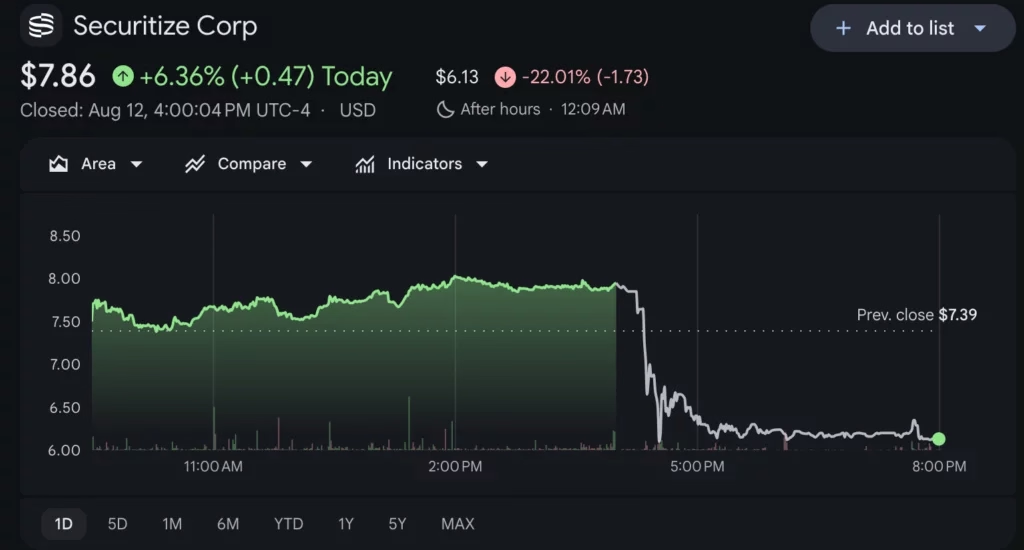
Public market participants responded to the earnings announcement with considerable skepticism. SECZ shares, which had gained approximately 6.8% during regular trading hours, experienced a dramatic reversal following the earnings release. After-hours trading saw shares decline roughly 21%, reflecting investor concerns about the company's path to profitability and the gap between operational growth and financial performance.
This stock price reaction underscores a critical challenge facing tokenization infrastructure companies: the need to balance long-term market development with near-term financial performance expectations. Public market investors often demand evidence of clear profitability trajectories, while infrastructure companies typically require extended periods of investment before achieving sustainable profitability.
Adjusted EBITDA and Non-GAAP Metrics 📊
Adjusted EBITDA performance provides additional context for understanding the company's financial trajectory. The adjusted EBITDA metric swung from a $1.8 million profit in the prior year to a $5.5 million loss in the current quarter. This deterioration reflects the operational challenges underlying the GAAP loss.
The GAAP net loss was further influenced by accounting treatments related to option, SAFE, and derivative liabilities. Specifically, the company recorded a $29.3 million loss from option liability changes, partially offset by a $21.8 million gain from derivative liability adjustments. These non-cash items, while significant on financial statements, reflect valuation changes rather than operational performance.
Regulatory Expansion and Strategic Positioning 🏛️
Despite financial challenges, Securitize has substantially expanded its regulatory footprint since achieving public company status. The company's capital division, Securitize Capital, obtained SEC registered investment adviser status in July, adding another regulated business segment to its existing broker-dealer, transfer agent, and alternative trading system operations.
This regulatory expansion is strategically significant. It positions Securitize to participate more directly in investment management activities and potentially capture additional revenue streams as tokenization adoption accelerates. The multi-regulated approach provides flexibility for serving diverse market participants and use cases.
Infrastructure Developments and Partnership Strategy 🤝
Securitize has been actively building critical infrastructure partnerships that extend its competitive moat. During Q2, the company received FINRA approval for its broker-dealer to custody tokenized securities and support atomic settlement between securities and stablecoins—a crucial capability for mainstream adoption.
Strategic partnerships with industry leaders have been expanding. Collaborations with Computershare and Continental Stock Transfer & Trust on issuer-sponsored tokenized equities represent bridges between traditional market infrastructure and blockchain-based systems. Infrastructure work with Jump Trading and Jupiter demonstrates engagement with leading liquidity and execution providers.
Post-quarter-end partnerships have reinforced this infrastructure strategy. A collaboration with Cantor Fitzgerald focused on infrastructure supporting on-chain IPOs and follow-on offerings positions Securitize at the intersection of traditional capital markets and digital asset innovation.
Tokenized Products Ecosystem Expansion 🌐
Securitize has been actively expanding its product offerings to capture emerging market opportunities. BlackRock's BUIDL tokenized fund became available as yield-bearing collateral through OKX and Standard Chartered, significantly expanding accessibility for institutional participants. The company also expanded its STAC fund to the Solana blockchain and secured a substantial $250 million USDe allocation from Ethena Labs.
These product developments are particularly significant because they demonstrate how traditional financial institutions and emerging digital asset platforms are converging around tokenized solutions. The availability of yield-bearing tokenized assets through major exchanges signals growing mainstream acceptance.
Balance Sheet Strength Amid Operational Challenges 💰
Entering Q3, Securitize's balance sheet reflected significant strength from its business combination with Cantor Equity Partners II. The company entered the new quarter with approximately $350 million in cash and zero balance sheet debt—a substantial capital position that provides runway for continued investment in infrastructure and market development.
This financial cushion is critical context for interpreting the quarterly losses. The company is not facing existential financial pressure despite negative earnings. Instead, it appears to be in an investment phase, deploying capital to build market infrastructure and achieve scale before optimizing for profitability.
The Path Forward: Regulatory Tailwinds and Market Evolution 🔮
Securitize management has signaled expectations for significant regulatory progress in the near term. CEO Carlos Domingo referenced anticipated SEC actions on innovation exemptions and what industry participants refer to as "Reg Crypto"—proposed regulatory frameworks specifically tailored for cryptocurrency and blockchain-based markets.
The SEC has confirmed an August 14 open meeting to consider proposed rules for a tailored offering regime covering certain crypto-related investment contracts. Additionally, SEC Commissioner Hester Peirce has indicated that a framework for limited on-chain trading of National Market System stocks remains under development, potentially enabling blockchain-based equity trading under regulatory oversight.
These regulatory developments could materially impact Securitize's business model and growth trajectory. Clearer regulatory frameworks could accelerate institutional adoption of tokenized securities, potentially expanding the addressable market significantly.
Industry Context: The Broader Tokenization Landscape 🌍
Securitize's challenges and opportunities exist within a broader industry context. The tokenization sector has attracted substantial institutional interest, with traditional financial institutions increasingly exploring blockchain-based asset issuance and trading. Major financial infrastructure providers, including the New York Stock Exchange, have announced plans for 24/7 trading and on-chain settlement for tokenized securities.
Securitize is positioned as a key design partner for the NYSE's planned digital platform, suggesting that traditional market infrastructure operators view the company's expertise as valuable for the transition to blockchain-based systems.
Key Takeaways: Understanding the Inflection Point 🎯
Securitize's Q2 results reveal a company at a critical juncture in market development:
-
Operational Growth vs. Financial Performance: Record assets, transaction volumes, and user activity are not yet translating into profitable operations, suggesting the market is in early adoption phases.
-
Cost Structure Challenges: Operating expense growth significantly outpaced revenue expansion, indicating that the company must either accelerate revenue growth or optimize cost structures to achieve profitability.
-
Regulatory Tailwinds: Expanding regulatory clarity and institutional interest in tokenization could provide substantial upside if the company can capture market share in the emerging digital asset infrastructure space.
-
Balance Sheet Strength: Substantial cash reserves and zero debt provide flexibility for continued investment and market development without immediate pressure to achieve profitability.
-
Market Skepticism: The significant stock price decline reflects investor concerns about the profitability timeline and business model sustainability in the current market environment.
The coming quarters will be critical for Securitize. The company must demonstrate that operational growth can eventually translate into revenue expansion and profitability. Regulatory progress, continued institutional adoption of tokenization, and strategic partnerships will likely determine whether current losses represent temporary growing pains or structural business model challenges. 📈
You May Also Like

Regulation
SEC Regulation Crypto Assets: New Rules Explained
August 26, 2026

Regulation
Trump's CLARITY Act: Reshaping Crypto Regulation in America
August 24, 2026
Regulation
South Korea Strengthens Crypto Oversight with New FIU Investigation Powers
August 23, 2026

Regulation
Reg Crypto Framework: End of Token Legal Ambiguity
August 23, 2026