Category:
RegulationSupreme Court Blocks Trump's Move on Fed Governor

In a landmark decision, the U.S. Supreme Court has blocked former President Donald Trump's attempt to remove Federal Reserve Governor Lisa Cook. This ruling ensures the stability of the Federal Reserve's leadership amidst ongoing debates over interest rates.
The Supreme Court's Ruling
The Supreme Court's 5-4 decision, led by Chief Justice John Roberts, emphasized the importance of legal standards over political influence. The Court ruled that the dismissal of Lisa Cook must adhere to legal procedures, thereby preventing any president from removing a Fed governor without judicial review.
Roberts noted that the decision was not about whether Cook could be removed for cause but rather about ensuring the legal framework is followed. "The ultimate question of whether the President can remove Cook for cause will depend in part on the underlying facts," Roberts stated, highlighting the need for a thorough examination of the facts under appropriate legal standards.
Impact on Federal Reserve Policy
With Lisa Cook remaining on the Federal Reserve Board, Trump lacks the majority needed to sway the Fed's policy direction through appointments alone. This ruling complicates his push for lower interest rates, as interest rate decisions remain influenced by the broader economic conditions rather than political pressure.
Trump had previously appointed Kevin Warsh as Fed Chair, succeeding Jerome Powell. Despite Trump's desires, Warsh maintained during his confirmation hearing that he was never pressured by Trump to predetermine interest rate decisions.
Economic Context and Implications
The Supreme Court's decision comes at a time when inflation is a key concern for policymakers. The Federal Reserve's recent decision to leave interest rates unchanged reflects a cautious approach to the current economic landscape. The latest Personal Consumption Expenditures inflation reading reached 4.1%, the highest since 2023, intensifying the debate on monetary policy.
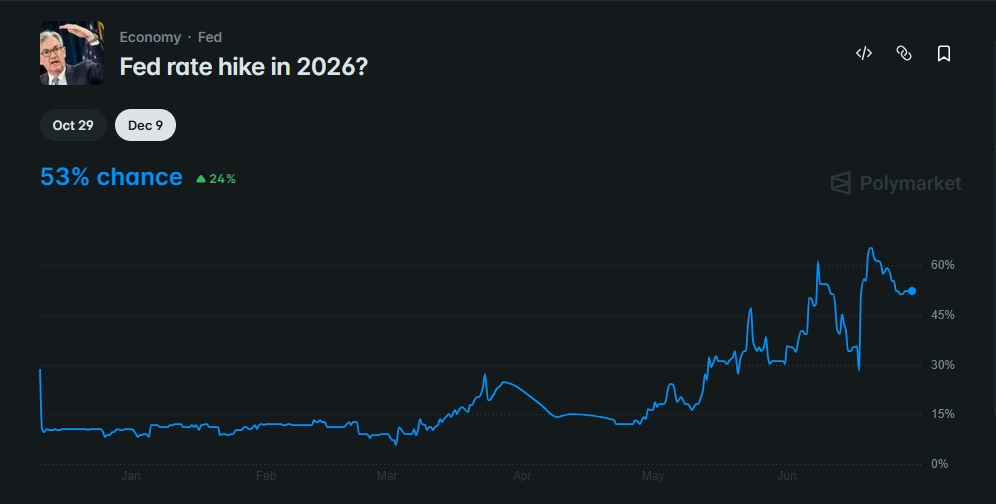
Interestingly, market predictions on platforms like Polymarket suggest a 53% probability that the Fed will raise rates before the year's end. This underscores the dynamic and uncertain nature of economic forecasting and the ongoing challenges in managing monetary policy.
Broader Trends in Cryptocurrency and Finance
The ruling is set against the backdrop of significant developments in the cryptocurrency space. As the Federal Reserve navigates its policy decisions, the crypto market continues to evolve with increasing interest in decentralized finance (DeFi) and blockchain technologies.
Cryptocurrency enthusiasts and investors monitor these economic decisions closely, as changes in interest rates can influence crypto market dynamics. The ongoing evolution of Web3 and blockchain technologies also presents new opportunities and challenges for financial regulation and policy-making.
Conclusion: Stability Amidst Uncertainty
The Supreme Court's decision to block Trump's bid to remove Lisa Cook underscores the importance of upholding legal processes in maintaining the Federal Reserve's stability. As the economic landscape remains volatile, the role of the Federal Reserve and its governors becomes increasingly critical.
While political pressures continue, the Fed's commitment to data-driven policy decisions serves as a reassuring factor for both traditional and crypto markets. As we look ahead, the interplay between economic policies, market trends, and technological advancements will shape the future of finance.
Stay informed and engaged as these developments unfold, and remember, the strength of a stable economic system lies in its adherence to legal and procedural integrity.