Category:
RegulationTrump Eyes AI Limits After Kimi K3's Coding Triumph

In a dynamic twist reminiscent of tech titans clashing, former President Donald Trump is reportedly considering a renewed crackdown on Chinese artificial intelligence (AI) models 🚫🤖. This resurgence in regulatory interest follows the impressive performance of Moonshot AI's Kimi K3, a cutting-edge 2.8-trillion-parameter AI model, which recently topped a major coding leaderboard.
Kimi K3's Rise to Prominence
Kimi K3's ascent has been nothing short of meteoric. Developed by Moonshot AI, a Beijing-based firm established in 2023 by AI researcher Yang Zhilin, the model has captivated the tech community. It achieved first place in Arena's Frontend Code Arena, outshining competitors from industry giants like OpenAI and Anthropic.
The model’s success has sparked substantial interest among American developers, eager to leverage its capabilities for projects at a fraction of the cost compared to domestic options. This interest has prompted discussions within the Trump administration about imposing restrictions on Chinese AI models to protect U.S. technological interests and security.
The Implications of AI Regulation
The potential regulations being discussed involve adding Chinese AI labs to the U.S. Commerce Department's Entity List, a move that could severely restrict their access to U.S. technology. Such actions would require the affected companies to obtain government licenses to operate within the U.S., effectively placing a barrier to their market entry.
However, implementing such restrictions is fraught with challenges. Earlier proposals were shelved over fears that they might hinder domestic AI development, a critical area where the U.S. seeks to maintain leadership.
Market Reactions and Predictions 📊
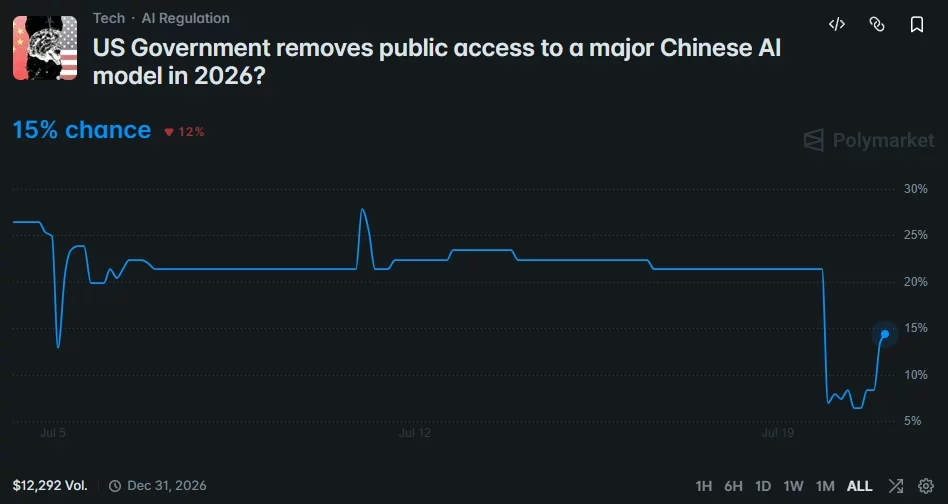
Despite the looming threat of regulatory action, prediction-market traders remain skeptical about a comprehensive U.S. ban on Chinese AI models. Polymarket contracts suggest only a 15% probability of federal action that would broadly block access to models like Kimi K3.
Interestingly, Moonshot plans to release Kimi K3's full model weights, potentially complicating any enforcement of U.S. restrictions. Once available, developers could host these models independently, bypassing Moonshot's services.
Broader Context: AI and Cryptocurrency 🌐
This geopolitical maneuvering plays out against a backdrop of intense investment in AI technologies. According to industry reports, global spending on AI-related infrastructure could reach $725 billion this year. This surge is contrasted by the fixed supply of Bitcoin, as highlighted by Binance founder Changpeng Zhao. Unlike AI, Bitcoin's protocol limits its total supply, offering a scarcity-driven counterpoint to AI's expansion.
Looking Ahead: Strategic Considerations
As Kimi K3 continues to draw attention, the U.S. faces a complex decision matrix. Balancing technological collaboration with national security concerns is no small feat. The administration's next steps could significantly impact the global AI landscape, shaping how countries engage with each other's technological advancements.
For U.S. businesses, the potential for AI-driven innovations remains a tantalizing prospect. Yet, they must navigate a regulatory environment that could shift rapidly.
Conclusion: Navigating the AI Frontier
The story of Kimi K3 underscores the challenges and opportunities at the intersection of technology and policy. As nations grapple with the implications of AI supremacy, strategic decisions made today will echo through the corridors of innovation tomorrow. Stakeholders worldwide are watching closely, ready to adapt to the evolving landscape. 🔍✨
You May Also Like

Regulation
SEC Regulation Crypto Assets: New Rules Explained
August 26, 2026

Regulation
Trump's CLARITY Act: Reshaping Crypto Regulation in America
August 24, 2026
Regulation
South Korea Strengthens Crypto Oversight with New FIU Investigation Powers
August 23, 2026
Regulation
Reg Crypto Framework: End of Token Legal Ambiguity
August 23, 2026