Category:
RegulationWhite House Crypto Meeting: CLARITY Act Odds Surge to 21%

🏛️ A Critical Moment for Cryptocurrency Regulation
The cryptocurrency industry stands at a pivotal crossroads as the White House prepares to convene a significant meeting with digital asset and prediction market executives on August 19. This gathering represents far more than a routine administrative encounter—it signals intensifying efforts to advance the Digital Asset Market CLARITY Act, legislation that could fundamentally reshape how cryptocurrencies are regulated across the United States. 🚀
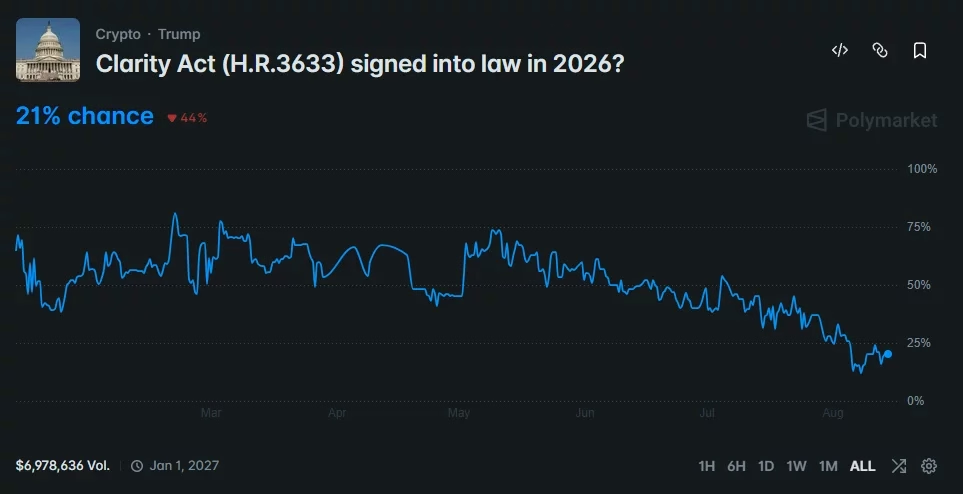
As stakeholders converge on Washington, prediction market traders have assigned the CLARITY Act a 21% probability of becoming law by 2026, a figure that jumped from 17% just one day prior. This modest but meaningful increase reflects growing optimism about the legislative path forward, even as significant obstacles remain on the horizon.
📋 Understanding the CLARITY Act's Scope and Impact
The CLARITY Act represents the most comprehensive attempt yet to establish federal clarity regarding digital asset oversight in the United States. At its core, the legislation aims to divide regulatory authority between two key agencies: the Commodity Futures Trading Commission (CFTC) and the Securities and Exchange Commission (SEC). ⚖️
Under the proposed framework:
- Digital commodity spot markets would fall under CFTC jurisdiction
- Securities-classified assets would remain within SEC oversight
- Exchanges, brokers, and dealers would operate under clearly defined regulatory parameters
- Stablecoin protocols would receive specific regulatory treatment
For the cryptocurrency industry, this distinction matters profoundly. The current regulatory landscape remains fragmented, with agencies issuing conflicting guidance and enforcement actions that have created substantial uncertainty for legitimate market participants. The CLARITY Act seeks to eliminate this ambiguity by establishing bright-line rules that investors, traders, and businesses can rely upon.
🗳️ Legislative Progress and Current Status
The CLARITY Act has already demonstrated bipartisan appeal, passing the House with a commanding 294-134 vote in July 2025. Notably, 78 Democrats supported the measure, signaling that digital asset regulation has transcended traditional partisan divisions. The Senate Banking Committee subsequently advanced its version by a 15-9 vote in May 2026, though the full Senate has yet to conduct a floor vote.
The timing of the August 19 White House meeting is particularly strategic. The Senate departed for its August recess without scheduling a vote, leaving lawmakers limited time upon their September 14 return. With government funding negotiations and midterm election preparations consuming floor time, the legislative window for CLARITY Act consideration has narrowed considerably. 📅
Senate Majority Leader John Thune explained before the recess that lawmakers lacked sufficient time to complete necessary debate and amendments. This procedural reality underscores why White House engagement has become essential—executive branch support could help break legislative logjams that have prevented advancement.
🤝 Unresolved Disputes Threatening Passage
Despite the bill's bipartisan momentum, four critical areas remain contested between crypto companies, traditional financial institutions, and Senate negotiators:
Government Ethics Provisions
One of the most contentious issues involves restrictions on cryptocurrency holdings and income for senior government officials. Senate negotiators are awaiting approval of a bipartisan ethics package developed by Republican Senator Thom Tillis and Democratic Senator Ruben Gallego. The White House had not endorsed this package before the August recess, creating uncertainty about whether consensus can be reached. 🔐
Democrats have pushed for stricter controls on crypto activity involving the president, vice president, lawmakers, and other senior officials. This reflects broader concerns about potential conflicts of interest as digital assets gain mainstream adoption and value.
Stablecoin Rewards Controversy
Traditional banking organizations have mounted vigorous opposition to provisions allowing rewards tied to stablecoin balances. The American Bankers Association, Independent Community Bankers of America, and 76 state banking associations jointly urged Senate leadership in July to revise Section 404 of the bill.
Banks contend that stablecoin rewards could divert deposits from traditional lenders, undermining their capacity to fund mortgages, agricultural credit, and small-business loans. The current draft language permits rewards connected to specific transactions or account activities but prohibits interest on idle stablecoin balances. This distinction has become a flashpoint, with industry representatives disagreeing sharply about whether the exception preserves legitimate customer incentives or creates a regulatory loophole. 💰
Decentralized Finance (DeFi) Treatment
The legislation must address how decentralized finance protocols—which operate without traditional intermediaries—fit within existing regulatory frameworks. This represents genuinely novel regulatory territory, as DeFi challenges conventional assumptions about who bears responsibility for compliance.
Financial Crime and AML Controls
Lawmakers and regulators remain engaged in substantive discussions about anti-money laundering (AML) and know-your-customer (KYC) requirements for digital asset transactions. Balancing robust financial crime prevention with innovation and user privacy has proven difficult.
📊 Prediction Markets Signal Skepticism
The Polymarket contract tracking CLARITY Act passage reveals telling insights about market participants' genuine expectations. Trading volume has reached approximately $7 million, indicating substantial interest and liquidity. The contract requires H.R. 3633 to be enacted before January 1, 2027, for holders of "Yes" positions to profit. 📈
The market's 21% probability reflects realistic assessment of legislative hurdles. Notably, the contract price collapsed from a February peak of 82% to just 16% in early August after the Senate confirmed it would recess without voting. The modest recovery to 21% following the White House meeting announcement suggests traders view the executive branch engagement as meaningful but insufficient to overcome structural obstacles.
Under Senate rules, proponents require 60 votes to overcome a filibuster and advance to final consideration. Republicans hold 53 seats, meaning the bill absolutely requires Democratic support—likely between 7 and 10 votes depending on Republican unity. Securing such bipartisan consensus on contentious issues like government ethics and stablecoin rewards remains extraordinarily challenging.
🎯 What the White House Meeting Could Accomplish
While the White House gathering presents an opportunity for high-level discussions, it's important to maintain realistic expectations about its direct impact. The meeting cannot itself change the bill's procedural status or magically resolve deeply rooted disagreements between stakeholders with conflicting interests.
However, executive branch engagement could prove valuable in several ways:
- Facilitating dialogue between crypto companies and traditional financial institutions
- Clarifying administration priorities regarding digital asset regulation
- Potentially brokering compromises on ethics and stablecoin provisions
- Demonstrating presidential commitment to legislative action
- Coordinating with Senate leadership on timing and strategy
The CFTC's scheduled inaugural Innovation Advisory Committee (IAC) meeting on August 20—just one day after the White House gathering—suggests coordinated regulatory engagement. This timing appears intentional, positioning the regulatory agency to discuss industry perspectives on crypto and prediction markets immediately following executive-level meetings.
🔮 Looking Ahead: The Path Forward
Even if the Senate approves an amended CLARITY Act, substantial work remains. The House would need to accept the Senate version, or both chambers would need to reconcile differences through a conference committee process. Finally, President Trump would need to sign the legislation into law.
The compressed timeline creates genuine urgency. With Congress focused on government funding and election-year politics beginning in earnest, the September-October window represents the realistic opportunity for CLARITY Act consideration. ⏰
For cryptocurrency stakeholders, this moment represents a crucial inflection point. Passage would provide the regulatory clarity that legitimate businesses desperately need to operate confidently. Failure would perpetuate the current fragmented regime, continuing to disadvantage American innovation while potentially driving development and trading activity offshore.
💡 Key Takeaways
The White House crypto meeting signals serious executive branch commitment to advancing digital asset regulation, though prediction market odds of 21% reflect realistic skepticism about passage. Unresolved disputes over government ethics, stablecoin rewards, DeFi treatment, and financial crime controls remain substantial obstacles. The narrow legislative window and high vote threshold required for Senate passage create genuine uncertainty about whether 2026 will finally bring comprehensive cryptocurrency regulation to the United States. Industry participants, policymakers, and investors should monitor both the August 19 White House meeting and subsequent Senate negotiations closely, as outcomes could reshape the American crypto landscape for years to come. 🌟
You May Also Like

Regulation
SEC Regulation Crypto Assets: New Rules Explained
August 26, 2026

Regulation
Trump's CLARITY Act: Reshaping Crypto Regulation in America
August 24, 2026
Regulation
South Korea Strengthens Crypto Oversight with New FIU Investigation Powers
August 23, 2026

Regulation
Reg Crypto Framework: End of Token Legal Ambiguity
August 23, 2026