Category:
BitcoinBitcoin Developer's Self-Custody Regret: A Wake-Up Call

The High Cost of Caution in Bitcoin Self-Custody 🔐
When a seasoned Bitcoin developer admits that security anxieties prevented him from accumulating more of the world's leading cryptocurrency, it raises an uncomfortable question for the entire digital asset community: Is self-custody holding back Bitcoin adoption? This isn't just theoretical speculation—it's a real concern voiced by someone deeply embedded in Bitcoin's technical infrastructure.
René Pickhardt, a prominent German Bitcoin developer known for his extensive work on the Lightning Network, recently shared that his apprehensions about managing private keys and securing wallet seeds kept him from building a larger Bitcoin position during periods when the asset showed significant upside potential. His candid admission cuts to the heart of a persistent tension in cryptocurrency: the philosophical ideal of self-custody versus the practical security burden it imposes.
Understanding the Self-Custody Paradox 🎯
Self-custody represents Bitcoin's core promise: removing intermediaries and giving individuals complete control over their assets. Yet this same feature creates a double-edged sword. While eliminating counterparty risk with centralized exchanges, it simultaneously transfers all responsibility for security directly to the holder.
Pickhardt framed his decision as a calculated risk-management choice rather than a critique of Bitcoin itself. He acknowledged that "security and key management always freaked me out"—a sentiment that likely resonates with many cryptocurrency holders, regardless of their technical expertise.
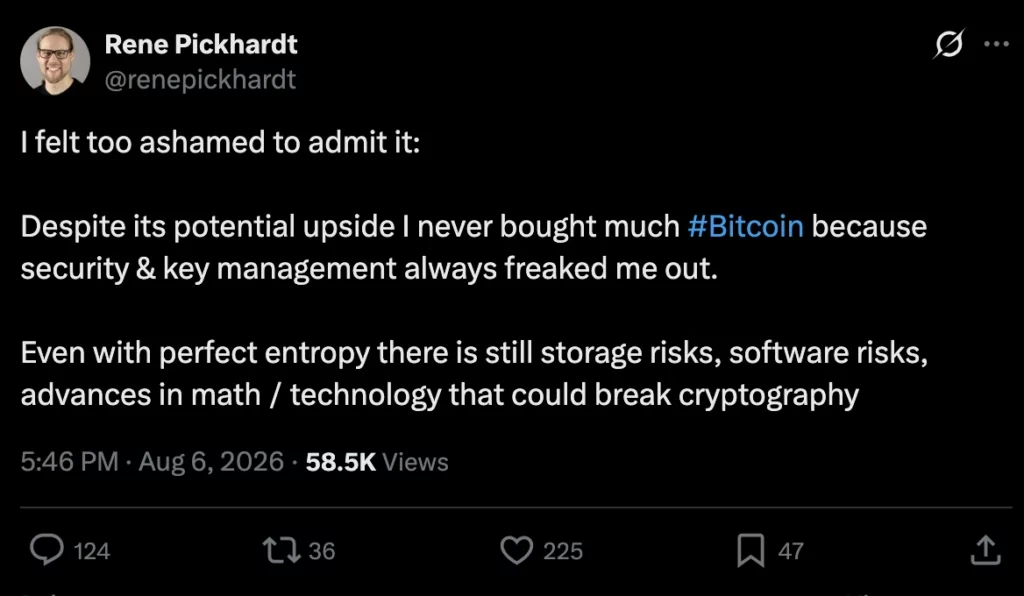
What makes Pickhardt's position particularly noteworthy is his background. As a Lightning Network researcher and developer with OpenSats, he possesses the technical knowledge that most retail investors lack. If someone with his expertise feels uncomfortable with self-custody responsibilities, what does that signal about mainstream adoption barriers?
The Coldcard Vulnerability: A Reality Check 🚨
Pickhardt's concerns arrived at a particularly relevant moment. The cryptocurrency community was grappling with a significant security incident involving Coldcard, one of the most respected hardware wallet manufacturers in the space.
The vulnerability centered on how the device generated wallet seeds—the foundation of all private key management. Security researchers at Block discovered that certain Coldcard firmware configurations could bypass hardware-based randomness and fall back to weaker software-generated entropy. This flaw meant that some seed phrases became predictable, potentially allowing sophisticated attackers to reconstruct private keys remotely without ever physically accessing the device.
The implications were staggering. Galaxy Research estimates suggest approximately 1,755 BTC was stolen across multiple attack waves targeting wallets affected by the vulnerable firmware. While this figure remains under investigation and should be treated as an evolving estimate, the scale underscores why Pickhardt's caution wasn't paranoia—it was prudent risk assessment.
How the Coldcard Flaw Worked 🔍
The technical details reveal why this vulnerability was particularly insidious:
- Entropy generation failure: The firmware relied on randomness when creating seed phrases, but certain configurations could compromise this process
- Predictability risk: Weakened entropy made seed phrases less random, reducing the computational difficulty of brute-force attacks
- Persistent exposure: Once a seed was generated under vulnerable conditions, the problem couldn't be fixed by simply updating firmware—users had to create entirely new seeds and move funds on-chain
- Cross-wallet vulnerability: The flaw persisted even if users imported the compromised seed into different hardware wallets
Coinkite, Coldcard's manufacturer, acknowledged the firmware issue and released patches. However, the company's critical warning highlighted the operational burden of self-custody: installing new firmware alone doesn't repair seeds created under vulnerable conditions. Users must manually migrate their Bitcoin to new addresses—a process that introduces additional complexity and potential points of failure.
The Broader Security Landscape 📊
The Coldcard incident didn't occur in isolation. Recent wallet security events have highlighted that hardware wallets, while significantly more secure than hot wallets or exchanges, still carry inherent risks:
- Firmware vulnerabilities: Device manufacturers must maintain security across multiple firmware versions
- Hardware design flaws: Physical components can have weaknesses that sophisticated attackers exploit
- User implementation errors: Even secure systems fail when users mismanage recovery processes
- Future cryptographic threats: Advances in computing power could theoretically compromise keys generated today
Blockstream CEO Adam Back responded to Pickhardt's concerns with a memorable quip: "With great bearer cash power comes great responsibility to not lose your keys." This encapsulates the fundamental Bitcoin trade-off—the freedom of self-custody demands that users accept accountability for security.
Why Technical Expertise Doesn't Eliminate Custody Concerns 💡
Pickhardt's situation deserves particular attention precisely because it challenges assumptions about who struggles with self-custody. His background includes:
- Extensive Lightning Network routing research
- Published mathematical frameworks for payment-channel networks
- Recognition as a Bitcoin researcher by Bitcoin Optech
- Deep understanding of Bitcoin's technical architecture
Yet even this expertise didn't eliminate his anxiety about key management. His concerns centered on multiple vulnerability vectors:
- Storage risks: How to securely store recovery phrases offline
- Implementation errors: The countless ways secure systems can fail through human mistake
- Long-term threats: Potential advances in quantum computing or cryptanalysis
- Operational complexity: The burden of maintaining security across years or decades
This reveals an uncomfortable truth: self-custody security isn't purely a technical problem—it's an operational and psychological one. Even knowledgeable developers can rationally conclude that the burden outweighs the benefits for their personal circumstances.
The Numbers Behind the Debate 📈
According to reports citing Galaxy Research, the Coldcard vulnerability affected approximately 5,000 wallets. While Block confirmed its own products remained unaffected and other manufacturers have detailed their separate entropy-generation designs, the incident sparked renewed scrutiny across the hardware wallet industry.
The estimated 1,755 BTC loss represents roughly $70-80 million at current valuations, though the exact attribution remains under investigation by Coinkite, blockchain analysts, and potentially law enforcement. This uncertainty itself highlights another self-custody challenge: tracing stolen funds and determining root causes requires sophisticated on-chain analysis.
Seed Phrases: The Master Key Problem 🔑
Understanding why the Coldcard fix proved so complicated requires grasping how wallet seeds function. The recovery phrase is effectively the master key to an entire wallet—not just a backup, but the cryptographic foundation from which all private keys derive.
If seed generation is compromised, offline storage cannot restore missing entropy afterward. This means:
- Moving a weak seed to different hardware doesn't solve the underlying vulnerability
- Users cannot simply update firmware and assume protection
- Complete seed regeneration and fund migration become necessary
- The operational burden falls entirely on individual holders
What This Means for Bitcoin Adoption 🌍
Pickhardt's admission carries implications beyond his personal portfolio decisions. While his experience is anecdotal and doesn't prove that self-custody fears are suppressing broader Bitcoin adoption, it highlights why usability and security remain fundamentally linked.
As hardware wallets become increasingly accessible to mainstream users, manufacturers face mounting pressure to make key management both verifiable and comprehensible. The current state of self-custody tools often requires users to:
- Understand cryptographic concepts
- Manage complex recovery procedures
- Stay informed about firmware updates and vulnerabilities
- Execute secure fund migrations when issues arise
- Maintain physical security for recovery phrases indefinitely
This operational burden represents a genuine barrier to adoption, particularly for less technical users who might otherwise embrace Bitcoin's monetary thesis.
The Path Forward 🚀
Several trends are addressing self-custody challenges:
Improved wallet design: Manufacturers are simplifying interfaces while maintaining security standards
Standardized best practices: Industry guidelines now clarify seed generation, storage, and recovery procedures
Multi-signature solutions: Users can distribute key management across multiple devices or locations
Institutional-grade security: Enterprise solutions provide self-custody with professional infrastructure
Educational resources: Comprehensive guides help users understand risks and mitigation strategies
The Fundamental Trade-Off ⚖️
Pickhardt's situation ultimately illustrates a core Bitcoin principle: self-custody removes one class of intermediary risk while creating another set of responsibilities. Eliminating exchange counterparty risk means accepting operational burden.
The Coldcard incident has made this trade-off harder to dismiss, particularly for holders deciding whether direct ownership justifies the security responsibilities. Strong conviction in Bitcoin's monetary thesis doesn't automatically translate into comfort with bearer-asset security.
Key Takeaways for Bitcoin Holders 📝
As the cryptocurrency market matures, several lessons emerge:
- Self-custody requires genuine commitment: It's not merely about technical capability but sustained operational discipline
- Security incidents will occur: Hardware wallets improve security but don't eliminate all risks
- Firmware updates matter: Users must stay informed about vulnerability disclosures and remediation steps
- Fund migration may be necessary: Security incidents sometimes require users to generate new seeds and move Bitcoin
- Risk assessment is personal: Different holders will reach different conclusions about self-custody versus custodial solutions
Looking Ahead 🔮
The investigation into Coldcard losses, blockchain tracing efforts, and any law-enforcement findings will determine the final scale of the incident. This information will likely influence how users evaluate hardware wallet manufacturers and seed generation practices.
For Bitcoin itself, Pickhardt's candid admission serves as a reminder that adoption barriers extend beyond price, regulatory clarity, or technical sophistication. They include the very real psychological and operational burden of managing bearer assets responsibly.
As Bitcoin matures and self-custody tools improve, the industry must continue balancing the philosophical ideal of decentralized control with the practical reality that most users need security solutions that are simultaneously robust and manageable. The path to mainstream adoption may depend less on convincing people to embrace self-custody and more on making self-custody genuinely accessible to those who want it.
You May Also Like

Bitcoin
Bitcoin as Hedge Against $40T U.S. Debt Crisis
August 24, 2026

Bitcoin
Tether's $120M Uruguay Bitcoin Mining Exit: What Went Wrong
August 23, 2026

Bitcoin
Bitcoin as Reserve Currency: Escaping the Dollar's Monetary Trap
August 22, 2026

Bitcoin
Bitcoin Treasury Returns to Profit Above $75,385
August 21, 2026