Category:
BitcoinBitcoin Miner Capitulation Deepens: 19.9% Difficulty Drop Signals Major Shift

The Bitcoin mining landscape is experiencing unprecedented stress 📉. As of late July 2026, the network witnessed a staggering 19.9% decline in mining difficulty from its peak—marking the third-deepest contraction since application-specific integrated circuits (ASICs) became the industry standard. This dramatic shift reveals far more than just struggling miners; it signals a fundamental transformation in how the cryptocurrency ecosystem generates value.
Understanding Bitcoin Miner Capitulation 🔍
Miner capitulation occurs when unprofitable operations shut down their equipment, reducing the network's total computational power. The current contraction represents one of the longest periods of sustained decline in Bitcoin's history, lasting approximately 287 days according to Bitcoin Magazine Pro's analysis.
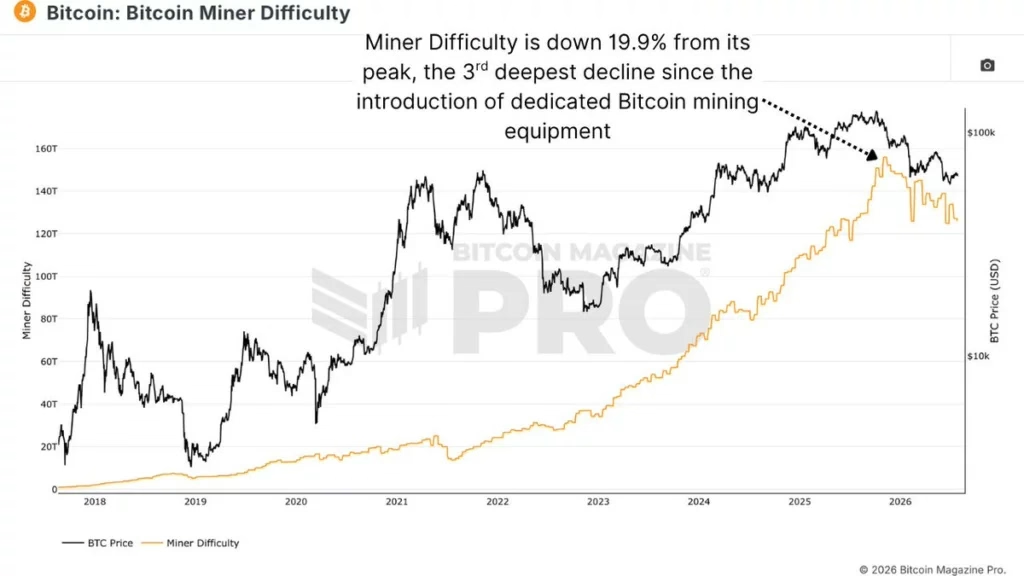
What makes this capitulation particularly significant is the scale of the hashrate retreat. Bitcoin's seven-day average hashrate stood near 868 exahashes per second on July 29, down from over one zettahash per second at its late-2025 peak. The 30-day average hashrate measured approximately 940 EH/s in the third quarter, representing a 12% decline from December's record of 1,066 EH/s.
The Perfect Storm: Price Pressure and Revenue Collapse 💥
Bitcoin's price performance has devastated mining economics. Trading near $63,100 on July 31, the asset had plummeted approximately 47% over the preceding 12 months and fallen nearly 50% below its October 2025 all-time high. This price collapse directly compressed miner revenue despite the protocol continuing to issue 3.125 BTC per block—a fixed reward that cannot adjust based on market conditions.
Hashprice, the metric measuring expected daily revenue from one petahash of computing power, had deteriorated to approximately $32 per PH/s per day by late July. For context, older mining fleets struggle to maintain cash-positive operations around the $30-$35 range unless operators secure electricity costs below roughly five cents per kilowatt-hour—a threshold increasingly difficult to achieve.
This economic squeeze forced listed Bitcoin miners to take drastic action. During the first quarter of 2026 alone, publicly traded mining companies sold more than 32,000 BTC to raise capital. This total exceeded their combined Bitcoin sales throughout the entirety of 2025, highlighting the severity of the liquidity crisis.
Historical Context: Comparing Past Contractions 📊
The current 19.9% difficulty decline places this capitulation among the most severe in Bitcoin's ASIC era. Only two previous periods saw deeper drawdowns:
- China's 2021 Mining Ban: The most dramatic contraction followed China's sweeping prohibition on cryptocurrency mining activities, which forced massive equipment relocations globally
- 2022 Crypto Winter: The industry-wide collapse following the Terra/Luna implosion and subsequent contagion through centralized finance platforms
Notably, difficulty has turned negative on a year-over-year basis for only the second time in Bitcoin's entire history. The previous instance directly followed China's 2021 ban. The current contraction, however, stems from multiple concurrent pressures rather than a single policy shock.
Beyond Bitcoin Mining: The AI Infrastructure Pivot 🤖
Perhaps the most fascinating development is why Bitcoin mining stocks have partially decoupled from the asset's price decline. Traditionally, mining equities behaved as leveraged Bitcoin exposure—rising sharply during bull markets and collapsing during downturns. That relationship has fundamentally shifted.
A basket of mining equities gained 56% during early 2026 while Bitcoin fell 17%, according to industry research. This divergence reflects a critical strategic pivot: major miners are increasingly monetizing their infrastructure as artificial intelligence and high-performance computing (HPC) data centers.
Hut 8 Mining exemplifies this transformation. On July 20, the company signed a second 15-year lease for 352 megawatts at its Beacon Point campus in Texas. This agreement elevated the campus's total base-term contract value to $19.6 billion, bringing Hut 8's entire contracted AI portfolio to $26.6 billion. The company's stock more than quadrupled over the preceding 12 months and gained an additional 11% following the announcement—gains driven by anticipated lease revenue rather than improved mining profitability.
Core Scientific announced similarly ambitious expansion plans on July 28. The company partnered with AMD on 15-year agreements covering approximately 530 megawatts with more than $14 billion in potential base contracted revenue. Core Scientific's total leased customer capacity reached roughly 1.1 GW, representing more than $24 billion in potential contracted revenue.
Most dramatically, TeraWulf reported that AI and HPC lease revenue reached $21 million in the first quarter of 2026—exceeding its Bitcoin mining revenue of less than $13 million for the first time in company history.
The Strategic Advantage: Repurposing Mining Infrastructure 🏗️
These developments reveal a sophisticated strategy. Operators can deactivate inefficient mining equipment while preserving valuable power connections, physical land, and data-center infrastructure for higher-margin AI workloads. This flexibility allows mining companies to weather the current Bitcoin economics collapse while positioning themselves for the AI boom.
However, significant risks accompany these ambitious projections:
- Construction timelines: Many projects require years of development before revenue generation begins
- External financing: Operators depend on capital partners and customers to fund buildout phases
- Execution challenges: Cost overruns, supply chain disruptions, or technical delays could derail schedules
- AI demand uncertainty: While AI infrastructure appears hot currently, sustained demand at projected levels remains unproven
Not all miners can successfully pivot to AI infrastructure. Some locations lack the networking redundancy, cooling capacity, or reliability standards required for enterprise AI workloads. Conversely, some efficient mining sites in favorable locations may continue generating acceptable returns on Bitcoin mining alone.
The Hashrate Decline: What It Means for Bitcoin 🔗
Difficulty adjustments serve as Bitcoin's self-regulating mechanism. When hashrate declines, difficulty falls proportionally, allowing remaining miners to find blocks more frequently and maintain consistent 10-minute block times. The current 19.9% difficulty drop reflects the network's healthy response to reduced participation.
However, lower hashrate does raise legitimate security considerations. Reduced computational power theoretically makes the network more susceptible to attacks, though Bitcoin's absolute hashrate remains extraordinarily high by historical standards. The network continues processing transactions with complete reliability and security.
The Transaction Fee Problem 💰
One factor complicating miner economics is Bitcoin's minimal transaction fee contribution to total revenue. The protocol's fixed block subsidy—now 3.125 BTC per block—remains the dominant revenue source. Transaction fees contribute only a small percentage of miner income, even during periods of network congestion.
This structural reality means miners cannot rely on fee revenue to offset subsidy reductions. The next halving event, scheduled for 2028, will reduce the block subsidy to 1.5625 BTC, further pressuring mining profitability unless Bitcoin prices appreciate significantly.
Market Implications and Looking Forward 🚀
The current miner capitulation represents a market-clearing event. Inefficient operations are shutting down, consolidating the industry around operators with superior electricity costs, technological advantages, or diversified revenue streams. This consolidation will likely strengthen remaining players.
The divergence between Bitcoin price performance and mining stock valuations reflects genuine economic transformation. Investors increasingly view major miners as energy and infrastructure companies rather than pure Bitcoin-exposure plays. This revaluation may persist regardless of Bitcoin's price trajectory.
For Bitcoin itself, the difficulty adjustment maintains network security and transaction processing reliability. The capitulation does not threaten Bitcoin's fundamental function—it merely redistributes mining rewards among a smaller set of participants.
Key Takeaways 📌
The 19.9% difficulty decline signals genuine miner stress but also reveals strategic adaptation:
- Profitability crisis: Low Bitcoin prices and compressed hashprices have made many mining operations uneconomical
- Infrastructure monetization: Leading miners are leveraging valuable power and real estate assets for higher-margin AI workloads
- Market consolidation: Inefficient operators are exiting while stronger players strengthen their positions
- Structural divergence: Mining stocks increasingly trade on AI infrastructure potential rather than Bitcoin price correlation
- Long-term challenges: Future halvings will continue pressuring mining economics without significant Bitcoin price appreciation
The mining industry's transformation from pure Bitcoin-focused operations to diversified energy and infrastructure companies represents one of cryptocurrency's most significant recent developments. Whether this pivot proves sustainable depends on AI infrastructure demand materializing as currently projected—and whether Bitcoin mining remains viable for operators unable to access lucrative data-center contracts.
You May Also Like

Bitcoin
Bitcoin as Hedge Against $40T U.S. Debt Crisis
August 24, 2026

Bitcoin
Tether's $120M Uruguay Bitcoin Mining Exit: What Went Wrong
August 23, 2026

Bitcoin
Bitcoin as Reserve Currency: Escaping the Dollar's Monetary Trap
August 22, 2026

Bitcoin
Bitcoin Treasury Returns to Profit Above $75,385
August 21, 2026