Category:
AltcoinsCardano Price Nears $0.17 Amid Dijkstra Roadmap
Cardano finds itself at a critical juncture as ADA price hovers near the $0.17 mark, caught between ambitious protocol upgrades and challenging technical conditions. The leading proof-of-stake blockchain is navigating a complex landscape where technological innovation meets market skepticism, creating both opportunities and risks for investors and network participants alike.
Understanding Cardano's Current Market Position 📊
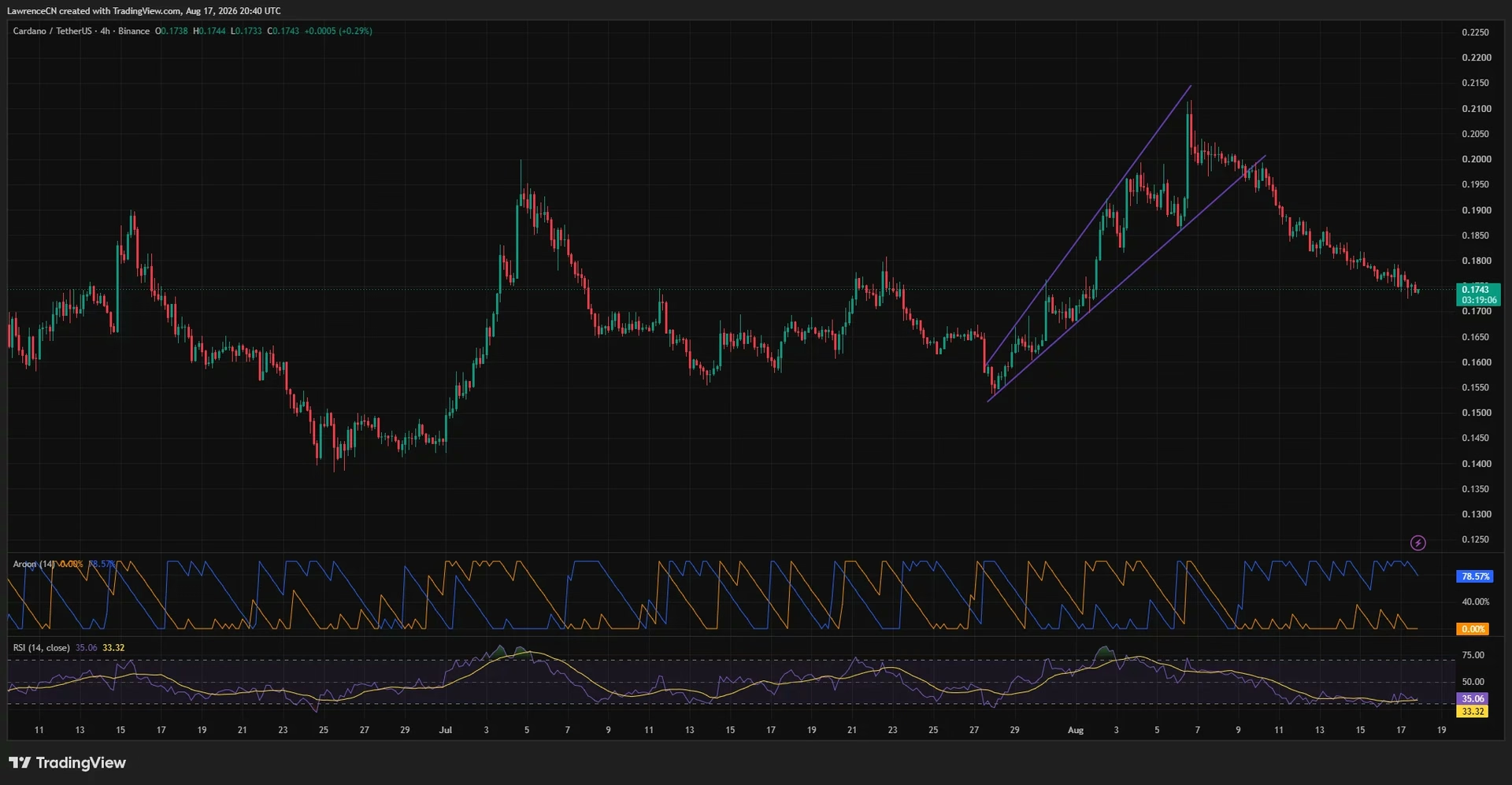
The ADA token has experienced notable volatility in recent weeks, trading near $0.174 after a significant pullback from its August peak above $0.21. This represents approximately a 17% decline from the month's highs, reflecting broader altcoin market dynamics where capital flows rapidly between tokens seeking new opportunities.
The technical picture reveals a bearish structure forming on shorter timeframes. Cardano price recently broke below an ascending channel that had guided its recovery from lows near $0.153 in late July. This breakdown signals weakening momentum among buyers, particularly as the token struggles to maintain positions above critical resistance levels.
The Dijkstra Upgrade: A Two-Phase Transformation 🚀
Despite near-term price pressures, Cardano's development roadmap remains remarkably ambitious. The upcoming Dijkstra Era represents the most significant protocol evolution since the network's launch, introducing fundamental improvements to scalability and functionality.
Intersect, the entity overseeing Cardano's governance, has unveiled a comprehensive two-phase rollout strategy. Phase one targets code completion in the fourth quarter of 2026, introducing protocol version 12 through a hard fork. This initial stage brings several transformative features to the network.
Phase One: Ouroboros Linear Leios and Beyond
The cornerstone of Phase One is Ouroboros Linear Leios, a revolutionary scaling mechanism designed to dramatically increase transaction throughput without compromising security. Unlike approaches requiring larger blocks or faster slot times, Linear Leios operates through an elegant two-tier system:
- Ranking blocks maintain the current consensus structure
- Endorser blocks reference transactions and receive certification from stake-based committees before ledger inclusion
- Gradual throughput increases occur through protocol parameter adjustments post-activation
This architecture allows Cardano to process substantially more transactions while preserving the robust security guarantees that make the network trustworthy for critical applications.
Beyond scaling, Phase One introduces nested transactions—a feature enabling transactions to contain child transactions with independent witnesses and execution conditions. This capability significantly expands developer flexibility when constructing complex on-chain applications, from DeFi protocols to enterprise solutions.
Additional Phase One improvements include PlutusV4 script context enhancements, refined account-address structures, and modifications to block architecture. These refinements collectively enhance the developer experience and network efficiency.
Phase Two: Ouroboros Peras and Settlement Finality
Phase Two, targeted for Q2 2027 code completion, introduces Ouroboros Peras—a voting-based settlement layer that fundamentally changes how the network achieves finality. While structural support ships during Phase One, Peras activation requires a separate hard fork within the Dijkstra Era.
Peras enables committees of stake pool operators to vote on recent chain tips, allowing the network to achieve settlement faster than the standard Ouroboros Praos process. This enhancement is particularly valuable for applications requiring rapid transaction confirmation, such as high-frequency trading systems and time-sensitive financial instruments.
Technical Analysis: Support and Resistance Zones 📈
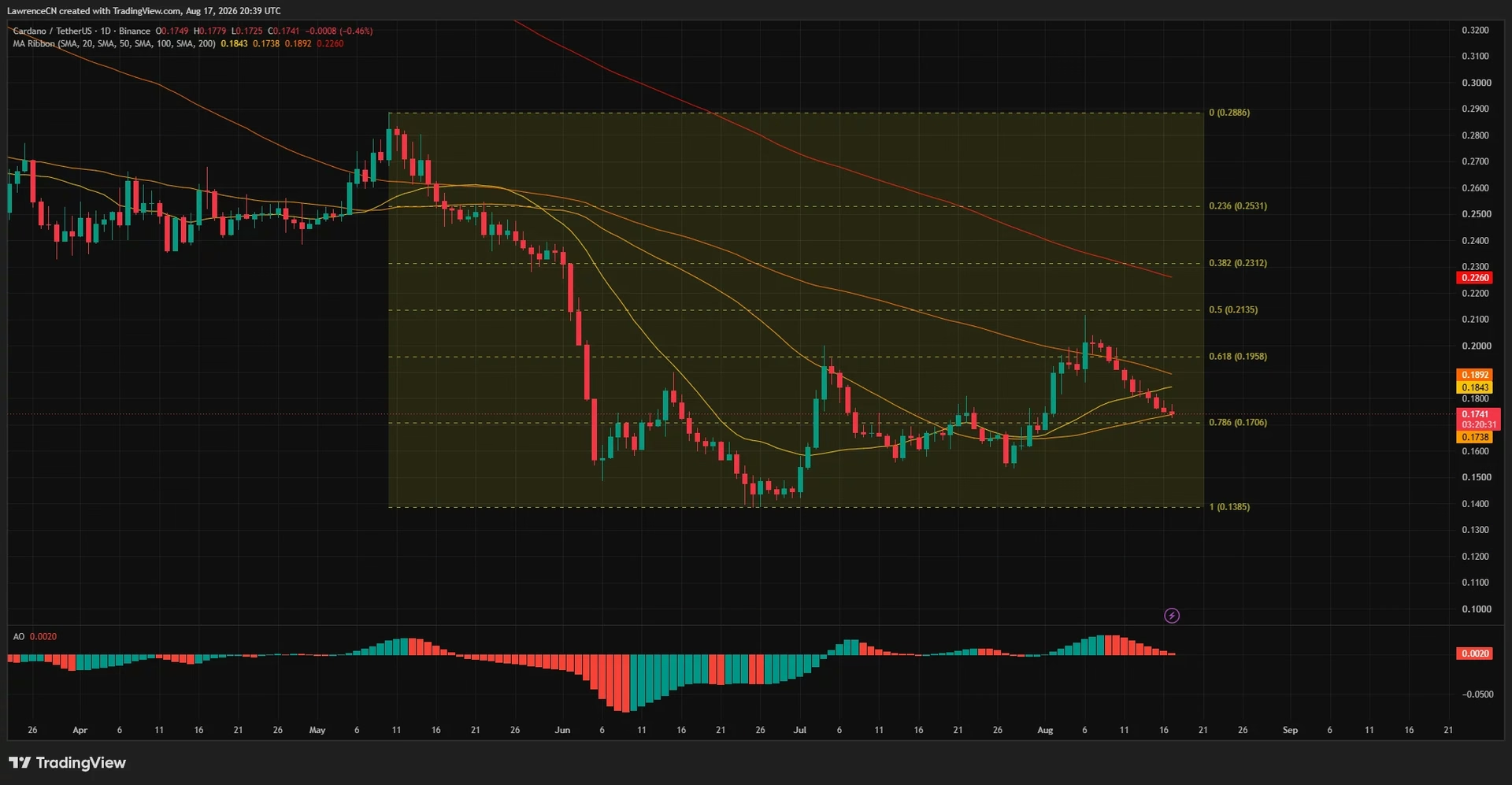
Cardano's daily chart reveals several critical technical levels that will determine near-term price direction. The immediate support area sits at $0.1706, coinciding with the 78.6% Fibonacci retracement level measured from June's low of $0.1385 to May's high of $0.2886.
This support level gains significance because ADA currently trades slightly above its 20-day simple moving average at $0.1738. However, the token remains below its 50-day average ($0.1843), 100-day average ($0.1892), and 200-day average ($0.2260), indicating sustained bearish pressure on intermediate and longer timeframes.
Momentum indicators paint a cautionary picture. The Relative Strength Index on the 4-hour chart stands at 35.06, approaching the oversold threshold of 30, though not yet triggering extreme readings. The Awesome Oscillator shows marginally positive momentum but with shrinking red bars, suggesting that buying pressure from August's recovery is rapidly dissipating.
Key Price Targets
Downside scenarios present concerning risks. A daily close below $0.1706 would weaken current support structures, potentially exposing the liquidity area near $0.166. Continued selling pressure could then bring the June swing low at $0.1385 into focus—representing a 20% decline from current levels.
Upside recovery requires ADA to reclaim the 50-day moving average near $0.1843. Successfully holding above this level would bring the 100-day average ($0.1892) and the 61.8% Fibonacci retracement at $0.1958 into view. The $0.1958 area holds particular significance as it aligns with both the former rising channel and the zone where August's advance began losing steam.
A sustained move above $0.1958 would enable traders to consider the 50% retracement at $0.2135, though current charts lack confirmation of such a reversal scenario.
Liquidation Risks and Market Structure 🔥
One factor creating immediate volatility is the concentration of leveraged positions above current price levels. CoinGlass liquidation heatmap data reveals substantial clusters of long positions between $0.183 and $0.187, with the highest concentration around $0.186-$0.187.
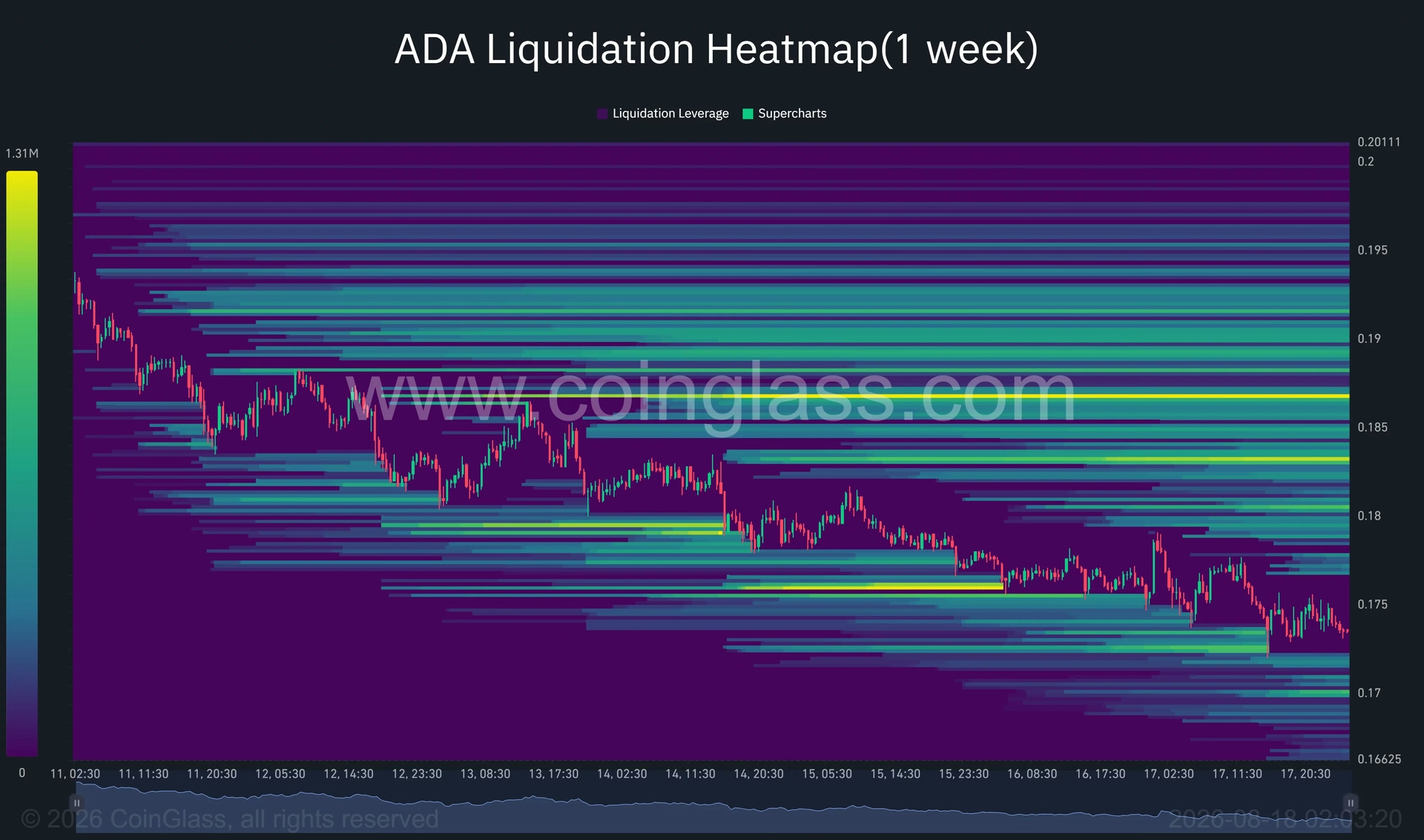
These liquidation clusters create a double-edged dynamic. Price moves above $0.183 could trigger cascading liquidations, creating upside momentum that accelerates gains. Conversely, if ADA fails to reach these levels, the lack of forced buying could limit recovery potential.
Market analysts have noted heavy capital rotation across the altcoin sector, where traders continuously move funds between tokens seeking the strongest near-term performers. This behavior results in short-lived rallies and extended consolidation periods, precisely the pattern Cardano currently displays.
Governance and Activation Requirements ⚖️
It's crucial to understand that the Dijkstra Era's timeline reflects estimated code-completion dates rather than confirmed mainnet launches. Both Phase One and Phase Two must navigate rigorous testing protocols before reaching mainnet.
Each phase requires passage through Preview and Pre-production test networks, allowing developers and node operators to identify vulnerabilities and optimize performance. This methodical approach prioritizes network stability over speed—a philosophy that has served Cardano well historically.
Moreover, mainnet activation demands on-chain governance approval. Delegated representatives, stake pool operators, and the Constitutional Committee must collectively vote on both hard fork proposals. This decentralized governance process ensures that network participants maintain control over fundamental protocol changes, though it also introduces timeline uncertainty.
Market Context and Altcoin Dynamics 💡
Cardano's current price action reflects broader altcoin market trends rather than network-specific weakness. Throughout 2026, alternative cryptocurrencies have experienced volatile consolidation as investors reassess valuations following the previous cycle's euphoria.
The Dijkstra roadmap actually positions Cardano favorably within this environment. While many competing protocols offer incremental improvements, Cardano's two-phase approach delivers fundamental architectural enhancements. Linear Leios represents a genuine breakthrough in blockchain scalability, addressing the trilemma of security, decentralization, and throughput that has constrained many networks.
Historically, major protocol upgrades have preceded significant price appreciation once markets digest the technical implications. Ethereum's transition to proof-of-stake, Bitcoin's Taproot activation, and Cardano's own Vasil upgrade all preceded substantial rallies as investors recognized enhanced utility and reduced technical risk.
What's Next for Cardano Investors 🎯
The immediate outlook depends on whether ADA maintains support above $0.1706. Failure to hold this level would suggest further consolidation toward $0.1385, while recovery above $0.1843 could reignite upside momentum toward $0.1958 and beyond.
Longer-term investors should view current price weakness as an opportunity to accumulate before the market fully prices in Dijkstra's implications. The combination of genuine technological advancement, clear governance processes, and ambitious but achievable timelines creates a compelling narrative for network adoption and token appreciation.
The key is maintaining patience through the consolidation phase while monitoring technical indicators for confirmation of either breakdown or breakout scenarios. As the Dijkstra roadmap progresses through 2026 and 2027, market participants will gain increasing confidence in the upgrade's success, likely driving renewed institutional and retail interest.
Final Thoughts 🌟
Cardano's price near $0.17 reflects the tension between technological promise and market uncertainty. The Dijkstra Era represents a watershed moment for the network, introducing capabilities that position Cardano as a serious competitor for enterprise and DeFi applications.
While short-term volatility will persist, the fundamental trajectory remains compelling. Investors should focus on the multi-year opportunity rather than daily price fluctuations, recognizing that transformative blockchain upgrades typically generate returns well after their technical completion.
You May Also Like
Altcoins
NCT Price Surge 200% on Upbit KRW Listing
August 26, 2026
Altcoins
WBT Reaches New All-Time High as Crypto Infrastructure Turns Institutional
August 26, 2026
Altcoins
Pi Network's August 24 Pricing Shakeup: End of Subsidized App Building
August 25, 2026
Altcoins
XRP Undervalued? Seven Spot ETFs & $1.4B Flows Tell
August 25, 2026