Category:
BitcoinChanos $80B Bitcoin Arbitrage Claim Against Strategy

The Resurgence of a Controversial Trading Thesis 📊
Short seller James Chanos has reignited one of cryptocurrency's most contentious debates by characterizing Strategy (MSTR) as an "$80 billion actionable spread" in Bitcoin arbitrage opportunities. His August statement represents a revival of arguments that have captivated institutional investors and cryptocurrency traders throughout 2024 and 2025, forcing the market to confront fundamental questions about valuation, corporate structure, and the true cost of Bitcoin exposure through equity vehicles.
The timing of Chanos's renewed commentary coincides with significant shifts in Strategy's Bitcoin holdings and market positioning. Understanding the nuances behind this claim requires examining the company's current financial structure, the mechanics of the proposed trade, and why such opportunities—if they truly exist—remain largely unexploited despite their apparent magnitude.
Understanding Strategy's Current Position 💰
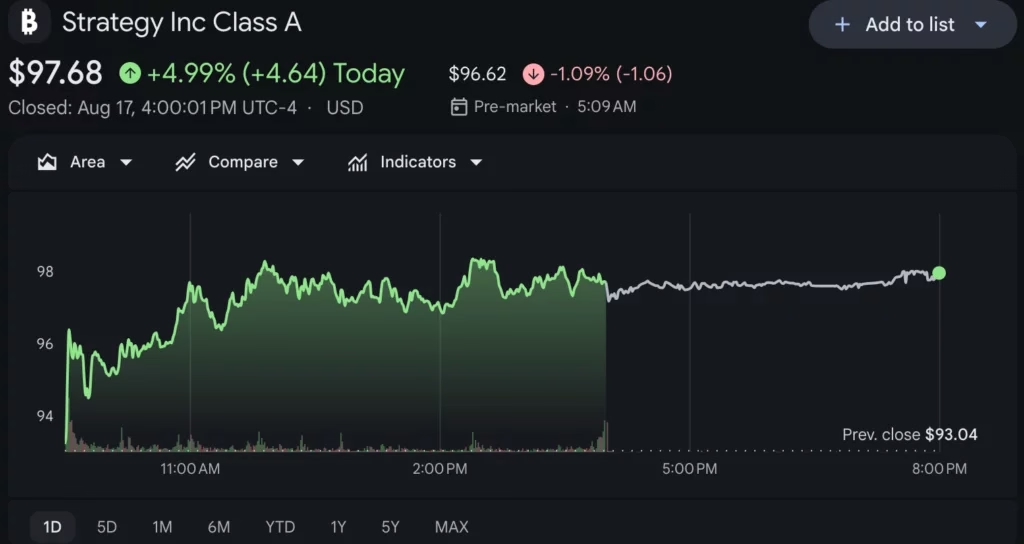
Strategy currently holds 840,447 Bitcoin following strategic sales during July and August 2025. This represents a modest decline from the peak of 847,363 BTC disclosed in the company's June SEC filings. At the time of Chanos's statement, with Bitcoin trading near $64,188 per coin, these holdings carried a market value of approximately $53.95 billion.
The mathematics appear straightforward on the surface: Strategy's market capitalization stood around $34.4 billion, while its Bitcoin holdings were worth $53.95 billion. This $19.5 billion gap forms the foundation of Chanos's arbitrage thesis. However, the reality of executing such a trade involves considerably more complexity than simple subtraction.
Strategy's dashboard metrics provide additional context. The company's modified net asset value (mNAV) multiple—a proprietary measure comparing enterprise value to Bitcoin holdings after accounting for the capital structure—hovered near 1.04. This represents only a 4% premium, a dramatic compression from the valuations that initially attracted short sellers and arbitrage traders during 2024 and early 2025.
Deconstructing the $80 Billion Claim 🔍
Chanos has not published detailed calculations supporting his $80 billion figure, which raises important questions about how this number was derived. The claim represents his characterization of the opportunity rather than a directly verifiable market gap. This distinction matters significantly for investors evaluating whether the trade represents genuine alpha or merely selective accounting.
The discrepancy between MSTR's market cap and Bitcoin holdings cannot be directly converted into arbitrage profit. Several critical factors intervene:
- Debt obligations: Strategy has issued multiple tranches of preferred securities carrying dividend rates between 8% and 12%
- Capital structure complexity: Preferred shareholders rank ahead of common equity holders
- Operating business: Strategy maintains software operations and other assets beyond Bitcoin holdings
- Dollar reserve: The company has accumulated a $4.65 billion cash reserve for obligations
- Financing costs: Both sides of a hedged position require funding and carry borrowing expenses
When these elements are properly accounted for, the "pure arbitrage opportunity" shrinks substantially. Comparing common equity market capitalization directly with Bitcoin holdings produces a discount rather than a premium when preferred securities and debt are considered.
The Preferred Securities Problem 🏢
Strategy has become increasingly sophisticated in its capital structure, issuing four distinct series of preferred shares: STRC, STRF, STRD, and STRK. These securities create a waterfall of claims that fundamentally alter the economic equation for common shareholders.
Each preferred series carries specific dividend obligations and liquidation preferences. In scenarios where Bitcoin declines or MSTR shares underperform, common shareholders absorb losses first while preferred holders maintain their dividend rights. This structural subordination means that purchasing MSTR shares does not provide economically equivalent exposure to holding Bitcoin directly.
The company's board has authorized additional capital raising through preferred share issuance, further diluting common shareholder claims on the underlying Bitcoin. Strategy simultaneously approved up to $1.25 billion in additional Bitcoin sales and $1 billion in repurchase programs, creating ongoing dynamics that affect the relationship between share price and Bitcoin value.
Chanos's Previous Trade and Its Lessons 📈
Chanos's history with this trade provides crucial context for evaluating his current claims. He began constructing a hedged position in late 2024, when MSTR traded at a substantial premium to its Bitcoin holdings. At certain points during November 2024, the premium exceeded three times the underlying Bitcoin value—an extraordinary divergence that attracted significant short interest.
The trader publicly described his position as long Bitcoin and short MSTR, arguing that investors were substantially overpaying for Bitcoin exposure available through cheaper alternatives like spot Bitcoin ETFs. This thesis attracted considerable institutional interest during a period when MSTR commanded unusual valuations.
Chanos closed his position on November 7, 2025, reportedly capturing gains exceeding 50% as the premium contracted. The trade's success demonstrated that arbitrage opportunities can exist in cryptocurrency markets, even when they require sophisticated execution and significant capital.
However, the trade's closure also revealed the limitations of such strategies. The premium compression that generated profits for short sellers reflected shifting investor sentiment and changing market conditions—not necessarily the emergence of a permanent mispricing.
Why the Arbitrage Remains Elusive 🤔
If an $80 billion arbitrage opportunity truly existed, one might reasonably expect sophisticated hedge funds and trading firms to exploit it aggressively. The fact that such large spreads persist suggests either that the opportunity is smaller than claimed or that execution barriers prevent profitable exploitation.
Shorting MSTR shares requires borrowing stock in a market where shares trade actively but borrow availability fluctuates. Borrowing costs have ranged considerably, sometimes exceeding 10% annually. Simultaneously, a long Bitcoin position requires custody solutions, financing arrangements, and exposure to counterparty risks.
The hedged trade also carries execution risk. If Bitcoin declines while MSTR rises due to short covering or changing investor demand, both components of the trade can generate losses simultaneously. This possibility explains why even traders who identified the initial premium chose to exit rather than maintain indefinite positions.
The Software Business Factor 🖥️
Strategy is not purely a Bitcoin treasury company. The organization maintains software operations and other business activities that contribute to enterprise value. These operations generate costs and potential revenues that complicate direct comparison between MSTR equity value and Bitcoin holdings.
The software segment's profitability and growth trajectory influence investor demand for MSTR shares independent of Bitcoin holdings. During periods when technology stocks trade at elevated valuations, MSTR may command premiums that reflect software business potential rather than Bitcoin appreciation alone.
Conversely, when technology sentiment deteriorates, the software business may drag on valuations even as Bitcoin appreciates. This dynamic adds another layer of complexity to arbitrage strategies that assume a simple relationship between share price and Bitcoin value.
Market Structure and Investor Behavior 💡
The continued existence of MSTR premiums—even at compressed levels—reflects rational economic behavior by different investor constituencies. Some investors prefer equity exposure for tax efficiency or portfolio construction reasons. Others value the liquidity and regulatory clarity that comes with purchasing shares rather than holding Bitcoin directly.
Institutional investors often face constraints that prevent direct Bitcoin ownership. Pension funds, mutual funds, and certain registered investment companies can more easily purchase MSTR shares than establish independent Bitcoin custody. These structural preferences support valuations above pure arbitrage levels.
Retail investors, meanwhile, may view MSTR as a more familiar and accessible Bitcoin exposure vehicle than cryptocurrency exchanges or self-custody solutions. This demand dynamic persists regardless of whether arbitrage traders identify pricing inefficiencies.
Recent Bitcoin Sales and Portfolio Management 📉
Strategy's recent Bitcoin sales during July and August 2025 warrant attention in evaluating current valuation claims. The company executed these sales under a board-authorized monetization program designed to fund preferred dividends, interest expenses, and security repurchases.
The sales reduced Bitcoin holdings from the June peak while generating proceeds for capital structure management. This activity suggests that Strategy's management prioritizes maintaining the preferred dividend structure and supporting common share repurchases over maximizing Bitcoin accumulation.
These decisions create ongoing tension between common shareholders seeking Bitcoin appreciation and preferred shareholders seeking reliable dividend income. The resolution of this tension through future sales or buybacks will influence the relationship between MSTR share price and Bitcoin value.
Looking Forward: What Investors Should Monitor 🔮
The debate surrounding Strategy's valuation will likely persist as long as the company maintains Bitcoin holdings exceeding its market capitalization. Several factors deserve monitoring:
Bitcoin price movements: Significant Bitcoin appreciation or depreciation will test whether MSTR valuations track underlying holdings or diverge further.
Preferred dividend sustainability: If Bitcoin prices decline substantially, Strategy's ability to maintain preferred dividends without liquidating Bitcoin becomes questionable.
Competitive dynamics: Additional Bitcoin-focused corporate vehicles or ETFs may reduce demand for MSTR shares specifically.
Interest rate environment: Changes in borrowing costs and risk-free rates will influence both Bitcoin valuations and MSTR share price dynamics.
Regulatory developments: Changes in cryptocurrency regulation could affect both direct Bitcoin ownership and corporate treasury structures.
The Bottom Line 🎯
Chanos's $80 billion arbitrage claim highlights legitimate questions about Strategy's valuation structure, but the figure appears to conflate the raw difference between Bitcoin holdings and market capitalization with executable profit. When preferred securities, debt obligations, financing costs, and execution risks are properly accounted for, the arbitrage opportunity shrinks substantially.
The compressed mNAV multiple near 1.04 suggests the market has already priced in much of the premium that previously attracted short sellers. While opportunities may exist for sophisticated traders with access to favorable borrowing rates and efficient execution, the days of three-times-premium valuations appear to have passed.
Investors considering MSTR should evaluate whether they value the equity exposure for reasons beyond pure Bitcoin arbitrage—such as software business potential, portfolio construction efficiency, or regulatory considerations. Those seeking pure Bitcoin exposure at minimal cost may find spot Bitcoin ETFs or direct ownership more suitable.
You May Also Like

Bitcoin
Bitcoin as Hedge Against $40T U.S. Debt Crisis
August 24, 2026

Bitcoin
Tether's $120M Uruguay Bitcoin Mining Exit: What Went Wrong
August 23, 2026

Bitcoin
Bitcoin as Reserve Currency: Escaping the Dollar's Monetary Trap
August 22, 2026

Bitcoin
Bitcoin Treasury Returns to Profit Above $75,385
August 21, 2026