Category:
BitcoinMARA Bitcoin Holdings Decline 29% Amid Q2 Loss

Marathon Digital's second-quarter 2026 financial results reveal a complex narrative of operational gains overshadowed by market headwinds and strategic repositioning. 📊 The Nasdaq-listed Bitcoin mining powerhouse reported a staggering $611.3 million net loss while simultaneously expanding its infrastructure footprint—a paradox that underscores the current challenges facing the cryptocurrency mining sector.
Understanding MARA's Q2 Performance 🔍
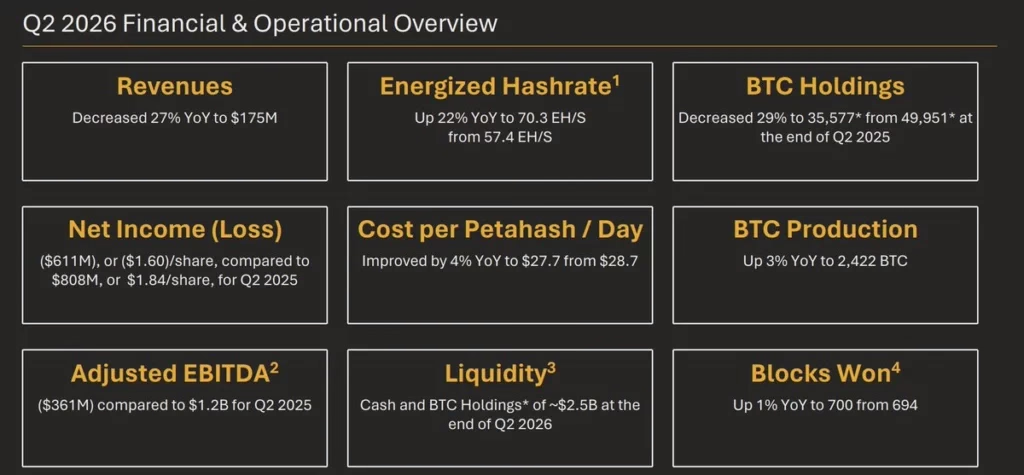
When Marathon Digital released its quarterly earnings on August 6, 2026, the numbers painted a sobering picture for investors. Revenue plummeted 27% year-over-year to $174.9 million, while the company's adjusted EBITDA turned deeply negative at -$360.9 million. Yet beneath these headline figures lies a story of deliberate strategic choices and market timing challenges.
The company's Bitcoin holdings declined to 35,577 BTC at quarter-end, representing a 29% decrease from the 49,951 BTC position held one year prior. However, this annual decline masks important nuances—the holdings actually increased slightly from 35,303 BTC at the end of Q1 2026, indicating that MARA's treasury management strategy shifted during the quarter.
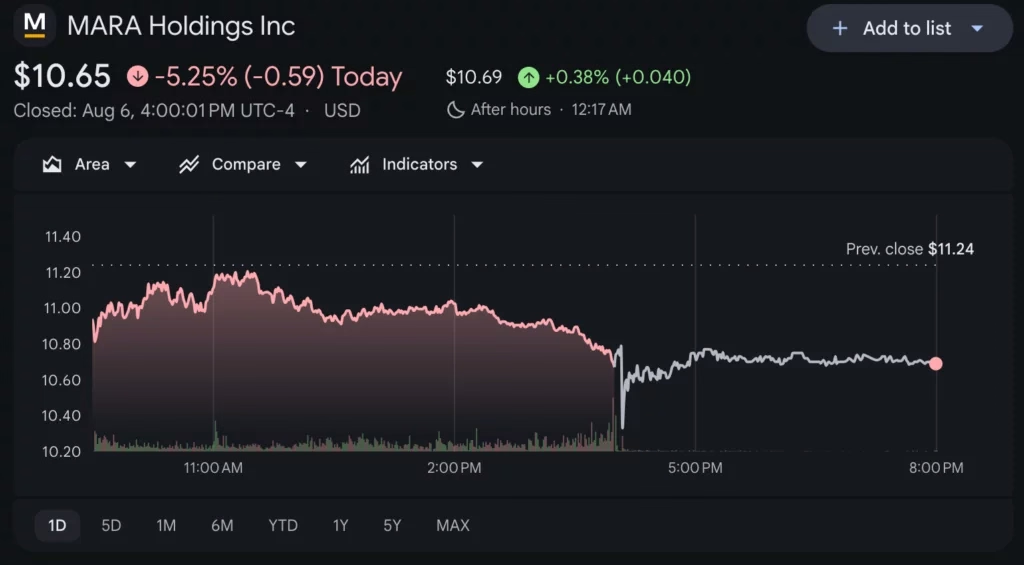
The Bitcoin Sales Strategy Behind the Numbers 💰
Marathon's significant year-over-year Bitcoin reduction primarily reflects aggressive sales earlier in 2026 rather than declining mining productivity. During the first quarter, the company divested 20,880 BTC, raising approximately $1.5 billion to fund operations, retire debt, and finance infrastructure initiatives. This aggressive liquidation reduced holdings from 53,822 BTC at year-end 2025 to 35,303 BTC by March 31, 2026.
In Q2, MARA continued its opportunistic selling approach, liquidating 2,213 BTC at an average price of $73,078. This more measured pace allowed Bitcoin production gains to partially offset sales, resulting in a slight sequential increase in holdings. The shift toward opportunistic Bitcoin sales represents a fundamental change from the company's earlier philosophy of retaining all mined coins—a policy adjustment that reflects the need to fund ambitious expansion plans.
By quarter-end, the company's combined cash and Bitcoin holdings totaled approximately $2.5 billion. Of the 35,577 BTC position, 26,307 BTC remained unrestricted, while 4,742 BTC were loaned and 4,528 BTC were pledged as collateral. Post-quarter, Marathon pledged an additional 18,750 BTC as initial collateral for two Bitcoin-backed credit facilities, expanding the portion of its treasury committed to financing arrangements.
Mining Operations Show Resilience 📈
Despite the financial headwinds, Marathon's core mining operations demonstrated meaningful improvement. The company's energized hashrate reached 70.3 exahashes per second (EH/s), marking a robust 22% increase from 57.4 EH/s in Q2 2025. Bitcoin production climbed 3% to 2,422 BTC, while the number of blocks won increased 1% to 700.
Operational efficiency metrics also improved, with cost per petahash per day declining 4% to $27.70 from $28.70 in the prior-year period. These gains demonstrate Marathon's ongoing investments in infrastructure and technology are yielding tangible results in terms of mining productivity and cost management.
However, these operational improvements could not overcome broader market pressures. The average Bitcoin price associated with mining revenue dropped sharply to approximately $71,325 in Q2 2026, compared with $98,975 in Q2 2025—a 28% decline that fundamentally impacted profitability despite higher production volumes. Additionally, purchased energy costs per Bitcoin at owned sites increased, indicating that higher hashrate alone could not eliminate margin compression.
Fair-Value Accounting and the Path to Losses 📉
The $611.3 million net loss reflects more than just operational challenges—it includes significant fair-value accounting adjustments. Marathon recorded approximately $343 million in fair-value losses tied to digital assets and related receivables. This contrasts sharply with Q2 2025, when the company benefited from substantial fair-value gains that supported positive earnings of $808.2 million.
This swing from gains to losses illustrates how Bitcoin mining companies' reported earnings can fluctuate dramatically based on cryptocurrency price movements and accounting treatments. The fair-value losses represent unrealized declines in the value of Marathon's Bitcoin holdings and related financial instruments, a reality check for investors expecting consistent profitability in volatile markets.
The Strategic Pivot: Bitcoin Mining Meets AI Infrastructure 🤖
Marathon's most significant strategic development involves leveraging its Bitcoin treasury to fund expansion into artificial intelligence and high-performance computing infrastructure. After the quarter ended, the company arranged two credit facilities providing $600 million in incremental borrowing capacity, pledging 18,750 BTC as collateral.
The centerpiece of this pivot is the proposed $1.5 billion acquisition of Long Ridge, which includes a 505-megawatt Ohio gas-powered facility with potential for over one gigawatt of computing capacity. Though pending regulatory approval, this transaction exemplifies Marathon's vision of transforming from a pure-play Bitcoin miner into a diversified digital infrastructure provider.
Complementing the Long Ridge development, Marathon is advancing an ambitious Texas expansion project. The 1,200-acre powered site is expected to provide up to 2 gigawatts of grid capacity over time. Combined with Long Ridge and existing assets, management projects the company could eventually operate approximately 4.8 gigawatts of power capacity—a transformational scale that would position Marathon as a major player in the computing infrastructure space.
What's Driving This Strategic Shift? 🌐
Marathon's pivot toward AI infrastructure reflects several converging trends:
- Mining Economics Pressure: Declining Bitcoin prices and rising energy costs compress traditional mining margins, necessitating diversification
- AI Boom Opportunity: Explosive demand for computing power to support artificial intelligence workloads creates new revenue opportunities
- Balance Sheet Strength: Marathon's substantial Bitcoin holdings provide unique collateral and financing opportunities unavailable to competitors
- Energy Assets: The company's access to power infrastructure and expertise positions it well to capitalize on AI infrastructure demand
- Long-term Value Creation: Management believes digital infrastructure and AI initiatives can generate steadier, more predictable revenue streams than mining alone
CEO Fred Thiel articulated this vision clearly: "Bitcoin mining provided the company's foundation, and digital infrastructure and other initiatives will expand the value we create from that foundation." However, the Q2 results demonstrate that this transition remains costly in the near term.
Key Takeaways and What Lies Ahead 🚀
Marathon Digital's Q2 2026 results reveal a company in transition—one managing near-term financial pressures while positioning for long-term infrastructure dominance. The 29% decline in Bitcoin holdings reflects deliberate capital deployment rather than operational failure, with proceeds funding ambitious expansion plans.
Investors should monitor several critical milestones:
- Financing Execution: Success in securing the $600 million credit facility and future financing arrangements
- Regulatory Approvals: Completion of Long Ridge acquisition and any required regulatory clearances
- Texas Development Progress: Timeline and execution of the 2-gigawatt Texas computing campus
- Bitcoin Treasury Management: Whether Marathon continues strategic Bitcoin sales or shifts toward accumulation
- AI Revenue Generation: Timeline for monetizing AI and computing infrastructure investments
Marathon remains one of the largest public Bitcoin miners and most significant corporate Bitcoin holders globally. Its next quarters will test whether the AI infrastructure pivot can deliver steadier revenue while preserving sufficient Bitcoin exposure to benefit from potential mining economics recovery. The company's ability to balance treasury deployment with long-term Bitcoin appreciation will ultimately determine whether this strategic transformation creates shareholder value or merely diversifies away from core competency.
The cryptocurrency and blockchain industry will be watching closely—Marathon's path forward could serve as a template for how traditional miners evolve in an increasingly AI-dominated computing landscape. 💡
You May Also Like

Bitcoin
Bitcoin as Hedge Against $40T U.S. Debt Crisis
August 24, 2026

Bitcoin
Tether's $120M Uruguay Bitcoin Mining Exit: What Went Wrong
August 23, 2026

Bitcoin
Bitcoin as Reserve Currency: Escaping the Dollar's Monetary Trap
August 22, 2026

Bitcoin
Bitcoin Treasury Returns to Profit Above $75,385
August 21, 2026