Category:
BitcoinNorth Korean Hackers Target Bitcoin Telegram Accounts

The cryptocurrency community faces an escalating threat as sophisticated threat actors execute a coordinated campaign against Bitcoin professionals and digital asset executives. 🚨 Social engineering has emerged as the weapon of choice, with attackers leveraging compromised Telegram accounts to orchestrate elaborate fake video meetings designed to deploy malware and steal sensitive wallet credentials.
The Evolution of Cryptocurrency Threats 🔐
The landscape of blockchain security has shifted dramatically over recent years. While early cryptocurrency attacks focused on exploiting protocol vulnerabilities and exchange infrastructure, modern threat actors have recognized that human trust remains the weakest link in the security chain. North Korean state-sponsored groups have become particularly adept at exploiting this reality, conducting highly targeted operations against the cryptocurrency industry with precision and sophistication.
The rise of remote work and virtual communication platforms has inadvertently created new attack surfaces. Hackers now weaponize the very tools that enable global collaboration, turning Telegram, Zoom, and Microsoft Teams into vehicles for credential theft and malware distribution.
Understanding the BlueNoroff Campaign 🎯
Security researchers have identified the coordinated campaign as originating from BlueNoroff, a North Korean state-sponsored threat actor also tracked as APT38. The U.S. Treasury has formally designated this group as controlled by the Reconnaissance General Bureau, North Korea's primary intelligence agency. Multiple security organizations, including Google Mandiant and JUMPSEC, have independently documented overlapping infrastructure and attack methodologies attributed to this sophisticated threat actor.
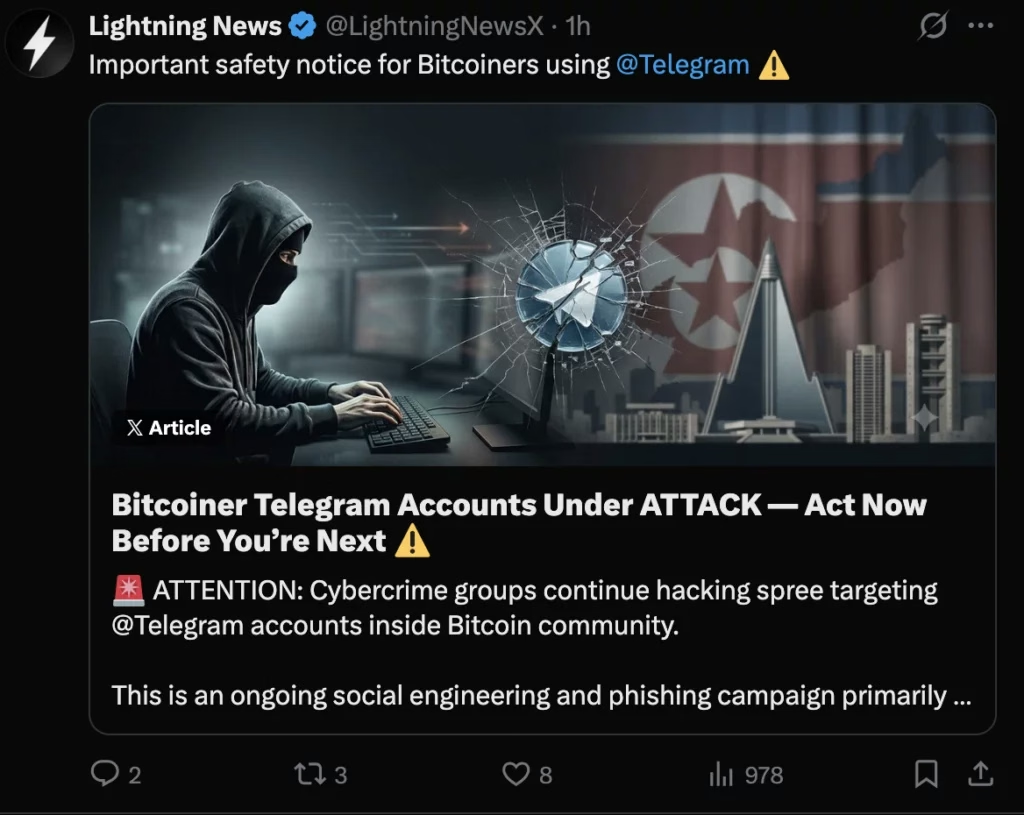
What makes BlueNoroff particularly dangerous is their operational sophistication. Unlike typical cybercriminals, state-sponsored actors operate with virtually unlimited resources, patient timelines, and deep knowledge of cryptocurrency infrastructure. They conduct extensive reconnaissance before launching attacks, often spending weeks building relationships and trust with targets.
How the Attack Chain Works 🔗
The attack methodology reveals a carefully orchestrated social engineering operation rather than a direct technical exploit. Here's how the campaign typically unfolds:
Initial Compromise: Attackers first compromise legitimate Telegram accounts belonging to real cryptocurrency industry professionals. These aren't random accounts—they're carefully selected based on their connections within the crypto community.
Trust Exploitation: Using the compromised accounts, threat actors send meeting invitations to targets. Because messages originate from genuine contacts and often reference existing professional relationships, traditional security awareness becomes ineffective. Your brain naturally trusts a message from someone you know.
Fake Meeting Setup: Victims are directed to fraudulent Zoom or Microsoft Teams meetings hosted on spoofed domains that closely mimic legitimate services. Some victims have reported seeing AI-generated video feeds of known crypto executives during these staged calls, adding another layer of authenticity.
Malware Delivery: During the fake meeting, operators display a supposed audio or video problem, prompting the victim to copy troubleshooting commands. This is where the attack becomes technical—the copied text contains malicious ClickFix commands that execute with user privileges.
The Technical Arsenal 💻
JUMPSEC researchers obtained source code from an active BlueNoroff phishing kit and revealed the technical sophistication embedded in their operations. The toolkit demonstrates platform-specific optimization:
Windows Systems: PowerShell and VBScript components disable security defenses, conduct system reconnaissance, and establish persistence mechanisms for follow-on access.
macOS Systems: Shell scripts and Mach-O binary payloads target Apple's ecosystem, stealing credentials from browsers, the Keychain, and Telegram user data.
Wallet Profiling: The phishing kit includes reconnaissance capabilities that scan for browser-based wallet providers before delivering malware. This selective targeting means operators identify high-value victims before payload execution, maximizing the return on their social engineering investment.
Once malware executes successfully, threat actors gain access to browser session data, cryptocurrency wallet extensions, seed phrases stored in memory, and Telegram authentication tokens. This creates a complete compromise of a victim's digital identity.
Scale and Scope of Operations 📊
The breadth of this campaign is staggering. Security Alliance tracked 164 blocked domains attributed to UNC1069 (BlueNoroff's Mandiant designation) between February 6 and April 7, 2026 alone. This represents an industrialized approach to cryptocurrency targeting, not isolated incidents.
The campaign spans multiple communication platforms:
- Telegram: Primary vector for initial contact and meeting invitations
- LinkedIn: Professional networking platform for reconnaissance and relationship building
- Slack: Enterprise communication channels for follow-up engagement
Researchers confirmed that high-confidence infrastructure remained active through late July 2026, indicating ongoing operations. This isn't a concluded campaign—it's an active, evolving threat that continues to adapt and expand.
Real-World Impact on the Community 👥
Multiple documented cases confirm the campaign's real-world impact. Cryptocurrency executives, including notable Bitcoin community members, have had their Telegram accounts compromised and weaponized against their professional networks. These aren't hypothetical scenarios—they're active compromises affecting people across the industry.
One particularly notable case involved a crypto executive whose account was used to launch attacks against his entire contact list. The trust factor made the campaign devastatingly effective, with numerous targets falling victim to the sophisticated social engineering.
Critical Misconceptions About the Threat ⚠️
As with many security incidents, myths have emerged around this campaign. Some claims suggest that merely opening a meeting link automatically drains cryptocurrency wallets. This oversimplification is dangerous because it misrepresents the actual threat.
The documented attack chains require additional user actions—copying and executing commands, installing suspicious updates, or running scripts. However, this shouldn't provide false comfort. Once malware executes, the consequences are severe and often irreversible.
The initial Telegram account compromise mechanism also remains partially unclear. While researchers confirm that accounts are being compromised, the exact methods vary. Claims about expired phone numbers being the primary vector remain unverified, suggesting the attack surface is broader and more diverse than initially understood.
Defensive Measures and Best Practices 🛡️
The FBI has issued specific guidance for cryptocurrency professionals and organizations:
Identity Verification: Establish independent verification channels separate from the initial communication. If someone requests a meeting via Telegram, verify through a phone call or in-person confirmation using a previously known contact method.
Credential Management: Never store wallet seed phrases, private keys, or sensitive credentials on internet-connected devices. Air-gapped systems, hardware wallets, and offline storage remain essential security practices.
Session Management: Enable two-factor authentication on all cryptocurrency accounts, but understand its limitations. Compromised devices can expose session data, so revoke suspicious sessions from a clean, separate device.
Red Flag Recognition: Treat the following as high-risk signals requiring immediate skepticism:
- Unexpected meeting requests from known contacts
- Sudden domain changes in meeting links
- Requests to copy and paste commands for troubleshooting
- Requests to install unfamiliar applications or software updates
- Suggestions to move conversations to different platforms
Multi-Layer Security: Implement endpoint detection and response (EDR) solutions, keep operating systems and applications patched, and maintain regular security awareness training specific to social engineering tactics.
The Broader Geopolitical Context 🌍
North Korean cyber operations against cryptocurrency represent a critical national security concern. Sanctions have severely restricted North Korea's access to traditional financial systems, making cryptocurrency an attractive alternative for evading international financial controls. By targeting cryptocurrency professionals and infrastructure, North Korean actors simultaneously gather intelligence and attempt to generate revenue through theft.
This campaign exemplifies how state-sponsored actors adapt traditional espionage techniques to modern digital environments. The sophistication rivals that of attacks against government agencies and critical infrastructure, yet targets the private cryptocurrency sector.
What the Future Holds 🔮
Expect this campaign to evolve and expand. Threat actors will likely:
- Refine Social Engineering: Use more sophisticated AI-generated deepfakes and voice synthesis
- Expand Target Lists: Move beyond executive-level targeting to include mid-level employees and contractors
- Adapt Infrastructure: Continuously rotate domains and hosting providers to evade detection
- Develop New Vectors: Explore emerging communication platforms and collaboration tools
The cryptocurrency industry must treat this as an existential security challenge requiring industry-wide coordination, information sharing, and elevated security standards.
Key Takeaways 📌
The North Korean campaign targeting Bitcoin and cryptocurrency professionals represents a sophisticated, ongoing threat that exploits human trust rather than technical vulnerabilities. The scale of operations, spanning hundreds of domains and multiple communication platforms, demonstrates institutional commitment to cryptocurrency targeting.
Individual vigilance matters, but organizational security protocols must evolve. Cryptocurrency professionals should implement strict identity verification procedures, maintain air-gapped credential storage, and recognize social engineering red flags. Organizations should conduct regular security awareness training, implement advanced threat detection, and establish incident response procedures specific to social engineering attacks.
The battle for cryptocurrency security is no longer primarily technical—it's psychological. Understanding how trust can be weaponized and maintaining skepticism toward unexpected communications may be the most valuable security practice in your arsenal. 🔑
You May Also Like

Bitcoin
Bitcoin as Hedge Against $40T U.S. Debt Crisis
August 24, 2026

Bitcoin
Tether's $120M Uruguay Bitcoin Mining Exit: What Went Wrong
August 23, 2026

Bitcoin
Bitcoin as Reserve Currency: Escaping the Dollar's Monetary Trap
August 22, 2026

Bitcoin
Bitcoin Treasury Returns to Profit Above $75,385
August 21, 2026