Category:
AltcoinsPi Network Double Bottom: Can It Break Out Before Protocol 26?
Pi Network's Technical Setup Points to Major Breakout Potential 🚀
Pi Network (PI) has captured the attention of cryptocurrency traders and investors as the token demonstrates compelling technical signals suggesting a potential breakout. Trading near $0.093 in early August, PI has climbed approximately 12% over the past week, significantly outperforming broader market conditions. This recovery marks a meaningful rebound from July's lows, setting the stage for what technical analysts believe could be a decisive moment for the altcoin.
The timing of this rally coincides with several positive catalysts, including the imminent Protocol 26 upgrade deadline and expanding ecosystem partnerships. However, the question remains: can Pi Network sustain this momentum and break through critical resistance levels?
Understanding the Double Bottom Pattern 📊
One of the most compelling technical formations currently visible on Pi Network's charts is a double-bottom pattern on the 4-hour timeframe. This pattern emerged after buyers successfully defended the $0.072–$0.075 support region on two separate occasions—first around July 14 and again near July 28.
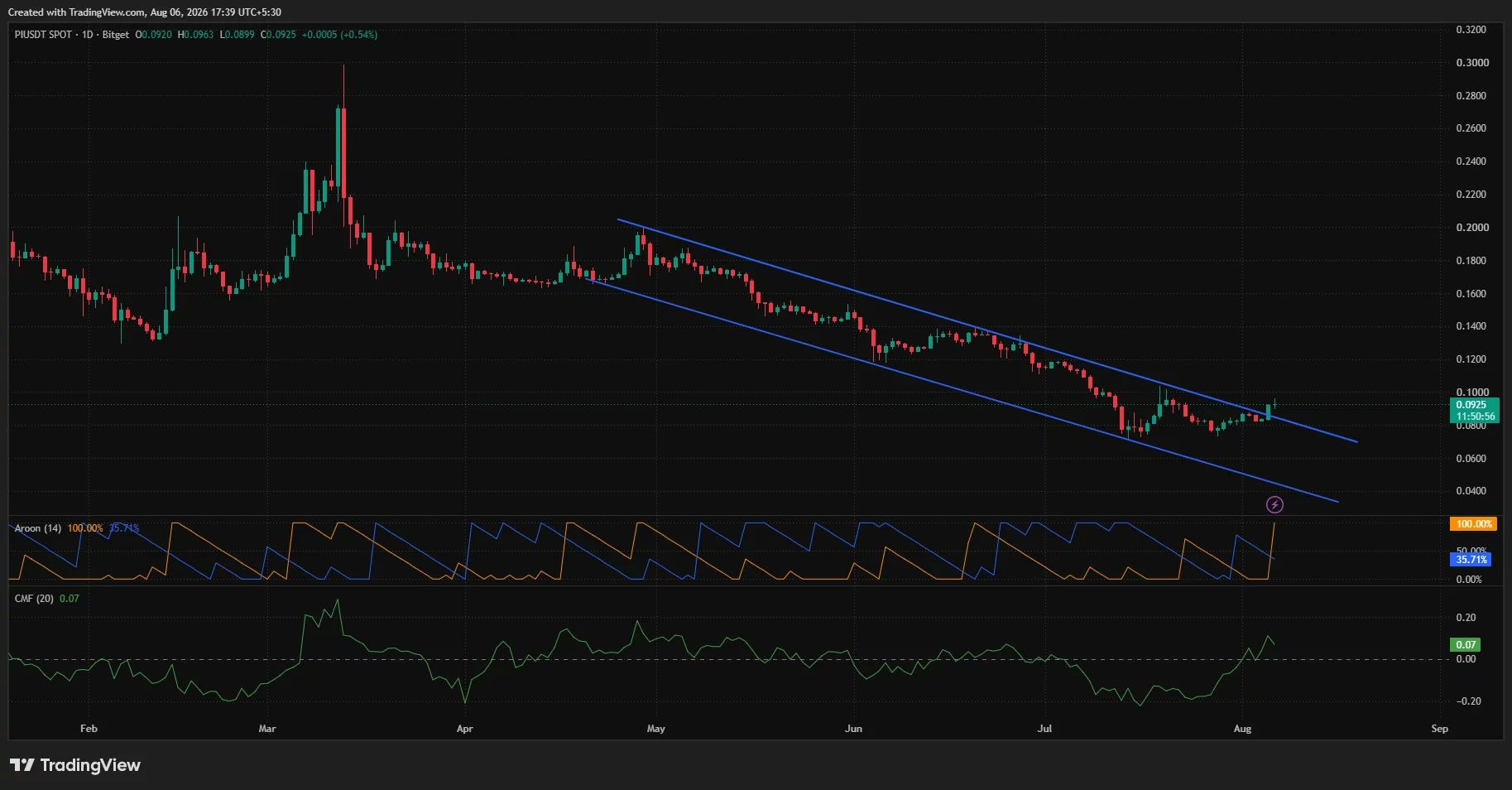
Double-bottom formations represent classic reversal patterns that signal potential shifts from downtrends to uptrends. The pattern's significance lies in its neckline resistance level, currently positioned around $0.102. For the double bottom to become officially confirmed, PI must close decisively above this neckline with accompanying volume expansion.
The measured target for this pattern sits near $0.132, representing approximately 42% upside from current levels. This projection derives from adding the pattern's approximate $0.030 depth to the neckline level, creating a mathematically-derived price objective that corresponds with former consolidation zones.
Immediate Resistance Zones and Price Targets 🎯
Before reaching the critical $0.102 neckline, Pi Network must overcome several intermediate resistance barriers. The immediate hurdle sits between $0.094–$0.096, where intraday sellers have positioned themselves. Breaking through this zone would establish momentum toward $0.098 and the psychologically important $0.10 level.
Trading volume has surged dramatically, with 24-hour trading activity reaching approximately $14.3 million—an 88% increase from the previous day. This volume expansion provides crucial confirmation that institutional and retail interest is genuinely increasing rather than representing mere technical noise.
Once PI clears $0.10, the path toward $0.115 and ultimately the $0.132 target becomes increasingly viable. However, traders must recognize that rejection anywhere between $0.095 and $0.102 could trigger a pullback toward $0.090 or even the 4-hour Supertrend support level near $0.086.
Daily Chart Breakout Signals Bullish Shift ✨
The daily timeframe presents an equally compelling narrative, with Pi Network price recently breaking above a descending channel that had dominated price action since late April, when the token traded significantly higher near $0.20. This channel breakout represents a meaningful shift in technical structure, suggesting that selling pressure may be exhausting.
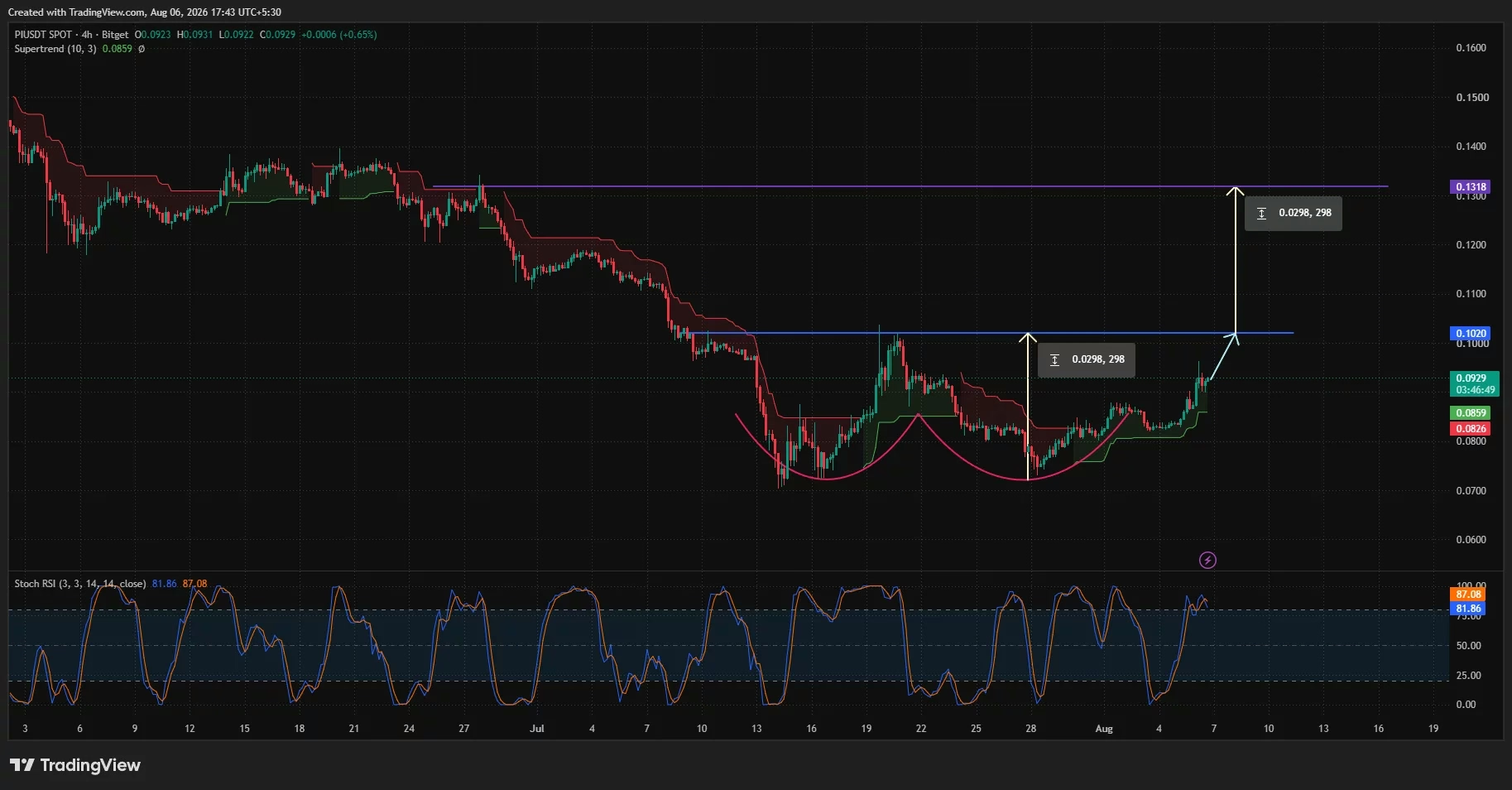
A daily close above the former channel resistance around $0.088–$0.090 would substantially strengthen the breakout thesis and suggest that the recovery has genuine staying power. Failure to hold these levels, conversely, could transform the current rally into another temporary recovery within the broader downtrend that has defined PI's trajectory since February 2025.
It's important to contextualize this recovery: Pi Network remains more than 96% below its February 2025 record high. While the recent weekly rally demonstrates encouraging momentum, it has not yet reversed the longer-term bearish structure that has plagued the token.
Momentum Indicators Suggest Bullish Pressure 📈
Technical indicators are providing mixed but generally supportive signals for continued upside momentum. The daily Aroon Up reading has reached 100%, compared with an Aroon Down reading of just 35.71%. This significant divergence indicates that recent highs are forming much more frequently than new lows—a hallmark of shifting momentum toward buyers.
The Chaikin Money Flow (CMF) indicator has also turned positive, registering at 0.07. A positive CMF reading indicates that buying pressure is beginning to exceed selling pressure within the market. However, the magnitude remains relatively modest, suggesting that accumulation is still in its early stages rather than indicating overwhelming institutional demand.
On the 4-hour timeframe, the Supertrend indicator has flipped bullish, establishing dynamic support near $0.086. This level now serves as an important floor for the near-term structure—a breakdown below this point would suggest that the bullish setup has lost validity.
Caution: Overbought Conditions Warrant Vigilance ⚠️
While momentum indicators support the bullish case, the 4-hour Stochastic RSI has climbed into overbought territory, with its two lines standing near 82 and 87 respectively. This reading raises legitimate concerns about a potential short-term pullback or consolidation period before another attempt at the neckline.
A retreat toward $0.090 would not invalidate the bullish setup if buyers successfully defend that level. Below $0.090, the next support zone sits at $0.086, followed by the $0.082–$0.083 region. A decisive breakdown under $0.075 would invalidate the entire double-bottom structure and suggest a return to the downtrend.
Protocol 26 Upgrade Creates Both Opportunity and Risk 🔧
The timing of Pi Network's technical breakout attempt coincides with the Protocol 26 upgrade rollout across the network's Mainnet infrastructure. All Mainnet node operators face an August 11 deadline to upgrade to version 26, creating a concrete catalyst that could drive sentiment and trading activity.
Protocol upgrades often serve as pivotal moments for blockchain projects, as they represent tangible progress toward network improvements and enhanced functionality. However, such upgrades also carry execution risk—if node operators fail to update in time, potential network disruptions could undermine confidence.
The project recently completed its second Launchpad test involving the SLICE test token, with over 242,000 participants committing 15.92 million Test-Pi to acquire 10 million SLICE tokens. While these represented testnet tokens rather than spot-market purchases of PI, the trial successfully validated Launchpad allocation mechanics and automated token pricing systems.
RoboPay Partnership Expands Ecosystem Utility 🤖
Beyond the Protocol 26 upgrade, Pi Network announced integration with RoboPay as an official payment partner through the Fabric Foundation. This partnership would theoretically allow PI to function as a payment method for robot services across the Fabric network, potentially creating new use cases and transaction demand.
However, it's crucial to distinguish between announced partnerships and actual transaction volume. The rollout timeline remains unclear, and the resulting transaction demand is entirely unproven. Investors should view such announcements as positive catalysts but not as guarantees of immediate price appreciation.
Market Liquidity and Geographic Constraints 💱
For traders, particularly those in the United States, Pi Network's liquidity profile remains narrower than established cryptocurrencies. CoinGecko lists OKX, Gate.io, and Bitget among the primary trading venues, though accessibility varies significantly by jurisdiction. This limited liquidity could amplify both gains and losses during breakout scenarios, as smaller volumes can move prices more dramatically.
Market capitalization has climbed above $1 billion, reflecting growing investor interest. However, the concentration of trading volume on fewer exchanges means that the path to true price discovery remains constrained compared to major cryptocurrencies.
What's Next: The Path Forward 🛣️
Pi Network's immediate outlook hinges on whether buyers can transform the daily channel breakout into sustained momentum. The critical decision point sits at the $0.102 neckline—a confirmed close above this level with expanding volume would officially validate the double-bottom pattern and activate the measured target near $0.132.
Short-term traders should monitor the $0.094–$0.096 resistance zone closely. A break above this area would suggest that momentum remains intact and that the $0.10 psychological level is within reach. Conversely, rejection in this zone could trigger a pullback toward $0.090 or the Supertrend support near $0.086.
Supply dynamics and future token unlocks represent additional risks that could undermine spot demand if market sentiment deteriorates. Investors should remain cognizant of the token's long-term bearish structure despite recent improvements, recognizing that this recovery, while encouraging, has not yet fundamentally reversed the downtrend from February 2025 highs.
Key Takeaways for Investors 🎬
- Technical Setup: A double-bottom pattern on the 4-hour chart suggests potential breakout to $0.132, representing 42% upside
- Resistance Levels: Immediate resistance sits at $0.094–$0.096, with the critical neckline at $0.102
- Positive Catalysts: Protocol 26 upgrade deadline and RoboPay partnership support near-term sentiment
- Indicator Caution: Overbought Stochastic RSI suggests possible short-term consolidation or pullback
- Market Context: PI remains 96% below February 2025 highs despite recent weekly gains
Pi Network's technical setup presents an intriguing breakout scenario, but success depends on sustained buying pressure and successful navigation through multiple resistance zones. The Protocol 26 deadline and partnership announcements provide genuine catalysts, yet execution remains paramount. Traders should approach this setup with appropriate risk management while remaining alert to the broader bearish context that has defined PI's performance over the past year.
You May Also Like

Altcoins
NCT Price Surge 200% on Upbit KRW Listing
August 26, 2026

Altcoins
WBT Reaches New All-Time High as Crypto Infrastructure Turns Institutional
August 26, 2026
Altcoins
Pi Network's August 24 Pricing Shakeup: End of Subsidized App Building
August 25, 2026

Altcoins
XRP Undervalued? Seven Spot ETFs & $1.4B Flows Tell
August 25, 2026