Category:
AltcoinsPump.fun Staff Cuts Before Token Vesting: What Happened
The cryptocurrency industry has witnessed numerous controversies surrounding token distribution and employee compensation, but few cases have highlighted the tension between company interests and worker rights quite like the recent allegations against Pump.fun. 🚨 Reports indicate that the meme coin launchpad platform dismissed employees weeks before their PUMP token allocations were scheduled to vest, raising serious questions about corporate governance in the crypto space.
The Timeline of Pump.fun Layoffs and Token Vesting 📅
Pump.fun, the platform behind the viral meme coin creation ecosystem, conducted significant workforce reductions in late March and early April following a period of rapid expansion. According to investigative reports, the timing of these layoffs was particularly noteworthy—they occurred just before the first major vesting milestone for employee token grants.
Employees had signed token grant agreements in June 2025, with terms stipulating that 25% of their allocations would vest after one year, with additional tranches releasing over time. The convergence of these two events—the layoffs and the impending vesting date—sparked speculation about whether the timing was coincidental or strategic.
Inside the Termination Meetings 🎤
Investigative documentation revealed that Pump.fun's head of talent, Lloyd McCarthy, called affected employees into a group meeting in late March. During this recorded session, co-founder Noah Tweedale addressed the workforce, explaining that the company had "grew too quickly," which limited its ability to operate with the agility and speed the organization desired.
This explanation, while common in startup environments, took on additional significance given the proximity to the vesting schedule. Affected workers received severance packages proportional to their tenure, but their unvested PUMP token allocations were reportedly canceled entirely—a move that would prove financially devastating as the token's value subsequently increased.
The Financial Impact: Seven-Figure Losses 💰
At least one former employee allegedly forfeited PUMP token allocations now valued at seven figures. This represents a significant financial loss, particularly for employees who had factored these token grants into their long-term compensation planning. The incident underscores the risks that crypto employees face when their compensation packages heavily depend on token appreciation and vesting schedules.
For context, understanding how token vesting typically works in the cryptocurrency industry is crucial. Most legitimate crypto projects structure employee grants with multi-year vesting periods (commonly 4 years with a 1-year cliff) to align worker incentives with long-term company success. However, this structure also creates moments of vulnerability where termination decisions can significantly impact employee wealth.
The Second Wave of Allegations 🌊
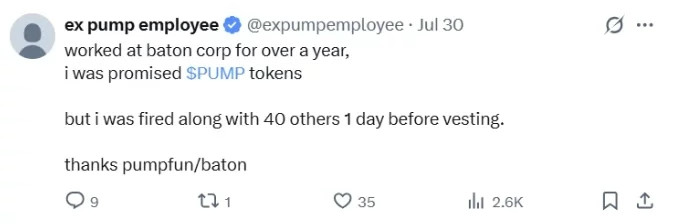
The controversy deepened when new allegations emerged regarding a second round of layoffs. According to claims from an X account created by someone identifying as an "ex pump employee," Baton Corp. (the company operating Pump.fun) dismissed approximately 40 workers in mid-July—allegedly just one day before another major vesting event.
The account owner claimed to have worked at the company for over one year and suggested that the timing was deliberate rather than coincidental. This pattern, if accurate, would paint a concerning picture of how the company managed its token distribution strategy relative to employment decisions.
However, it's important to note that independent verification of the 40-worker claim remains incomplete. While the initial March-April layoffs were documented through emails, termination records, and recorded meetings, the July allegations rest primarily on the former employee's testimony without corroborating employment documentation that has been publicly reviewed.
Allegations About the PUMP Airdrop Strategy 🎁
The same X account made additional claims suggesting that Pump.fun never intended to conduct a public PUMP airdrop. According to the allegation, company leadership opposed "giving free money" to platform users, which contradicts typical community-building strategies in the crypto space. This claim, if substantiated, would indicate a significant departure from industry norms where platforms often distribute tokens to early users as a mechanism for decentralization and community engagement.
Such a strategy would be particularly noteworthy given that Pump.fun has built its reputation on democratizing meme coin creation. The platform's business model centers on allowing users to easily launch tokens with minimal barriers to entry, yet apparently restricting token distribution to the broader community raises questions about the platform's actual commitment to decentralization principles.
PUMP Token Distribution and Market Implications 📊
The allegations surfaced against the backdrop of Pump.fun's first significant team and investor token distribution following a one-year lockup period. On July 15, approximately 57.279 billion PUMP tokens—valued at roughly $86.49 million at that time—transferred to 121 different wallets.
This distribution marked the beginning of a three-year vesting schedule for team and investor allocations, making previously restricted tokens available to recipients. While such transfers don't prove that tokens were immediately sold, they do increase the circulating supply available for potential market transactions. This is significant because continued insider distributions could theoretically create selling pressure if recipients move tokens to exchanges.
For U.S. token holders, these employment allegations don't directly affect their ownership rights to PUMP tokens already held. However, the broader market concern remains valid: if team members and investors with large allocations begin liquidating positions, the token could face sustained downward price pressure.
Current PUMP Token Performance and Market Context 📉
At the time of reporting, PUMP traded near $0.002, representing approximately a 77% decline from its September 2025 all-time high. The token did show modest daily gains of nearly 5% in certain trading periods, but the overall trajectory reflects significant depreciation from peak valuations.
This price performance must be contextualized within the broader dynamics of the Pump.fun ecosystem. A comprehensive analysis by CoinGecko examined 18.67 million tokens created through the platform between January 2024 and June 2026. The research revealed a sobering statistic: 12.8 million tokens (68.67%) recorded their final bonding-curve trade on their launch day.
Tokens that never traded were excluded from the analysis, but the data still paints a picture of an ecosystem where the vast majority of projects fail to maintain trading activity beyond their initial launch. This high failure rate correlates directly with Pump.fun's low barriers to token creation—the platform's defining feature that allows users to launch tokens with minimal friction also enables rapid abandonment when early market demand fails to materialize.
Broader Implications for Crypto Employment and Governance 🏛️
These allegations raise important questions about how cryptocurrency companies structure employment agreements and token compensation. The incidents highlight potential vulnerabilities in standard token grant agreements where termination clauses might allow companies to cancel substantial allocations shortly before vesting events.
Industry observers have noted that while traditional equity compensation in tech includes legal protections and regulatory oversight, crypto token grants operate in a more ambiguous space. The lack of standardized protections means that employment termination clauses can vary dramatically between organizations, and employees may not fully understand the implications until they're terminated.
Key concerns include:
- Timing vulnerability: Layoffs coordinated with vesting schedules could represent a strategy to avoid distributing promised compensation
- Regulatory ambiguity: Unlike traditional stock options, token grants exist in legal gray areas with limited employee protections
- Transparency gaps: Many crypto companies don't publicly disclose their token distribution policies or employment termination procedures
- Precedent setting: How Pump.fun handles these allegations could influence how other platforms structure employee compensation
What This Means for the Crypto Industry 🔮
The Pump.fun situation serves as a cautionary tale for crypto employees and a test case for how the industry handles governance issues. As the cryptocurrency space matures, questions about employment practices and token distribution will likely attract increased scrutiny from regulators, investors, and industry participants.
The incident also highlights the tension between rapid growth and sustainable operations. While Pump.fun's explosive expansion demonstrated market demand for accessible token creation tools, the subsequent workforce reductions suggest the company may have overextended during its growth phase. This pattern—rapid scaling followed by sharp corrections—has become increasingly common in the crypto sector.
For potential employees considering positions at crypto companies, these events underscore the importance of carefully reviewing token grant agreements, understanding vesting schedules, and seeking legal counsel before accepting positions where significant compensation depends on token appreciation.
Looking Forward 🚀
Pump.fun has not publicly addressed the allegations regarding the timing of layoffs relative to token vesting events. The platform continues to operate as a meme coin launchpad, generating substantial transaction volumes despite the controversies surrounding its token and employment practices.
As the crypto industry evolves, expect increased pressure on platforms to implement transparent employment policies, standardized token grant agreements, and clear governance structures. The Pump.fun case may ultimately contribute to industry-wide standards that better protect employee interests while maintaining the flexibility that crypto companies require to operate effectively.
The broader cryptocurrency community remains divided on these issues. Some argue that startup volatility naturally leads to employment disruptions, while others contend that deliberately timing layoffs before vesting events crosses ethical and potentially legal lines. Regardless of one's perspective, the Pump.fun situation has sparked important conversations about worker protections in the rapidly evolving crypto economy.
You May Also Like
Altcoins
NCT Price Surge 200% on Upbit KRW Listing
August 26, 2026
Altcoins
WBT Reaches New All-Time High as Crypto Infrastructure Turns Institutional
August 26, 2026
Altcoins
Pi Network's August 24 Pricing Shakeup: End of Subsidized App Building
August 25, 2026
Altcoins
XRP Undervalued? Seven Spot ETFs & $1.4B Flows Tell
August 25, 2026