Category:
AltcoinsRavencoin Network Crisis: 19% Price Collapse
When Trust in Blockchain Fractures 🔐
The cryptocurrency market experienced a significant jolt when Ravencoin, a blockchain platform focused on asset tokenization and transfer, disclosed a critical vulnerability that had been exploited for days without detection. On August 11, the Ravencoin team announced that a severe consensus flaw had compromised network integrity, triggering a cascading series of events that would ultimately reshape the project's trajectory and test the resilience of its community.
This incident serves as a sobering reminder that even established blockchain projects remain vulnerable to sophisticated attacks. The discovery initiated emergency responses across the ecosystem, from mining pools to cryptocurrency exchanges, each racing to implement protective measures before the situation spiraled further out of control.
The Vulnerability: A Deep Technical Breakdown 🔍
The core issue centered on the KAWPOW mining algorithm's block header validation process. Specifically, the flaw existed in how the protocol handled the nHeight field within the KAWPOW block header—a critical parameter that should correspond to a block's actual position in the blockchain.
Attackers discovered they could manipulate this nHeight field to bypass the normal, computationally intensive proof-of-work verification requirements. Rather than performing genuine ProgPoW calculations, malicious actors could trick vulnerable nodes into accepting blocks that contained no legitimate mining work whatsoever. The implications were staggering: fraudulent blocks could be created at a fraction of the cost of legitimate blocks, potentially flooding the network with worthless transactions.
The Exploitation Timeline 📅
The attack began on August 7 and continued undetected until 2Miners released an emergency patch on August 10. During this three-day window, malicious blocks infiltrated the network with increasing frequency. Analysis by 2Miners revealed a troubling pattern:
- Exploitation period: August 7 through August 10
- Affected block range: Heights 4,489,527 to 4,491,615
- Compromised blocks identified: 96 out of 2,089 examined blocks
- Pre-August 7 status: Zero affected blocks detected in earlier samples
This data confirmed that August 7 marked the precise moment when the vulnerability was first weaponized, establishing a clear timeline for network recovery efforts.
The Consensus Split: Network Fragmentation 🌐
One of the most alarming aspects of this incident was the emergence of competing blockchain histories. The network essentially fractured into two distinct chains: one containing the fraudulent blocks and another representing the legitimate transaction history.
Two Miners and RavenMiner, the dominant mining pools controlling the majority of the network's hash rate, made a critical decision. Rather than continuing to mine on the compromised chain, they pivoted to mining from block 4,487,775—the last confirmed unaffected block. This strategic move created what's known as a "recovery chain," a parallel version of the blockchain that excluded all exploited blocks and transactions.
Ravencoin's official warning highlighted the potential consequences: if the recovery chain achieved dominance, any transactions confirmed after block 4,487,775 could vanish from the accepted history. Some transactions might return to the mempool for reprocessing, but the project explicitly cautioned that "this is not guaranteed." This uncertainty created significant anxiety within the community, particularly for users and exchanges holding substantial RVN balances.
Market Reaction: The Price Plunge 📉
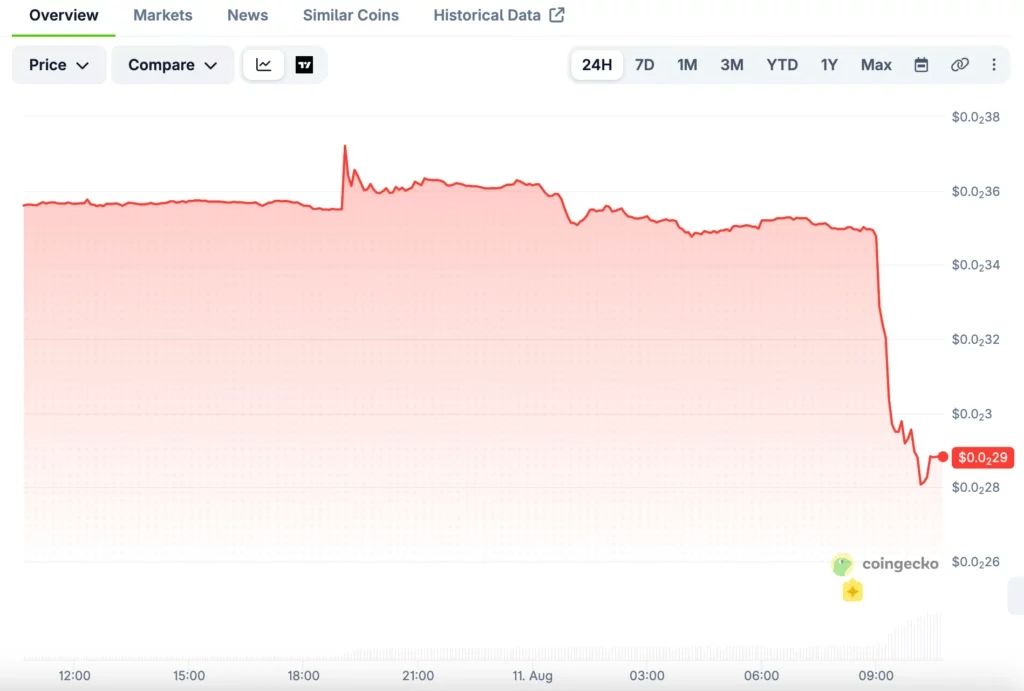
The market responded swiftly and severely to news of the consensus vulnerability. RVN fell 19.1% over a 24-hour period, trading near $0.00288 as traders reassessed their exposure to a network experiencing fundamental security issues.
The price collapse reflected broader concerns:
- Market capitalization erosion: RVN's market cap declined to approximately $47.3 million
- Trading volume surge: Despite the price drop, 24-hour trading volume approached $11 million as panic selling intensified
- Confidence crisis: Investors questioned whether the development team could effectively manage such critical vulnerabilities
This represented a significant blow to a project that had been working to establish itself as a serious contender in the asset tokenization space.
Exchange Response: The Great Halt 🛑
Exchanges, serving as critical infrastructure for the cryptocurrency ecosystem, took immediate protective action. Upbit, a major Asian exchange, suspended all Ravencoin deposits and withdrawals on August 10, citing network issues. The exchange maintained trading functionality while blocking transfers—a prudent approach that prevented users from being locked out while protecting the exchange from processing potentially irreversible transactions.
Bitget followed suit, initiating a suspension of RVN deposits and withdrawals beginning August 10, framing it as "wallet maintenance." These coordinated actions across multiple platforms effectively froze Ravencoin liquidity, preventing the movement of potentially compromised assets.
Ravencoin's guidance to exchanges was unambiguous: suspend all transfers and treat any confirmations after block 4,487,775 as potentially reversible. This represented an unprecedented level of caution, reflecting the severity of the situation.
The Emergency Patch: Racing Against Time ⚡
2Miners released version 4.6.1.1-hf1 as an emergency countermeasure. The patch implemented several critical safeguards:
Key features of the emergency release:
- Header validation enhancement: Blocks whose declared header height differed from their actual chain position were automatically rejected starting at height 4,487,776
- Checkpoint establishment: A new checkpoint was added at block 4,487,775, anchoring the legitimate chain history
- Chain state rebuilding: Damaged index data could be repaired, allowing nodes to resume normal operation
The upgrade process, however, came with significant operational challenges. The first restart after applying the patch could consume several hours as the software replayed approximately 4.49 million blocks and 28 million transactions while reconstructing chain state. For operators managing multiple nodes, staggered upgrades became necessary to maintain network stability.
Historical Context: A Pattern of Vulnerability 📚
This wasn't Ravencoin's first encounter with critical vulnerabilities. In 2020, the network suffered a different but equally serious exploit that resulted in the unauthorized creation of approximately 315 million RVN tokens. That incident involved excess token issuance—fundamentally different from the current proof-of-work validation flaw but equally damaging to network credibility.
The recurrence of major vulnerabilities raised uncomfortable questions about the project's development practices and security auditing procedures. While different in nature, these incidents suggested systemic issues in how the protocol was being reviewed and tested before deployment.
Lessons from Similar Incidents 🎓
Ravencoin wasn't alone in experiencing network-level crises. The cryptocurrency industry had witnessed similar events:
- Monero's 18-block reorganization in 2025 invalidated previously confirmed transactions, demonstrating that even mature networks could experience competing chain histories
- These episodes illustrated why exchanges adopted cautious policies regarding transaction finality when proof-of-work networks developed competing histories
Such incidents reinforced the importance of robust consensus mechanisms and thorough security testing before mainnet deployment.
The Path Forward: Recovery and Rebuilding 🔧
Ravencoin faced several critical milestones to restore network health:
Immediate priorities:
- Achieving consensus on a stable, dominant chain
- Widespread adoption of the patched software across nodes, exchanges, miners, and blockchain explorers
- Development of a combined upstream Ravencoin release addressing both the KAWPOW validation flaw and a separate asset transfer quantity overflow bug
Maintainer Hans Schmidt recommended using the 2Miners code for the mining vulnerability until an official combined patch became available, acknowledging that the core Ravencoin development team was still working on comprehensive fixes.
What This Means for the Broader Ecosystem 🌍
The Ravencoin incident carried implications extending beyond the project itself. It highlighted persistent challenges in blockchain security, particularly regarding:
- Consensus mechanism robustness: Even well-established algorithms like ProgPoW contained exploitable weaknesses
- Vulnerability disclosure: The delay between exploitation and public disclosure created extended windows of exposure
- Network coordination: Recovery required unprecedented cooperation between mining pools, exchanges, and the development team
For investors and users, the incident reinforced the principle that cryptocurrency holdings remain subject to technical risks that traditional financial systems don't typically face.
Conclusion: Resilience Through Crisis 💪
Ravencoin's network vulnerability and subsequent recovery represented a critical test of the project's resilience and community commitment. The 19% price decline reflected legitimate concerns about network security, but the rapid response from mining pools and the development team demonstrated that organized, coordinated action could mitigate catastrophic outcomes.
The path to full recovery requires sustained effort: widespread software upgrades, exchange confidence restoration, and—most importantly—addressing the underlying development and security practices that allowed such vulnerabilities to reach mainnet. Whether Ravencoin emerges stronger from this crucible or whether the incident marks a turning point in user confidence remains to be seen.
For the broader cryptocurrency community, Ravencoin's struggles serve as a reminder that security is not a destination but an ongoing process requiring constant vigilance, thorough testing, and transparent communication when vulnerabilities inevitably surface.
You May Also Like

Altcoins
NCT Price Surge 200% on Upbit KRW Listing
August 26, 2026

Altcoins
WBT Reaches New All-Time High as Crypto Infrastructure Turns Institutional
August 26, 2026
Altcoins
Pi Network's August 24 Pricing Shakeup: End of Subsidized App Building
August 25, 2026
Altcoins
XRP Undervalued? Seven Spot ETFs & $1.4B Flows Tell
August 25, 2026