Category:
AltcoinsXRP Ledger 3.3.0: Privacy and Batch Features Explained

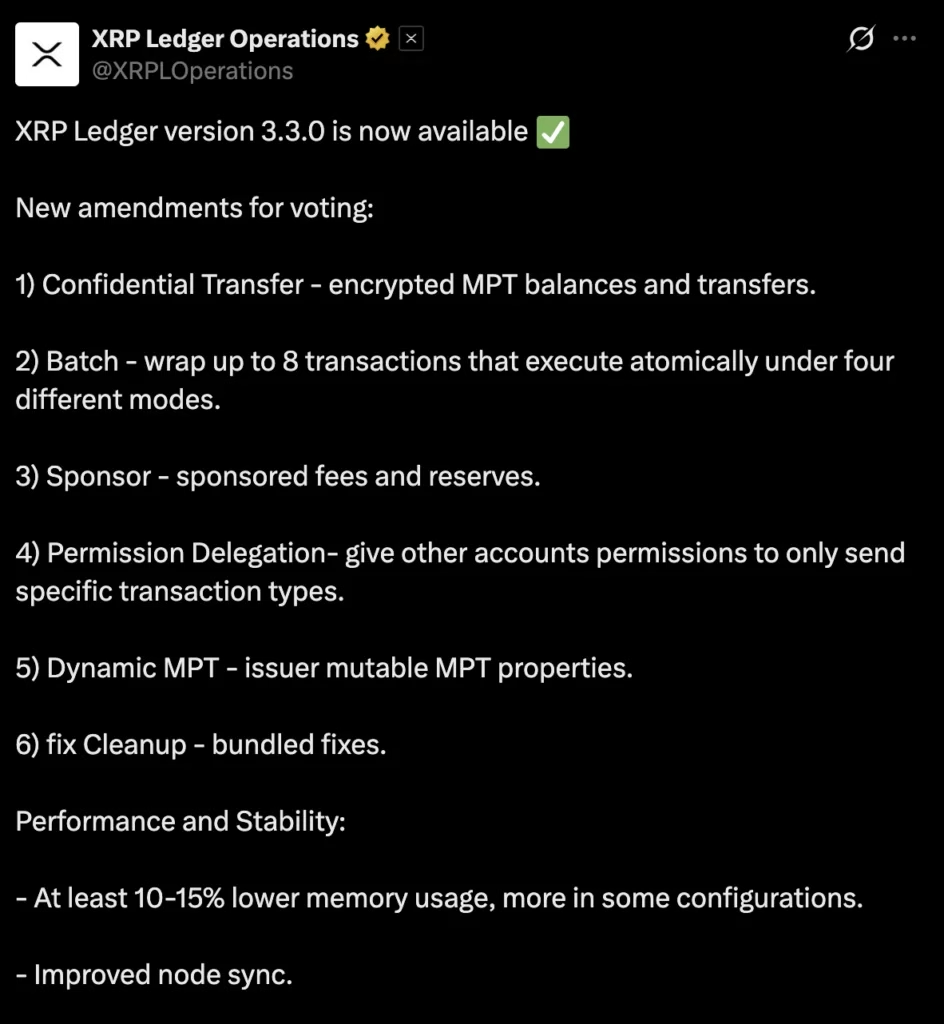
The XRP Ledger ecosystem just reached a significant technical milestone 🚀 With the release of xrpld version 3.3.0 on August 6th, developers have introduced a suite of protocol enhancements designed to expand the network's capabilities in privacy, transaction efficiency, and institutional adoption. However, it's crucial to understand that releasing new code and activating features on the mainnet are two very different processes in the blockchain world.
Understanding XRP Ledger 3.3.0: What's Really New 🔍
The XRP Ledger 3.3.0 update represents months of development work aimed at addressing real-world challenges facing enterprises and individual users. This release introduces protocol code for several groundbreaking features, but here's the important distinction: the software release itself does not activate these features on the network. Instead, it provides validators with the tools they need to vote on whether these amendments should become active.
This governance structure is fundamental to how the XRP Ledger operates. Under the network's amendment process, any new protocol feature requires more than 80% support from trusted validators, maintained continuously for two weeks, before taking effect. This rigorous approach has proven its worth in the past by preventing buggy or insecure features from reaching production.
ConfidentialTransfer: Privacy Meets Compliance 🔐
One of the most anticipated features in XRP Ledger 3.3.0 is ConfidentialTransfer, which addresses a critical gap in the current system. Multi-Purpose Tokens (MPTs) on the XRP Ledger have been incredibly useful, but they've lacked privacy protections that many institutional users require.
ConfidentialTransfer uses advanced cryptographic techniques to shield individual MPT balances and transfer amounts from public view. What makes this particularly valuable is that it doesn't sacrifice compliance—authorized parties like issuers, auditors, or regulatory bodies retain the ability to verify transaction information when needed. This elegant balance between privacy and oversight could be transformative for:
- Institutional trading where transaction sizes remain confidential
- Supply chain tokenization requiring privacy from competitors
- Cross-border payments with regulatory transparency
- Confidential corporate debt instruments and securities
The feature represents years of research into privacy-preserving cryptography applied to distributed ledgers. However, it's essential to note that ConfidentialTransfer remains subject to amendment activation, meaning private MPT transfers should not be described as currently active on XRPL mainnet.
BatchV1_1: Atomic Transactions Return Stronger 💪
Another headline feature is BatchV1_1, which brings back atomic transaction functionality with enhanced security. The XLS-56 standard allows multiple transactions to be packaged together and processed as a single unit, even when they involve different accounts.
This capability matters tremendously for settlement workflows where several actions must succeed together. Imagine a scenario where:
- Party A sends funds to an escrow account
- Party B delivers goods (represented as tokens)
- An intermediary releases payment to the seller
- Fees are collected by the network
Without atomic batching, if step 2 failed after step 1 succeeded, Party A would lose funds while Party B retains the goods. BatchV1_1 ensures all steps succeed together or none at all.
The history of this feature is instructive. An earlier batch implementation was disabled before mainnet activation after developers discovered a security vulnerability in transaction-signing logic. Rather than rushing to deploy, the XRPL community took time to develop BatchV1_1 as a thoroughly vetted replacement. This demonstrates the network's commitment to security over speed—a principle that has served the ecosystem well.
Sponsor: Frictionless User Onboarding 🎯
Based on the XLS-68 proposal, the Sponsor feature addresses one of the biggest barriers to blockchain adoption: the need to acquire cryptocurrency just to pay network fees. This feature allows one account to cover transaction fees or reserve requirements while the user maintains complete control of their account and private keys.
The practical implications are significant:
- DApp platforms can onboard users without requiring them to purchase XRP first
- Enterprise applications can sponsor transactions for their customers
- Mobile wallet providers can offer gasless transactions
- Institutional custodians can manage fee structures separately from user accounts
This is particularly relevant given the growing interest in tokenized finance. Recent initiatives like the JPMorgan, Mastercard, Ondo Finance, and Ripple collaboration on tokenized Treasury redemption demonstrate institutional appetite for XRPL-based solutions. The Sponsor feature removes technical friction from these implementations.
DynamicMPT: Flexible Token Properties 🔄
The DynamicMPT feature, based on XLS-94, targets token issuers who need flexibility as business requirements evolve. Currently, token properties are largely immutable once issued. DynamicMPT allows issuers to designate selected properties as mutable at creation time, then update those permitted fields later.
This addresses real-world scenarios such as:
- Regulatory changes requiring token property modifications
- Compliance requirement updates from jurisdictions
- Business model pivots affecting token economics
- Security protocol enhancements to existing tokens
By allowing controlled mutability rather than complete immutability or complete freedom, DynamicMPT strikes a balance that institutional issuers need. This flexibility without chaos makes XRPL increasingly attractive for enterprise tokenization initiatives.
The Critical Distinction: Released vs. Activated ⚠️
Some reports have circulated describing "six upgrades" as already live on the XRP Ledger. This framing requires important clarification. The version 3.3.0 release includes code for ConfidentialTransfer, BatchV1_1, Sponsor, and DynamicMPT—the four major features discussed above. However, other changes like fixCleanup3_2_0 belong to earlier release cycles, and LendingProtocolV1_1 represents work in progress rather than completed features.
More importantly, inclusion in software is not the same as network activation. This distinction has mattered historically. The original Batch amendment was halted after a security vulnerability was identified before mainnet activation. Similarly, Permission Delegation (which was replaced with PermissionDelegationV1_1 after a bug discovery in September 2025) never activated because validators rejected it during the amendment process.
These examples illustrate why the governance process exists: it prevents flawed features from reaching production and harming users or the network.
What Happens Next: The Validator Vote 🗳️
With version 3.3.0 released, node operators now face a critical decision. They must assess the new code, understand the proposed amendments, and decide whether to upgrade their infrastructure and support individual features through voting.
The timeline for activation depends entirely on validator behavior:
- Validators must upgrade to version 3.3.0 to participate in voting
- Each amendment votes separately with its own timeline
- 80% supermajority required for two continuous weeks
- Any amendment can fail if support drops below the threshold
This means activation dates are unpredictable. Some features might activate within weeks, while others could take months or never activate at all. For XRP holders and XRPL users, the immediate impact is technical rather than monetary—the network's toolkit expands, but this doesn't guarantee increased XRP demand or price appreciation.
Implications for the Broader Blockchain Ecosystem 🌐
The XRP Ledger 3.3.0 release reflects broader trends in blockchain development. Privacy, scalability, and institutional adoption are no longer niche concerns—they're fundamental requirements for blockchain networks aiming to support real-world use cases.
The emphasis on privacy through ConfidentialTransfer aligns with growing regulatory demands and institutional requirements. The atomic batching capability addresses settlement complexities that traditional finance has grappled with for decades. The Sponsor feature tackles the user experience problems that have hindered blockchain adoption. And DynamicMPT acknowledges that tokenized assets require operational flexibility.
Together, these features position the XRP Ledger as increasingly sophisticated infrastructure for enterprise tokenization, a market that major financial institutions are actively exploring.
Key Takeaways and What to Watch 👀
As the XRPL community evaluates version 3.3.0, several developments warrant attention:
Immediate milestones to monitor:
- Validator adoption rates for version 3.3.0
- Amendment support levels during voting periods
- Scheduled activation dates for individual features
- Any security findings or community concerns
Longer-term implications:
- How institutional users respond to privacy and sponsorship features
- Whether tokenized finance initiatives accelerate with these tools
- How XRPL's feature set compares to competing smart contract platforms
- Whether other networks adopt similar governance models
The release of XRP Ledger 3.3.0 marks a maturation of the ecosystem. Rather than rushing features to production, the XRPL community is taking measured steps to ensure new capabilities are secure, well-tested, and properly governed. This approach builds confidence among institutional users and demonstrates a commitment to long-term sustainability over short-term hype.
The next verifiable milestones will be validator adoption, amendment voting results, and eventual activation dates. Until those thresholds are met, the new capabilities should be understood as released in node software and moving through governance—not as fully active XRP Ledger mainnet features. This distinction matters for anyone evaluating XRPL's current capabilities versus its future potential.
You May Also Like

Altcoins
NCT Price Surge 200% on Upbit KRW Listing
August 26, 2026

Altcoins
WBT Reaches New All-Time High as Crypto Infrastructure Turns Institutional
August 26, 2026
Altcoins
Pi Network's August 24 Pricing Shakeup: End of Subsidized App Building
August 25, 2026

Altcoins
XRP Undervalued? Seven Spot ETFs & $1.4B Flows Tell
August 25, 2026