Category:
Market AnalysisBitcoin Drops Below $63K Despite Iran Relief Talks

🔴 Bitcoin's Unexpected Decline Amid Geopolitical Easing
In a surprising turn of events, Bitcoin price fell below $63,000 on Monday, August 3rd, defying the typical market dynamics that usually favor risk assets during periods of geopolitical de-escalation. While traditional markets celebrated renewed diplomatic efforts between the United States and Iran—with oil prices tumbling and equity futures climbing—the flagship cryptocurrency failed to participate in the broader relief rally. This divergence raises critical questions about the current state of digital asset demand and the forces reshaping crypto market dynamics. 📉
Understanding the Geopolitical Backdrop 🌍
The context surrounding Bitcoin's weakness reveals a complex interplay of factors that extend far beyond simple price action. President Trump's decision to cancel a planned military strike on Iran and pivot toward diplomatic negotiations marked a significant de-escalation in Middle East tensions. This development typically benefits risk assets by reducing inflation concerns tied to disrupted energy supplies.
Crude oil markets responded predictably to this news. Brent crude fell to approximately $83.28 per barrel, while West Texas Intermediate dropped to $79.47. Treasury yields also declined as investors reassessed inflation risks. Nasdaq futures surged roughly 0.8%, and S&P 500 futures gained 0.6%—clear signals that equities were pricing in the relief trade. Yet Bitcoin remained stubbornly weak, suggesting that traditional macro factors no longer drive cryptocurrency sentiment as they once did.
The Case for Capital Rotation 💱
Analysts point to a compelling explanation for Bitcoin's underperformance: speculative capital rotation toward technology stocks. When multiple asset classes offer attractive volatility and potential returns, traders naturally diversify their exposure. The tech sector's recent momentum may be siphoning away demand that previously flowed into digital assets.
This rotation hypothesis gains credibility when examining the broader market structure. Cryptocurrency investors, particularly those engaged in speculative trading, often view crypto and growth stocks as interchangeable sources of leverage and volatility. As equity markets stabilized and showed renewed strength, some traders likely reduced their crypto positions to capture gains in more traditional venues.
The weakness in Bitcoin price action—trading near $62,556, down 1.38% over 24 hours and 4.35% over seven days—reflects this competitive pressure. Ether fell approximately 1.8% to $1,841, while XRP and Solana also posted declines, indicating broad-based weakness across digital assets rather than Bitcoin-specific concerns.
🔐 Coldcard Security Crisis Compounds Market Concerns
Beyond macro factors, a significant security incident involving Coldcard hardware wallets added downward pressure to sentiment. Galaxy Research head Alex Thorn identified what he termed a "LIKELY" fourth organized attack wave targeting Coldcard-generated addresses, representing a troubling escalation in the ongoing incident.
The scope of the vulnerability expanded considerably. Thorn's updated analysis estimates approximately 1,815.75 BTC across 5,294 suspected victim addresses—a substantial figure that underscores the severity of the situation. This total combines three previously identified waves totaling 1,367.05 BTC across 4,585 addresses with the newly discovered fourth wave encompassing 709 addresses and 448.7 BTC.
The technical nature of the vulnerability deserves careful examination. The issue stems from seed generation problems in affected Coldcard firmware, not from flaws in Bitcoin's underlying cryptography. Specifically, certain devices created seeds with insufficient randomness, enabling attackers to search through a narrower range of possible private keys than would normally be computationally feasible.
Coinkite responded by releasing corrected firmware for each affected model. However, this update presents a critical challenge: installing new firmware does not repair seeds already generated by vulnerable versions. Users must generate entirely new seeds using corrected firmware and transfer their holdings—a process requiring technical sophistication and creating friction that many retail users struggle to navigate.
The incident also revealed suspicious activity in Bitcoin's mempool, with some users potentially able to replace unconfirmed attacker transactions using higher fee transfers. Yet success with this approach remains uncertain, adding another layer of complexity for affected parties.
📊 Spot Bitcoin ETF Outflows Signal Weakening Institutional Interest
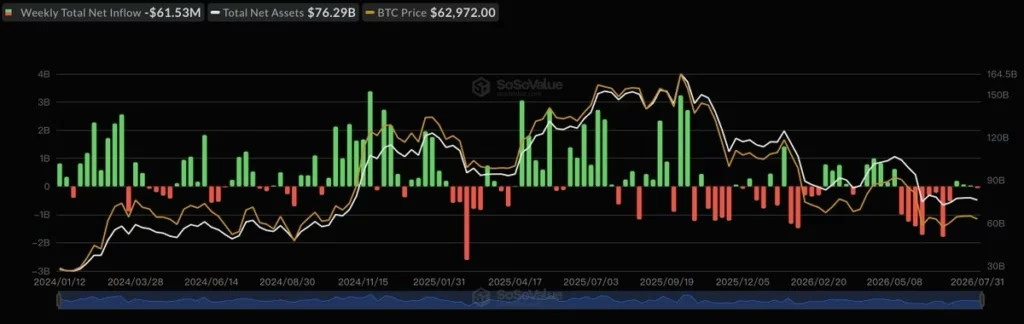
Institutional demand metrics painted an equally concerning picture. U.S. spot Bitcoin ETFs experienced net outflows of approximately $61.5 million during the week of July 27-31, ending a three-week streak of consecutive inflows. The reversal gained particular intensity on July 31st alone, when funds collectively lost $265.4 million.
The outflow distribution across major providers revealed significant institutional repositioning:
- BlackRock's IBIT: $122.7 million in withdrawals
- Fidelity's FBTC: $54.8 million in outflows
- Grayscale's GBTC: $52.6 million in outflows
These figures matter significantly because spot Bitcoin ETFs represent the primary vehicle through which institutional investors access Bitcoin exposure. Outflows suggest that regulated fund managers were reducing exposure as Bitcoin approached critical long-term support levels. While ETF flows don't definitively indicate investor expectations about future price direction, they do demonstrate that institutional appetite weakened precisely when prices approached key technical levels.
🏛️ Political Uncertainty: The CLARITY Act Disappointment
Political headwinds compounded the technical and fundamental challenges facing Bitcoin. The Digital Asset Market Clarity Act (CLARITY Act), widely anticipated as a positive catalyst for crypto regulation and institutional adoption, failed to appear on Monday's official Senate schedule.
The timing proved particularly disappointing. Senate leaders would ordinarily need to file cloture by Wednesday, August 5th, to hold a potential Friday vote on proceeding to the bill. Such a procedural vote would not constitute final passage but would represent critical momentum toward legislative action. The absence of scheduled action removed a near-term policy catalyst that many traders had anticipated.
This legislative delay matters because regulatory clarity has emerged as a fundamental requirement for sustained institutional participation in cryptocurrency markets. Until lawmakers establish clear frameworks governing digital assets, many institutional investors remain hesitant to deploy significant capital. The CLARITY Act's postponement signaled that legislative progress remains uncertain, reinforcing caution among regulated fund managers.
📈 Technical Analysis: Bitcoin at Critical Junctures
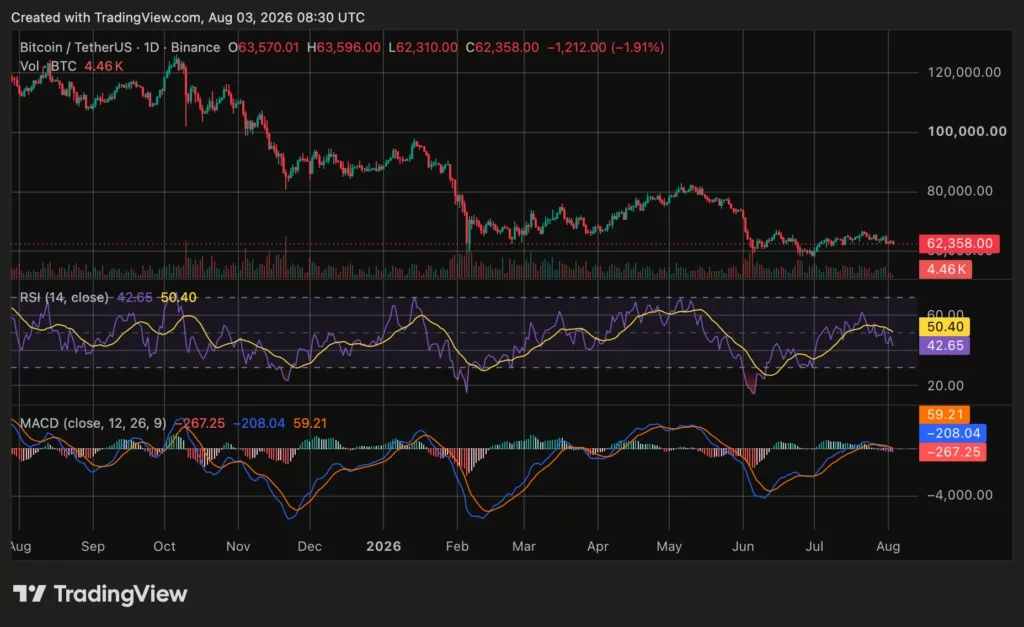
From a technical perspective, Bitcoin's price action revealed deteriorating momentum indicators at precisely the wrong time. The cryptocurrency struggled within the $63,000 to $65,000 range, with relative strength index (RSI) readings at 42.65—below the 50-level moving average of 50.40, indicating weakening buying pressure.
The MACD histogram's negative turn added confirmation to the bearish technical picture. A sustained break below $60,000 would significantly weaken the current price structure and potentially trigger additional liquidations. Conversely, a recovery above $65,000 to $66,000 would provide evidence that buyers had reasserted control.
MicroStrategy founder Michael Saylor highlighted an important long-term support level by noting that the company had begun tracking Bitcoin's 200-week moving average. According to Saylor's analysis, Bitcoin has remained above this indicator 92% of the time since its inception—a remarkable statistic suggesting that prices near or below this average represent exceptional opportunities or severe warnings, depending on one's perspective.
🎯 What Happens Next? Key Takeaways
Bitcoin's failure to follow the broader relief trade during Iran de-escalation represents a meaningful shift in market dynamics. Several critical insights emerge from this episode:
Capital Competition: Technology stocks are increasingly competing with cryptocurrencies for speculative capital. When equities offer attractive returns, traders naturally rotate toward traditional markets.
Security Remains Paramount: The Coldcard incident reminds investors that hardware wallet vulnerabilities can create systemic risks, even when underlying Bitcoin technology remains secure.
Institutional Caution: ETF outflows suggest that regulated fund managers are becoming more defensive as Bitcoin approaches long-term support levels.
Political Uncertainty Persists: Delayed regulatory clarity continues to dampen institutional enthusiasm despite growing mainstream acceptance of digital assets.
The path forward for Bitcoin depends on whether buyers can defend critical support levels while awaiting clearer signals from both macroeconomic conditions and regulatory developments. Until then, traders should expect continued volatility as competing forces—geopolitical relief, institutional caution, security concerns, and capital rotation—battle for dominance. 🚀
You May Also Like

Market Analysis
XRP Price Falls 5% as Leverage Hits Seven-Month High
August 26, 2026

Market Analysis
Crypto Market Hits Extreme Greed: What This Means for Bitcoin
August 26, 2026

Market Analysis
Ethereum Price Rally Overheats Below $2,550 Resistance
August 26, 2026

Market Analysis
Hyperliquid Price Rally: HYPE Targets $97 Amid $80 Support
August 25, 2026