Category:
Market AnalysisBitcoin May Surge if AI Bubble Bursts, Hayes Warns

The AI Infrastructure Boom: A Ticking Time Bomb? 💣
The artificial intelligence revolution has captivated investors worldwide, driving unprecedented capital expenditure across the technology sector. Yet beneath the surface of this seemingly unstoppable growth lies a concerning pattern that's drawing attention from seasoned crypto analysts. BitMEX cofounder Arthur Hayes recently published a provocative thesis suggesting that the current AI infrastructure boom resembles a leveraged real estate market far more than a technology boom—and if his analysis proves correct, Bitcoin could be positioned for significant gains.
Hayes's central argument challenges the prevailing narrative around artificial intelligence spending. Rather than viewing the massive capital investments as straightforward technology expenditures generating high margins, he frames them as a credit-driven real estate play. This distinction carries profound implications for investors across both traditional and crypto markets.
Understanding Hayes's Real Estate Analogy 🏗️
The Credit Crisis Scenario
Hayes argues that the AI infrastructure boom could unwind as a credit crisis rather than a traditional dot-com style equity collapse. This differentiation matters enormously for predicting market outcomes. In his framework, data centers represent leveraged real estate containing computing equipment—assets that can rapidly depreciate as newer, more efficient chips enter the market.
The comparison to 2008 is deliberate and instructive. Hayes describes the current situation as "a credit story like 2008 and not an earnings story like 2000." This means the risk isn't primarily about profits disappearing but rather about debt obligations exceeding cash flows.
The Debt Trap
Consider the mechanics: Banks, insurance companies, private credit funds, and infrastructure investors continue financing data center construction even as demand growth begins moderating. When weaker projects can't generate sufficient cash to meet debt obligations, lease payments, or interest expenses, financial stress spreads throughout the lending ecosystem.
The critical vulnerability lies with lenders and investors holding significant AI infrastructure exposure. Even if major technology companies remain profitable, their financiers could face severe losses—much like how mortgage-backed securities became toxic despite some homeowners continuing to pay.
Current Spending Acceleration Defies Contraction Narrative 📈
Tech Giants Double Down on AI Investment
Recent corporate filings paint a picture of accelerating, not decelerating, AI capital spending. Alphabet reported $44.9 billion in capital expenditure during the second quarter of 2026, with approximately 60% directed toward servers and 40% toward data centers and networking infrastructure.
More tellingly, Alphabet raised its 2026 capital spending guidance to between $195 billion and $205 billion—an increase from the previous $180 billion to $190 billion range. The company explicitly attributed this upward revision to faster capacity delivery required to meet surging demand. Google Cloud revenue surged 82% year-over-year to $24.8 billion, while cloud operating income reached $8.8 billion.
Microsoft's Continued Expansion
Microsoft reported quarterly capital expenditure of $41 billion, with roughly two-thirds directed to CPUs and GPUs for AI workloads. Microsoft Cloud revenue increased 27% to $59.3 billion, while commercial remaining performance obligations—essentially future revenue commitments—reached an impressive $678 billion.
Amazon painted a similar picture. AWS revenue increased 37% to $42.2 billion in the second quarter, marking its fastest growth in 18 quarters. AWS operating income reached $16.6 billion, demonstrating that cloud profitability remains robust despite massive infrastructure investments.
When Will the Slowdown Begin? ⏰
Hayes's Timeline
Hayes forecasts that announced AI capital spending growth will begin slowing during the second half of 2027, becoming clearer throughout 2028. These dates represent his personal projection rather than confirmed industry trends. Current data doesn't yet support an industrywide contraction.
However, Hayes's timing aligns with certain market realities. The enormous capital requirements for AI infrastructure naturally face physical and financial limits. Land availability, power grid capacity, and financing constraints will eventually moderate the growth trajectory.
The Bitcoin Connection: Policy Response as Catalyst 🔗
Strategic Importance Drives Government Intervention
Hayes's bullish Bitcoin thesis hinges on anticipated government policy responses. He argues that U.S. authorities will protect strategically important AI companies and their lenders because computing capacity has become integral to economic competition with China.
When credit stress emerges in the AI infrastructure sector, Hayes expects the Federal Reserve and Treasury to implement monetary easing and liquidity support. This policy response would parallel the 2008 financial crisis playbook—massive intervention to prevent systemic collapse.
The Liquidity Flow to Bitcoin
The resulting monetary expansion would create conditions favorable for Bitcoin and other alternative assets. Historically, periods of aggressive monetary easing have benefited hard assets and cryptocurrencies as investors seek inflation hedges and non-correlated returns.
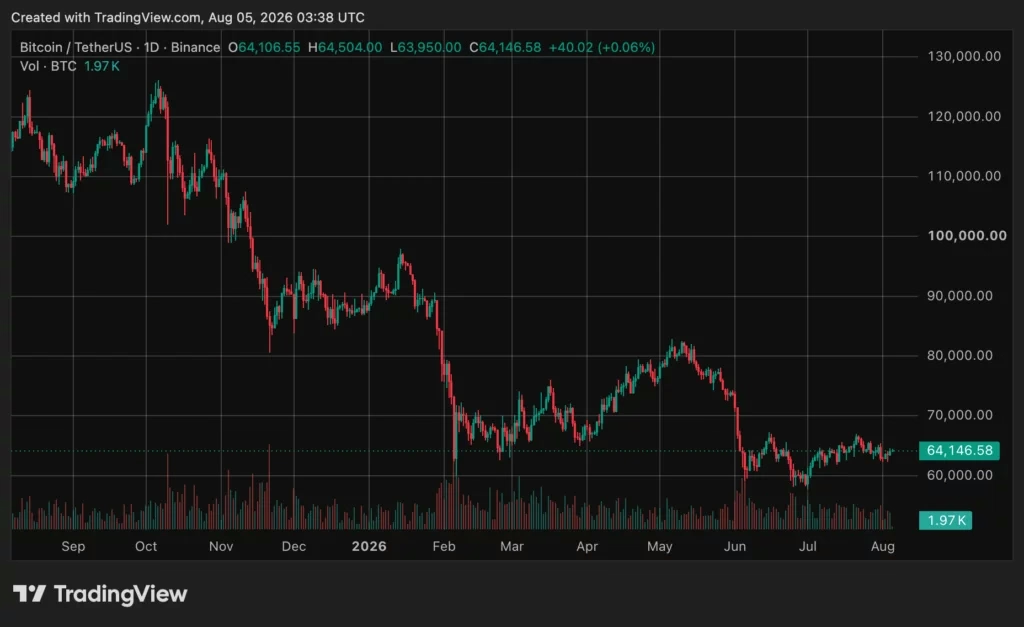
Hayes discussed potential Bitcoin trading ranges: between $60,000 and $70,000 as a consolidation zone, with downside support near $50,000, before an eventual rise toward $1 million. He emphasized these levels are forecasts dependent on monetary policy, credit creation, and investor demand developing as he expects.
The Broader Context: Tech IPO Competition 💼
Hayes has previously warned that major technology listings—including potential offerings from OpenAI, Anthropic, and SpaceX—could absorb liquidity that might otherwise flow into cryptocurrency markets. These competing capital demands add another layer of complexity to crypto market dynamics.
The timing and scale of these potential IPOs could significantly influence when capital begins rotating from traditional equities toward Bitcoin and other digital assets.
Analyzing the Counterarguments 🤔
Strong Fundamentals Persist
The most compelling counterargument to Hayes's thesis comes from current financial results. Tech companies continue reporting robust cloud growth and expanding customer backlogs. Amazon's AWS backlog, Microsoft's remaining performance obligations, and Google Cloud's revenue acceleration all suggest demand remains strong.
Additionally, Hayes acknowledges significant limitations in his analysis. He cannot identify which borrower might trigger a crisis or determine Bitcoin's precise bottom. His scenario remains a sophisticated forecast rather than a confirmed prediction.
The Real Estate Comparison Has Limits
While Hayes's analogy between data centers and leveraged real estate carries merit, technology infrastructure differs from residential housing in crucial ways. Older data centers can be repurposed, upgraded, or converted for alternative uses. Computing equipment, though depreciating, maintains some residual value.
Moreover, the companies operating these facilities—Alphabet, Microsoft, Amazon—possess enormous cash flows and balance sheet strength to absorb losses that would devastate traditional real estate developers.
What This Means for Bitcoin Investors 📊
Scenario Planning
Rather than viewing Hayes's thesis as definitive prediction, sophisticated investors should incorporate it into broader scenario analysis:
- Bull Case: AI infrastructure credit stress triggers monetary easing, supporting Bitcoin toward $100,000+
- Base Case: AI spending moderates gradually; Bitcoin consolidates in $50,000-$70,000 range
- Bear Case: AI demand remains robust; capital flows continue toward tech equities rather than crypto
Diversification Remains Essential
Regardless of which scenario unfolds, Hayes's analysis underscores the importance of portfolio diversification. Bitcoin's potential role as a hedge against credit crises and monetary expansion complements traditional portfolio components.
The Bottom Line: Waiting for Confirmation 🎯
Arthur Hayes presents a intellectually rigorous argument that deserves serious consideration from market participants. His comparison of AI infrastructure to leveraged real estate reveals genuine structural vulnerabilities in how this sector is being financed.
However, current corporate filings show no evidence of the predicted slowdown. Tech companies continue accelerating capital spending, cloud revenues are booming, and customer backlogs are expanding. Hayes's timeline suggests the real stress test arrives in 2027-2028.
For Bitcoin investors, the thesis offers a compelling long-term narrative: if credit stress does emerge in AI infrastructure, the resulting policy response could create ideal conditions for cryptocurrency appreciation. Yet patience is required. The signals Hayes predicts won't appear for months or years.
The intersection of AI infrastructure dynamics, credit markets, and monetary policy will remain one of the most important stories for both traditional and crypto investors to monitor. Whether Hayes's forecast proves prescient or overly pessimistic, the underlying structural questions about how AI is being financed deserve continued scrutiny. 🚀
You May Also Like

Market Analysis
XRP Price Falls 5% as Leverage Hits Seven-Month High
August 26, 2026

Market Analysis
Crypto Market Hits Extreme Greed: What This Means for Bitcoin
August 26, 2026

Market Analysis
Ethereum Price Rally Overheats Below $2,550 Resistance
August 26, 2026

Market Analysis
Hyperliquid Price Rally: HYPE Targets $97 Amid $80 Support
August 25, 2026