Category:
Market AnalysisBitcoin Reclaims $64K: What 3.4% CPI Means for Fed Policy

Bitcoin's Sharp Recovery Signals Market Resilience 🚀
After weeks of volatility and geopolitical uncertainty, Bitcoin has bounced back to reclaim the psychologically important $64,000 level. This recovery came on the heels of the U.S. Consumer Price Index (CPI) report for July, which showed inflation cooling to 3.4% annually—matching market expectations and providing some breathing room for digital asset investors. The move demonstrates how closely cryptocurrency markets track macroeconomic data, particularly inflation metrics that directly influence Federal Reserve policy decisions.
The timing of Bitcoin's recovery is particularly noteworthy given the broader market pressures that had weighed on risk assets in recent weeks. Geopolitical tensions, including concerns about U.S.-Iran conflicts and potential disruptions to the Strait of Hormuz, had pressured energy prices and created uncertainty across financial markets. Bitcoin's ability to bounce back despite these headwinds suggests growing institutional confidence in the asset class.
Understanding the July CPI Data 📊
The Bureau of Labor Statistics reported that headline CPI rose 3.4% year-over-year in July, down from 3.5% in June. On a monthly basis, prices increased just 0.1%, aligning perfectly with economist forecasts. More importantly, core CPI—which strips out volatile food and energy prices—climbed 2.5% annually, a meaningful deceleration from June's 2.6% reading.
This data represents a critical milestone in the inflation trajectory. While the 3.4% headline rate remains above the Federal Reserve's 2% target, the direction of travel matters enormously to policymakers and investors alike. The moderation suggests that aggressive rate hikes implemented over the past two years may be having their intended effect on price pressures.
Key Inflation Metrics at a Glance:
- Headline CPI: 3.4% (down from 3.5% in June)
- Core CPI: 2.5% (down from 2.6% in June)
- Monthly CPI: 0.1% (matching expectations)
- Fed Target: 2.0%
How Bitcoin Reacted to In-Line Inflation Data 💹
Bitcoin initially traded near $63,400 ahead of the CPI announcement, reflecting the broader market anxiety about inflation surprises. Once the data came in line with expectations, the cryptocurrency surged approximately $700 to reach $64,100 within minutes of the release. This immediate reaction underscores how important monetary policy expectations are to Bitcoin's price action.
Investment professionals in the digital asset space emphasize that Bitcoin's response to inflation data depends critically on how those figures influence interest rate expectations. According to market analysis, Bitcoin functions as a liquidity-sensitive asset—it thrives when capital is abundant and borrowing costs are low, but struggles during periods of monetary tightening and elevated interest rates.
The Federal Reserve's September Decision: What Markets Expect 🎯
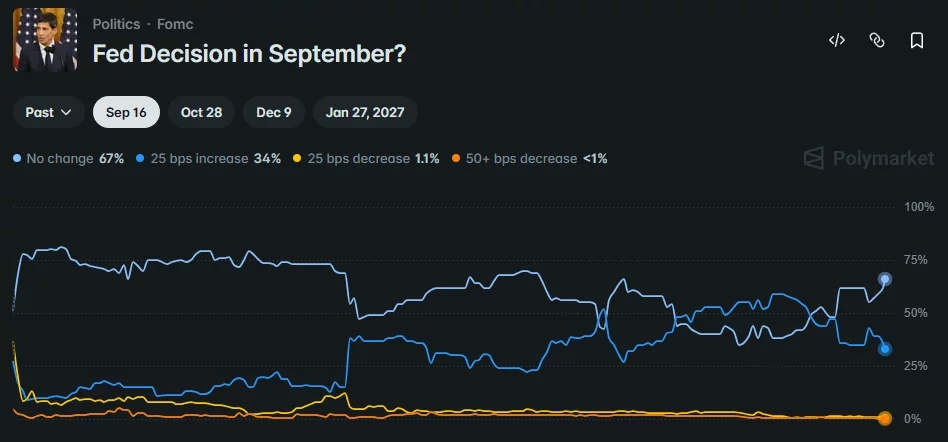
The in-line CPI reading did little to shift expectations for the Federal Reserve's September policy meeting. Polymarket prediction market data shows traders assigning a 67% probability to no rate change in September, with only a 34% chance of a 25-basis-point increase. This stability in rate expectations provides some certainty for Bitcoin investors, though it doesn't necessarily signal an imminent shift toward rate cuts.
Market participants also assessed the likelihood of additional rate hikes extending into 2026. Prediction markets placed the probability of at least one more rate increase during 2026 near 55%, suggesting the Fed may maintain a hawkish bias even as inflation cools. This mixed signal creates a complex environment for digital assets that benefit from monetary easing but remain vulnerable to persistent inflation concerns.
What Analysts Are Saying About Fed Policy 💬
Cryptocurrency analysts offered nuanced perspectives on what the CPI data means for monetary policy trajectory. Many emphasized that a single in-line inflation report, while positive, doesn't provide definitive direction for Fed decision-making. The softer employment report released the previous Friday created additional complexity—inflation data alone couldn't determine whether the central bank would prioritize fighting remaining price pressures or supporting labor markets.
Ryan Lee, chief analyst at Bitget Research, characterized the situation as relatively constructive for Bitcoin. "An in-line CPI reading neither forces a hawkish re-pricing nor delivers a clear dovish catalyst," Lee explained. This preservation of status quo expectations actually benefits Bitcoin by removing the threat of an inflation-driven policy shock while maintaining the possibility of future monetary easing.
Liquidity and Derivatives: The Next Price Drivers 📈
With macroeconomic data providing limited new direction, market analysts identified alternative factors that may drive Bitcoin's near-term price action. Institutional spot Bitcoin ETF flows, overall market liquidity conditions, and derivatives positioning have moved to the forefront of price discovery mechanisms.
Fabian Dori, chief investment officer at Sygnum Bank, highlighted several structural factors worth monitoring beyond traditional inflation metrics. Treasury cash balances, regulatory changes affecting bank leverage ratios, private credit creation, and the expanding stablecoin ecosystem all influence the broader liquidity environment that affects Bitcoin valuations.
Key Factors Influencing Bitcoin's Next Move:
- ETF Flows: Institutional inflows through spot Bitcoin ETFs provide the most direct signal of institutional demand
- Derivatives Positioning: Options and futures markets reveal trader sentiment about volatility and directional conviction
- Treasury Dynamics: Fed balance sheet operations and Treasury issuance affect overall market liquidity
- Stablecoin Adoption: Growing use of stablecoins reflects on-chain activity and exchange liquidity
Options Markets Remain Defensive Despite In-Line Data ⚠️
Interestingly, derivatives traders continued pricing in significant downside protection even after the CPI report matched expectations. Andrei Grachev, managing partner at DWF Labs, noted that traders were paying premium prices for put options protecting against declines to $60,000, while call options at $70,000 were relatively cheaper.
This defensive pricing structure suggests underlying caution about the broader monetary policy path rather than concern about a single inflation report. The gap between put and call pricing indicates that professional traders remain uncertain about whether the Fed will maintain restrictive policies or eventually pivot toward easing.
Technical Levels: Where Bitcoin Must Hold 🎲
Technical analysts identified several critical price levels that will determine whether Bitcoin's recovery gains traction or reverses. The $64,000-$64,100 level where Bitcoin bounced represents important short-term support. However, more meaningful resistance exists between $65,021 and $65,510 on a daily closing basis.
Bitfinex analysts noted that two consecutive daily closes above $68,300 would signal a more significant technical shift. This level combines the cost basis of short-term Bitcoin holders with April's monthly opening price, making it psychologically and technically significant.
Conversely, if Bitcoin falls back toward $62,000-$63,000, it would suggest that the CPI relief proved temporary and that broader policy concerns remain. This support zone would be critical to defend for bulls attempting to establish a sustained recovery.
The Producer Price Index: Next Inflation Test 🔍
While the CPI data provided some relief, markets quickly turned attention to the July Producer Price Index (PPI) scheduled for release the day after the CPI report. PPI measures inflation at the wholesale level, revealing whether price pressures are developing earlier in the supply chain before reaching consumers.
A softer PPI reading could reduce demand for options protection and support Bitcoin's rally, while an upside surprise might reignite concerns about persistent inflation and Federal Reserve rate hikes. This sequential data release creates a two-day window of potential volatility for cryptocurrency markets.
Geopolitical Risks and Energy Prices: Complicating Factors 🌍
One factor that limited Bitcoin's upside response to the in-line CPI report was ongoing geopolitical uncertainty. Tensions in the Middle East and concerns about potential disruptions to the Strait of Hormuz could elevate energy prices, which would complicate the inflation narrative and potentially limit the Fed's ability to cut rates.
Oil price movements directly influence headline inflation readings and create tail risks for policymakers. Should energy supply disruptions materialize, Bitcoin's positive reaction to the CPI data could be reversed by renewed inflation concerns and hawkish Fed repositioning.
What Comes Next: Jackson Hole and Beyond 🗓️
Market participants identified the Federal Reserve's Jackson Hole Economic Symposium as the next critical event for Bitcoin and broader financial markets. Fed officials' speeches at this annual gathering typically provide important clues about the central bank's policy trajectory and economic outlook.
Iggy Ioppe, chief investment officer at Theo, suggested that short-term market attention would likely remain focused on yield opportunities, with investors balancing Bitcoin's sensitivity to institutional flows against traditional safe havens like gold. The coming weeks will reveal whether the CPI relief translates into sustained monetary easing or proves temporary.
Key Takeaways: Bitcoin's Path Forward 🎬
Bitcoin's recovery to $64,000 following the in-line CPI report demonstrates the cryptocurrency's responsiveness to monetary policy expectations. While the inflation data provided some relief, it didn't dramatically shift the Fed's policy outlook, leaving Bitcoin dependent on liquidity flows and derivatives positioning.
The next critical tests include the PPI release, Fed communications at Jackson Hole, and whether Bitcoin can maintain support above $64,000 while establishing acceptance above the $65,021-$65,510 resistance band. Geopolitical risks and energy price dynamics add additional complexity to the inflation picture.
For Bitcoin investors, the message is clear: while macroeconomic conditions are improving, the path to sustained monetary easing remains uncertain. Institutional adoption through spot ETFs and careful attention to liquidity conditions will likely prove more important than any single inflation report. The digital asset class has matured significantly, but its sensitivity to Fed policy ensures that macroeconomic developments will continue driving price action in the months ahead. 💫
You May Also Like

Market Analysis
XRP Price Falls 5% as Leverage Hits Seven-Month High
August 26, 2026

Market Analysis
Crypto Market Hits Extreme Greed: What This Means for Bitcoin
August 26, 2026

Market Analysis
Ethereum Price Rally Overheats Below $2,550 Resistance
August 26, 2026

Market Analysis
Hyperliquid Price Rally: HYPE Targets $97 Amid $80 Support
August 25, 2026