Category:
Market AnalysisBitcoin Resists Sell-Off: Three Critical Risks Threaten $60K Drop

Bitcoin's Resilience in Turbulent Markets 🔥
Bitcoin demonstrated remarkable resilience on July 30, maintaining its position near $64,600 despite mounting macroeconomic headwinds and geopolitical tensions. While the leading cryptocurrency managed to recover from an intraday low of $62,383, its inability to break through established resistance levels signals that buyer strength remains constrained. This consolidation phase reflects a broader market struggle between defensive positioning and institutional confidence.
The cryptocurrency market has become increasingly sensitive to external shocks beyond its traditional boundaries. Bitcoin's performance during market stress events now serves as a barometer for institutional appetite for risk assets, making each price movement worthy of careful analysis.
Understanding Bitcoin's Current Price Range 📊
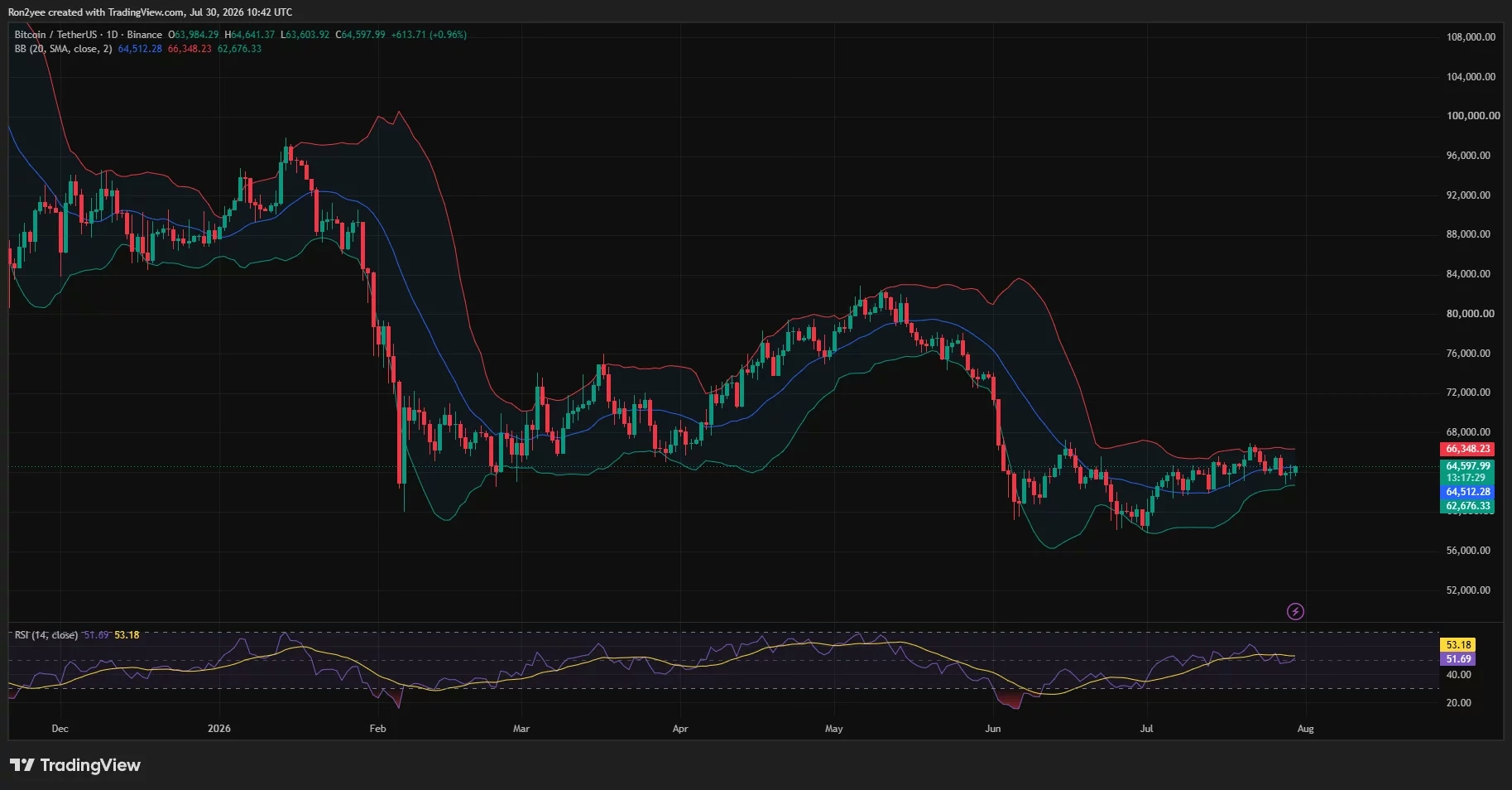
Technical analysis reveals that Bitcoin remains trapped within a well-defined consolidation zone that has persisted for several trading sessions. The daily chart shows BTC trading directly above the Bollinger Band midpoint at $64,512, with the upper resistance band positioned near $66,348 and the lower support band around $62,676.
Momentum indicators paint a picture of equilibrium rather than directional conviction. The daily relative strength index (RSI) registered at 51.69, marginally below its signal average of 53.18. This neutral positioning suggests that while sellers have been contained, buyers have not yet accumulated sufficient momentum to execute a decisive breakout.
Key technical levels to monitor:
- Upper resistance: $66,500 (major overhead barrier)
- Midpoint support: $64,512 (current consolidation anchor)
- Lower support: $62,676 (first critical floor)
- Downside target: $60,000 (psychological level under threat)
The consolidation pattern itself represents a healthy market dynamic—accumulation before directional moves. However, the surrounding macro environment threatens to interrupt this orderly process.
Risk #1: Geopolitical Tensions and Energy Market Shock ⚠️
Renewed military conflict between the United States and Iran has emerged as an unexpected market disruptor. Following Iranian missile strikes toward a US base in Jordan, American forces launched retaliatory strikes against Islamic Revolutionary Guard Corps targets. While Jordanian air defenses successfully intercepted five Iranian missiles, the escalation raised critical concerns about potential disruptions to Persian Gulf energy supplies and Red Sea shipping lanes.
This geopolitical volatility directly impacts Bitcoin's price trajectory through the energy market channel. Crude oil surged 6.6% in a single session and held above $84 per barrel, reflecting genuine supply concerns. Rising energy costs cascade through the global economy, resurrecting inflation expectations that central banks had partially tamed.
Why this matters for Bitcoin:
- Higher oil prices fuel inflation expectations
- Elevated inflation pressures keep Treasury yields anchored at higher levels
- Sustained high yields reduce the appeal of non-yielding assets like Bitcoin
- Risk-off sentiment typically flows away from cryptocurrencies during geopolitical crises
Historically, Bitcoin has sometimes benefited from geopolitical uncertainty as a hedge against currency debasement. However, in the current environment dominated by inflation concerns and rising real yields, the cryptocurrency faces headwinds rather than tailwinds from regional conflicts.
Risk #2: Federal Reserve's Hawkish Stance and Rate Expectations 💰
The Federal Reserve's July meeting delivered a message that markets interpreted as more hawkish than anticipated. While policymakers maintained the federal funds rate at the expected 3.5%–3.75% range, three FOMC members voted in favor of a quarter-point rate increase. This 9-3 split vote signaled that additional tightening remains possible if inflation metrics deteriorate.
Fed Chair Kevin Powell's rhetoric reinforced this hawkish positioning by explicitly rejecting the concept of a "soft target" for inflation. The central bank reaffirmed its commitment to the 2% inflation objective without flexibility, suggesting policymakers view current price pressures as requiring sustained vigilance.
Implications for Bitcoin and risk assets:
- Steady rates provide minimal relief when accompanied by hawkish forward guidance
- Higher-for-longer interest rates reduce the present value of speculative assets
- Institutional investors increasingly favor safe-haven bonds over cryptocurrencies when rate hikes remain possible
- The opportunity cost of holding Bitcoin rises as Treasury yields remain elevated
The Fed's messaging essentially communicated that financial conditions will remain restrictive. For Bitcoin, which thrives during periods of monetary accommodation and falling real yields, this stance represents a structural headwind that cannot be easily overcome by positive sentiment alone.
Risk #3: Regulatory Uncertainty and Delayed Clarity Act 📋
The US Senate's decision to postpone action on the Digital Asset Market Clarity Act represents the third major risk threatening Bitcoin's recovery momentum. Lawmakers shifted priorities toward a Russia sanctions package and federal nominations, narrowing the legislative calendar before the August 8 recess. While this delay does not create immediate operational changes for Bitcoin, it removes a significant potential catalyst for institutional confidence.
The Clarity Act was designed to establish a coherent regulatory framework by dividing oversight responsibilities between the Securities and Exchange Commission (SEC) and the Commodity Futures Trading Commission (CFTC). Clear regulatory guidance has been a long-standing institutional demand, with many large financial firms hesitant to expand cryptocurrency exposure until the regulatory landscape stabilizes.
Why regulatory clarity matters:
- Institutional investors require clear compliance frameworks before deploying capital
- Uncertainty creates legal risk that discourages large allocations
- Token issuers and US exchanges need definitive rules to operate confidently
- Delayed regulation removes a catalyst that could have challenged resistance levels
Senate Republicans released updated legislative text on July 22, combining Banking and Agriculture Committee proposals into a single framework. However, unresolved ethics language and the requirement for Democratic support remain significant obstacles to passage. The regulatory vacuum persists, leaving Bitcoin without a policy-driven reason to challenge its $66,500 resistance while geopolitical and monetary risks intensify.
Bitcoin's Defensive Strength: Why $62K Held 💪
Despite these headwinds, Bitcoin demonstrated notable resilience compared to traditional risk assets. US equities experienced sharp declines on July 30, with the Dow Jones Industrial Average losing 2.2%, the S&P 500 dropping 1.5%, and the Nasdaq sliding 1.7%. Bitcoin, by contrast, recovered most of its post-FOMC decline rather than extending losses below $62,000.
This relative outperformance suggests that defensive buying has stabilized the cryptocurrency at critical support levels. Institutional investors appear to be maintaining their Bitcoin exposure rather than capitulating to selling pressure. US spot Bitcoin ETFs recorded approximately $32.1 million in net inflows on July 29, with BlackRock's IBIT attracting $89.8 million, demonstrating continued institutional demand during the market turmoil.
However, this defensive buying reveals a critical limitation:
While defensive buying has been sufficient to prevent a breakdown below $62,000, it has proven inadequate to restart the broader rally. Bitcoin's repeated inability to clear the $65,000–$66,500 range demonstrates that buyers lack the conviction necessary for a decisive breakout. This dynamic creates a precarious equilibrium where the cryptocurrency is defended at lower levels but lacks the strength to advance significantly.
The Gold Rotation Question: Separating Fact from Fiction 🏆
Market observers have speculated about potential capital rotation from cryptocurrencies into gold as risk aversion increases. Spot gold did hold near $4,062 per ounce, and US gold futures gained 0.7% following the Fed announcement. Gold had also risen approximately 2% in the post-Fed session.
However, the evidence for a broad crypto-to-gold rotation remains inconclusive. Investment demand in precious metals has remained subdued, and silver actually traded slightly lower during the same period. This mixed performance weakens the argument that investors are systematically moving capital from digital assets into traditional precious metals.
The clearer defensive move has been into oil-linked exposure and away from equities sensitive to interest rates and economic growth. Bitcoin's recovery toward $64,600 also contradicts the notion that capital has abandoned cryptocurrencies entirely in favor of traditional havens. The market appears to be differentiating between various risk assets rather than executing a uniform flight to safety.
Fear Index and Sentiment Indicators 📈
Crypto market sentiment remains decidedly weak despite Bitcoin's technical resilience. The Fear and Greed Index stood at 28, down from 29 and firmly within the "fear" category. This metric, which aggregates market sentiment from multiple sources, indicates that participants remain cautious and risk-averse.
Weak sentiment often precedes market bottoms, as excessive fear creates the psychological conditions for capitulation and subsequent reversals. However, sentiment extremes alone cannot overcome the structural headwinds presented by geopolitical tensions, hawkish Fed policy, and regulatory uncertainty.
The $60,000 Question: What Could Trigger a Deeper Decline? 🚨
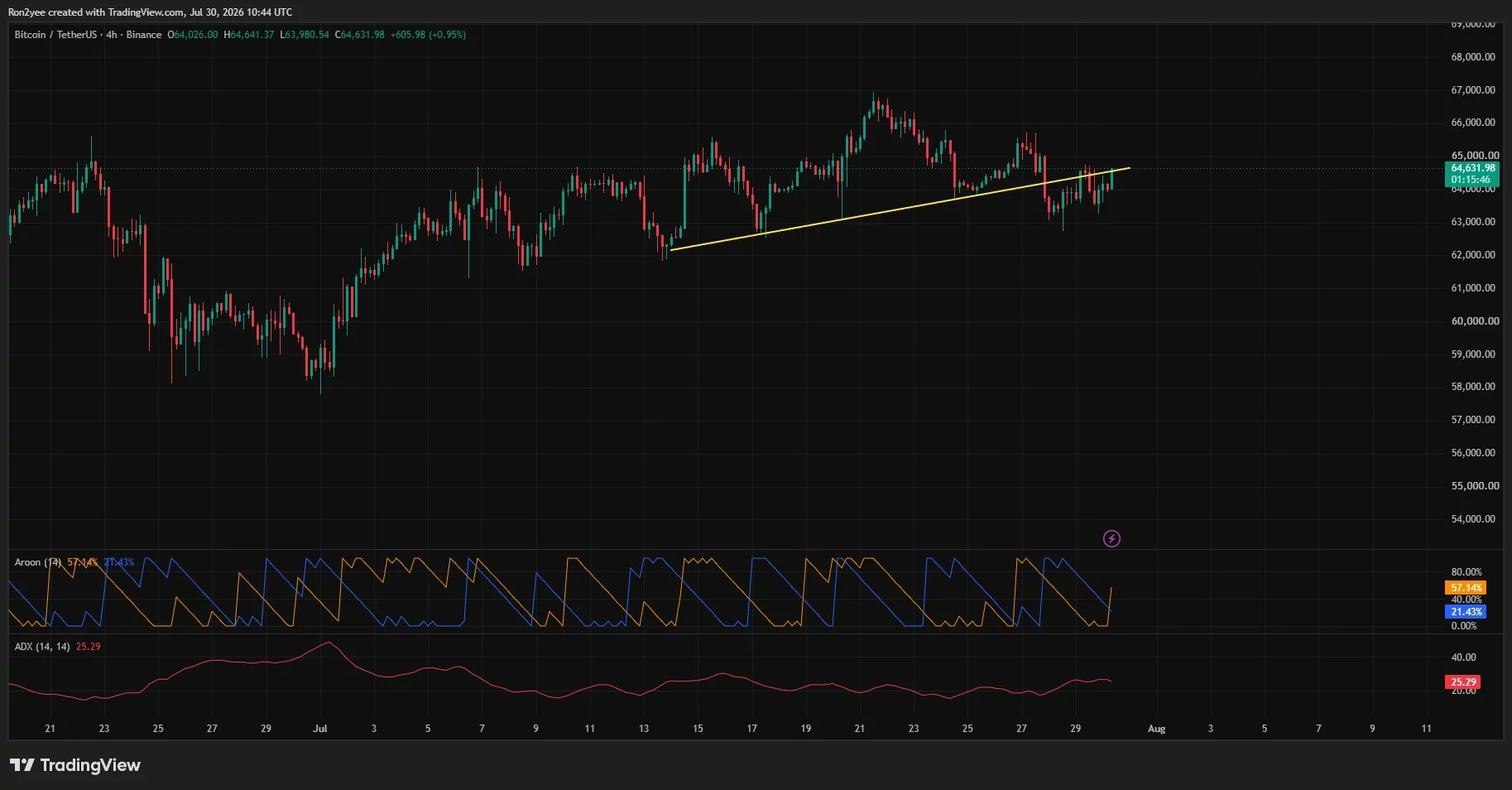
The convergence of three distinct risk factors creates a scenario where Bitcoin could test significantly lower levels. A breakdown below the $62,676 support level would likely accelerate selling toward the $60,000 psychological barrier.
Catalysts that could trigger a $60K test:
- Further escalation of US-Iran tensions disrupting energy supplies
- Surprise inflation data prompting additional Fed rate hike expectations
- Regulatory setback or adverse SEC enforcement action
- Broader equity market correction exceeding 5-10%
- Major exchange or lending platform insolvency
- Forced liquidations triggered by cascading margin calls
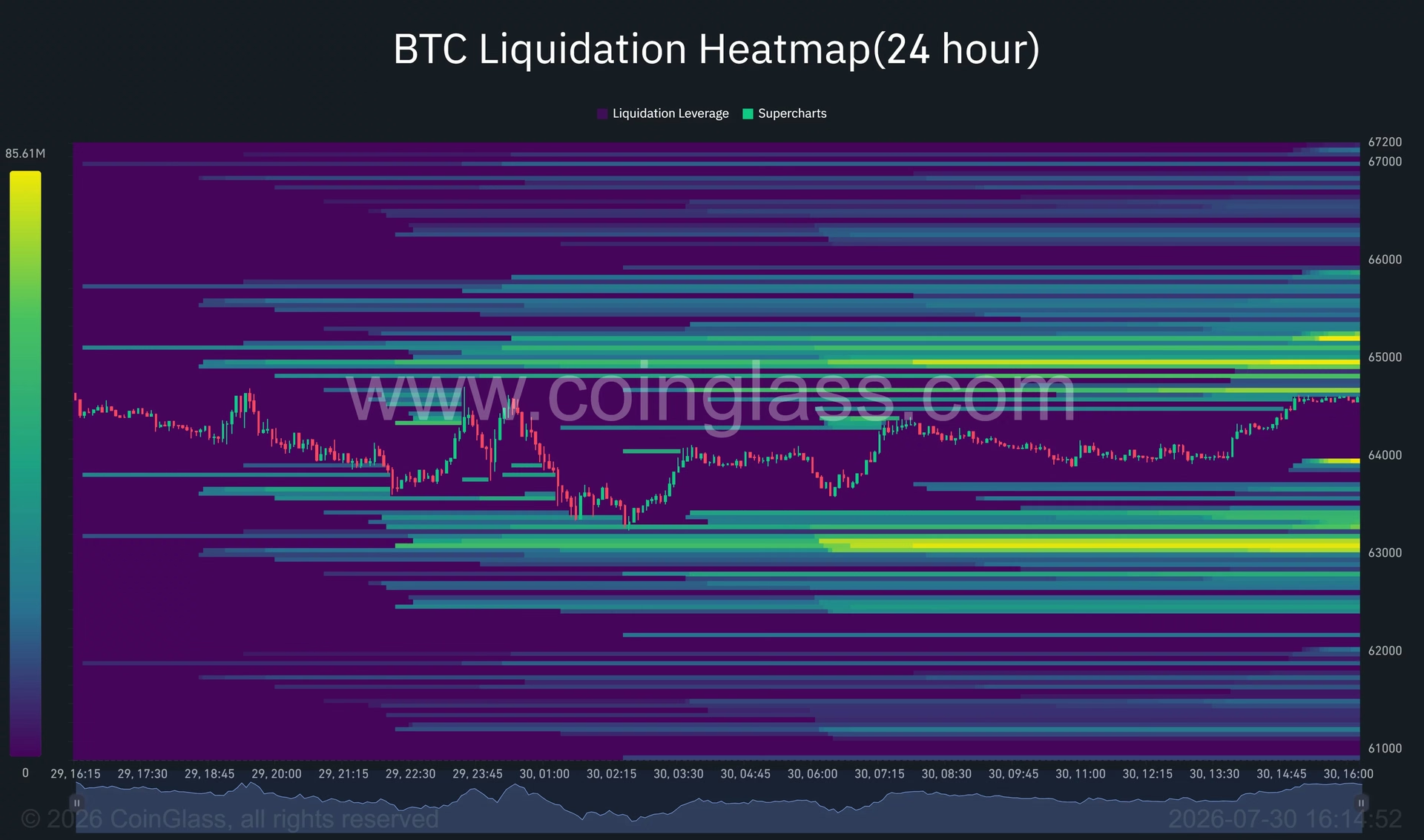
The liquidation heatmap reveals significant liquidation levels concentrated around $60,000–$61,000, suggesting that a break below $62,000 could trigger automated selling and cascade lower through these zones.
What Investors Should Monitor Going Forward 👀
The next 48-72 hours will be critical for determining Bitcoin's near-term direction. Key events and data points deserve close attention:
Immediate catalysts:
- Any further escalation in US-Iran military actions
- Crude oil price movements (critical inflation indicator)
- Fed speaker commentary on inflation and rate hike probability
- Cryptocurrency market derivatives positioning and funding rates
- Institutional Bitcoin ETF flows and accumulation patterns
- Technical breakdown below $62,676 support level
Institutional investors are likely monitoring the same indicators, and their collective positioning could determine whether defensive buying holds or breaks under pressure.
Conclusion: Resilience Tested But Not Broken 🎯
Bitcoin's price action near $64,600 reflects a market in transition between competing forces. The cryptocurrency has demonstrated genuine resilience by recovering from intraday lows and maintaining institutional support through spot ETF inflows. However, three distinct risks—geopolitical tensions, hawkish Fed policy, and regulatory uncertainty—create a precarious environment where downside risks may outweigh upside potential.
The $60,000 level represents a critical psychological and technical barrier. While defensive buying has held this region, the absence of strong upside momentum suggests that Bitcoin lacks the conviction necessary to establish a sustained recovery. Investors should approach this consolidation phase with caution, maintaining awareness that the balance between buyers and sellers could shift rapidly if any of the identified risk factors intensify.
The crypto market's maturation means Bitcoin now trades alongside traditional risk assets rather than independently. Until geopolitical tensions ease, the Fed signals greater flexibility on rates, or regulatory clarity emerges, Bitcoin will likely remain range-bound—defended at lower levels but unable to break decisively higher. Patience and risk management should guide positioning in this uncertain environment.
You May Also Like

Market Analysis
XRP Price Falls 5% as Leverage Hits Seven-Month High
August 26, 2026

Market Analysis
Crypto Market Hits Extreme Greed: What This Means for Bitcoin
August 26, 2026

Market Analysis
Ethereum Price Rally Overheats Below $2,550 Resistance
August 26, 2026

Market Analysis
Hyperliquid Price Rally: HYPE Targets $97 Amid $80 Support
August 25, 2026