Category:
Market AnalysisBitcoin Steadies Near $64K as HYPE Leads Crypto Gainers

The cryptocurrency market is navigating a period of consolidation as Bitcoin hovers near the $64,000 mark, with mixed signals from macroeconomic data and institutional flows creating an intriguing backdrop for digital asset traders. 📊 While the largest cryptocurrency has managed to maintain relative stability, the broader market is displaying a fascinating split between winners and losers, with emerging tokens like Hyperliquid capturing significant attention.
Bitcoin Price Action: Consolidation Above $64K 💰
Bitcoin traded in a narrow range near $63,800 early Thursday morning, reflecting the cryptocurrency's struggle to build sustained momentum following the release of U.S. inflation data. The asset briefly climbed above $65,000 ahead of the consumer price index announcement, but repeated attempts to establish a stronger foothold in that region failed to materialize. This consolidation pattern suggests that market participants remain cautious despite some positive economic indicators.
The muted response to inflation data that came in line with expectations reveals an important market dynamic: the removal of downside risk doesn't automatically trigger fresh buying pressure. While the July consumer price index matched economist forecasts at 0.1% monthly and 3.4% annually, this relief failed to ignite the kind of momentum that would push Bitcoin decisively toward new resistance levels. The cryptocurrency's inability to capitalize on favorable macro news suggests that other factors are currently weighing on investor sentiment. 🤔
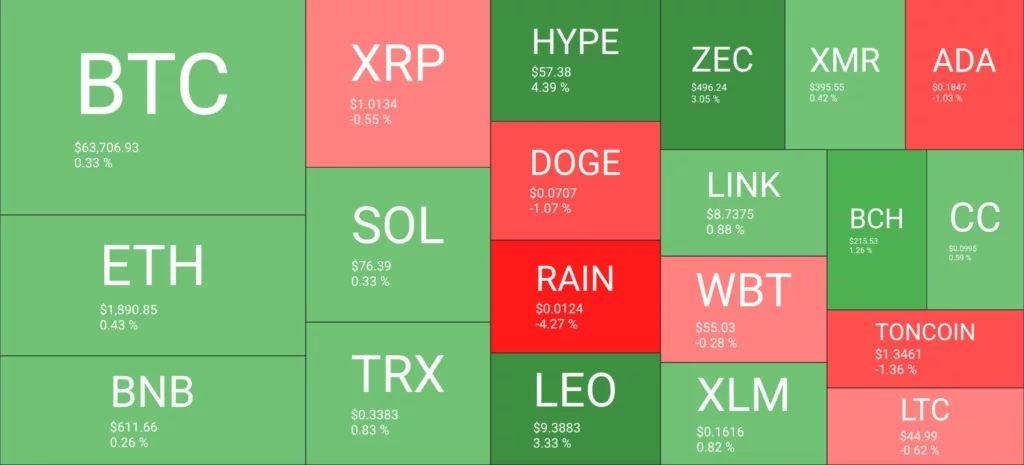
At the time of writing, Bitcoin represented approximately 56.6% of the total cryptocurrency market capitalization, which stood near $2.27 trillion. This dominance reflects Bitcoin's enduring position as the primary barometer for overall crypto market health, though recent price action indicates that smaller-cap tokens are increasingly capturing investor attention.
The Inflation Report: Relief Without Momentum 📈
July's consumer inflation figures provided some reassurance to market observers concerned about potential Federal Reserve rate hikes. The Bureau of Labor Statistics reported that core CPI, which excludes volatile food and energy prices, increased 0.2% monthly and slowed to 2.5% annually—a reading that suggested disinflationary pressures continue to work through the economy.
This data prompted futures markets to lower the implied probability of a September rate hike from 54% to approximately 40%, according to Reuters. Traditional equity markets responded more enthusiastically than cryptocurrency, with the MSCI Asia Pacific index rising about 1% and South Korea's Kospi gaining more than 4%. The divergence in performance between traditional and digital assets highlights an important reality: Bitcoin's price action is increasingly driven by factors beyond macroeconomic data points alone.
HYPE Leads Crypto Gainers in Impressive Rally 🚀
While Bitcoin remained relatively subdued, Hyperliquid emerged as the standout performer among major cryptocurrencies, trading around $57 and gaining roughly 4% to 5% over the 24-hour period. This performance marked a continuation of HYPE's recovery trajectory that began the previous week, when the token rebounded from approximately $51 toward the $57 level.
The outperformance becomes even more pronounced when examining smaller-cap cryptocurrencies. CoinMarketCap ranked Velvet as the best performer among its top 100 cryptocurrencies, surging 23.76% to approximately $0.70. Virtuals Protocol followed with a 9.86% gain to $0.596, while OKB rose 9.19% to roughly $104. Mantle gained 5.99%, further demonstrating the breadth of strength in alternative tokens.
This divergence between Bitcoin's consolidation and alternative token strength reflects a classic market dynamic where capital rotates between major and emerging assets. When Bitcoin struggles to establish new highs, traders often seek opportunities in smaller-cap tokens that offer greater volatility and potential for outsized returns.
The Broader Cryptocurrency Landscape 🌐
Major cryptocurrencies displayed mixed performance as of Thursday morning. Ether traded around $1,890, BNB hovered near $611, XRP settled at $1.01, and Solana remained close to $76. TRON exchanged hands around $0.338, while Dogecoin changed hands near $0.0707. Cardano was approximately $0.184, and Chainlink traded near $8.74.
The losers' column told an equally compelling story. Audiera led declines with a 15.74% drop, while Curve DAO Token fell 7.42%. Official Trump declined 5.75%, Uniswap dropped 5.55%, and Pepe lost 4.34%. Even Dogecoin, the market's most famous meme token, fell about 2.1%, suggesting that weakness extended across multiple asset categories.
Institutional Flows: A Mixed Picture for Bitcoin 📉
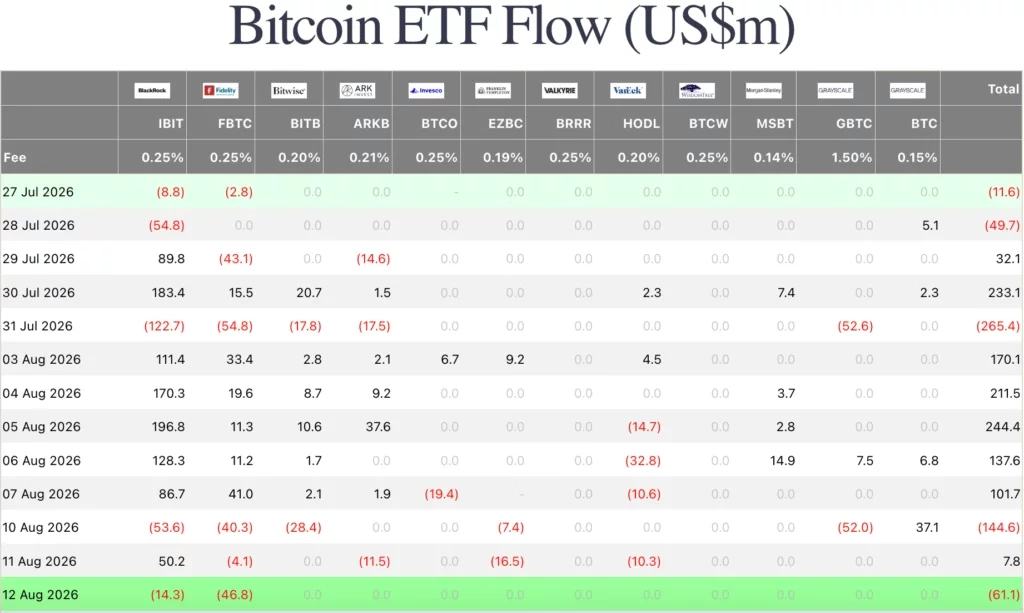
U.S. exchange-traded fund flows provided crucial context for understanding Bitcoin's subdued performance. Spot Bitcoin ETFs recorded $61.1 million in net outflows on August 12, according to Farside data. Fidelity's FBTC accounted for $46.8 million of redemptions, while BlackRock's IBIT lost $14.3 million. These outflows represented a notable reversal from the previous week's institutional enthusiasm.
The contrast with Ether ETF performance was striking. U.S. spot Ether ETFs attracted $7.4 million in inflows, entirely through BlackRock's ETHA, while every other listed fund recorded zero net flow for the session. This divergence highlighted an important institutional narrative: while Bitcoin faced redemption pressure, Ethereum maintained its appeal to professional investors.
These latest redemptions interrupted a stronger period of institutional Bitcoin demand that had characterized earlier August. Four consecutive Bitcoin ETF inflow sessions had previously brought in $763.6 million before flows weakened this week, suggesting that the initial enthusiasm surrounding Bitcoin's price stability was beginning to fade.
What's Next for Bitcoin and Crypto Markets? 🔮
Several critical economic data points remain on the horizon that could significantly impact Bitcoin's trajectory. The Bureau of Labor Statistics released July producer prices on August 13 at 8:30 a.m. ET, with any significant surprise potentially altering Federal Reserve expectations for the September 15-16 meeting.
Attention will then shift to the Jackson Hole Economic Policy Symposium scheduled for August 27-29, which focuses on financial innovation, payments, and policy—topics increasingly relevant to the cryptocurrency industry. The August employment report follows on September 4, while August CPI arrives September 11, providing policymakers with two major data releases before the crucial September Federal Reserve meeting.
Bitcoin faces several competing forces heading into this period. While inflation concerns have not produced a fresh shock, ETF demand has softened and the $65,000 resistance level remains difficult to reclaim. The trajectory of upcoming employment and inflation readings will prove critical in determining whether market expectations continue shifting toward a Federal Reserve pause before September's policy decision. ⏰
Commodity markets also provided context for Bitcoin's performance. Brent crude traded near $88.50 early Thursday after recently dipping below $90, as weaker demand forecasts offset continuing Middle East supply concerns. Energy price weakness often correlates with reduced inflation expectations, which could theoretically support Bitcoin's long-term outlook.
Key Takeaways 🎯
- Bitcoin consolidation near $64K reflects cautious sentiment despite favorable inflation data
- HYPE and alternative tokens outperform as capital rotates from major cryptocurrencies
- Institutional ETF flows show divergence with Bitcoin facing redemptions while Ether attracts inflows
- Multiple economic catalysts ahead including producer prices, employment data, and Jackson Hole symposium
- The $65,000 resistance level remains a key technical battleground for Bitcoin's next directional move
The cryptocurrency market's current state exemplifies the complexity of digital asset price discovery in an environment where macroeconomic factors, institutional flows, and technical levels all compete for influence. Bitcoin's ability to break decisively above $65,000 or defend support near $63,000 will likely depend on developments in the broader economic landscape rather than cryptocurrency-specific catalysts. 💡
You May Also Like

Market Analysis
XRP Price Falls 5% as Leverage Hits Seven-Month High
August 26, 2026

Market Analysis
Crypto Market Hits Extreme Greed: What This Means for Bitcoin
August 26, 2026

Market Analysis
Ethereum Price Rally Overheats Below $2,550 Resistance
August 26, 2026

Market Analysis
Hyperliquid Price Rally: HYPE Targets $97 Amid $80 Support
August 25, 2026