Category:
Market AnalysisEthereum Price at $1,868: Can ETH Break $2,000?

Ethereum's Critical Juncture: Breaking Through the $2,000 Barrier 📊
Ethereum (ETH) finds itself at a pivotal moment in its market cycle. Trading around $1,868 in early August 2026, the world's second-largest cryptocurrency continues to face significant headwinds as it attempts to reclaim the psychologically important $2,000 level. Yet beyond the technical resistance points and chart patterns, a brewing debate within the developer community threatens to add complexity to Ethereum's price trajectory.
The cryptocurrency market has witnessed numerous cycles of boom and bust, but Ethereum's current positioning reveals something more nuanced—a network grappling with both technical challenges and philosophical disagreements about its future direction. Understanding where ETH might be headed requires examining both the immediate price action and the longer-term implications of emerging proposals that could reshape validator economics.
Technical Analysis: Ethereum's Descending Channel Trap 🔍
The daily chart tells a story of consolidation and constraint. Ethereum has repeatedly failed to maintain positions above $1,900 since late July, suggesting that buyers lack the sustained conviction needed for a decisive breakout. The cryptocurrency currently trades below its 20-day simple moving average at $1,887.53, a bearish signal that indicates short-term momentum remains challenged.
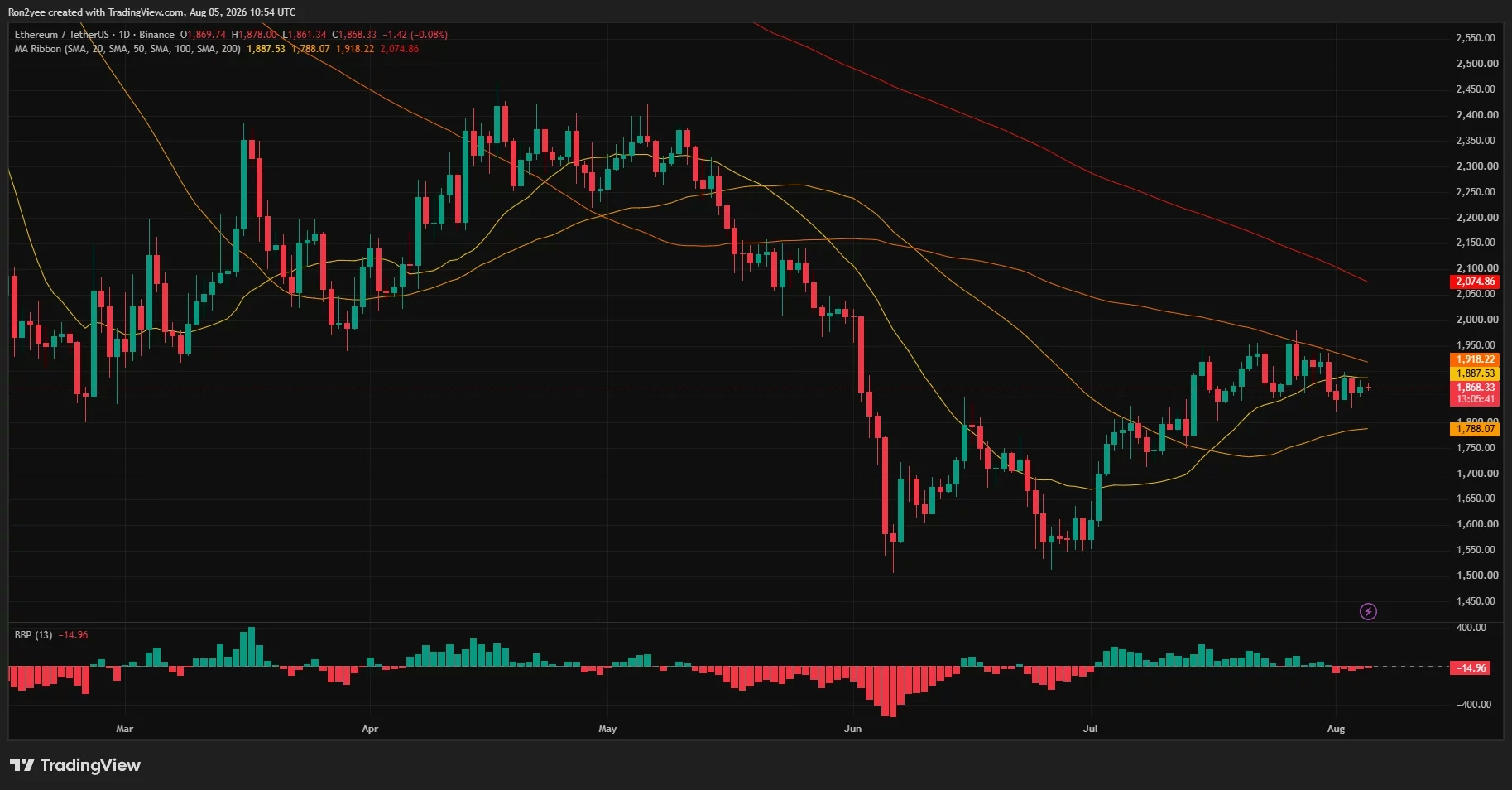
Looking at the moving average structure reveals the depth of Ethereum's struggle. The 100-day SMA at $1,918.22 creates formidable resistance, while the 200-day SMA sits considerably higher at $2,074.86. This arrangement—with ETH trading below three of its four major moving averages—suggests that the broader trend remains uncertain. The silver lining exists in the form of the 50-day SMA at $1,788.07, which Ethereum continues to hold above, preserving the recovery structure that began after the network's June decline toward $1,500.
The Bull Bear Power indicator has deteriorated to minus 14.96, signaling that sellers maintain a marginal advantage in the current environment. However, this reading remains far removed from the deeply negative levels witnessed during June's capitulation, suggesting that panic selling hasn't taken hold.
The 4-Hour Breakout Setup 🎯
On the 4-hour timeframe, Ethereum trades near the upper boundary of a descending channel that has constrained price action since the July 27 peak near $1,975. This technical pattern represents both opportunity and risk. The immediate breakout area sits between $1,875 and $1,885—a relatively narrow range that will determine whether buyers can establish momentum.
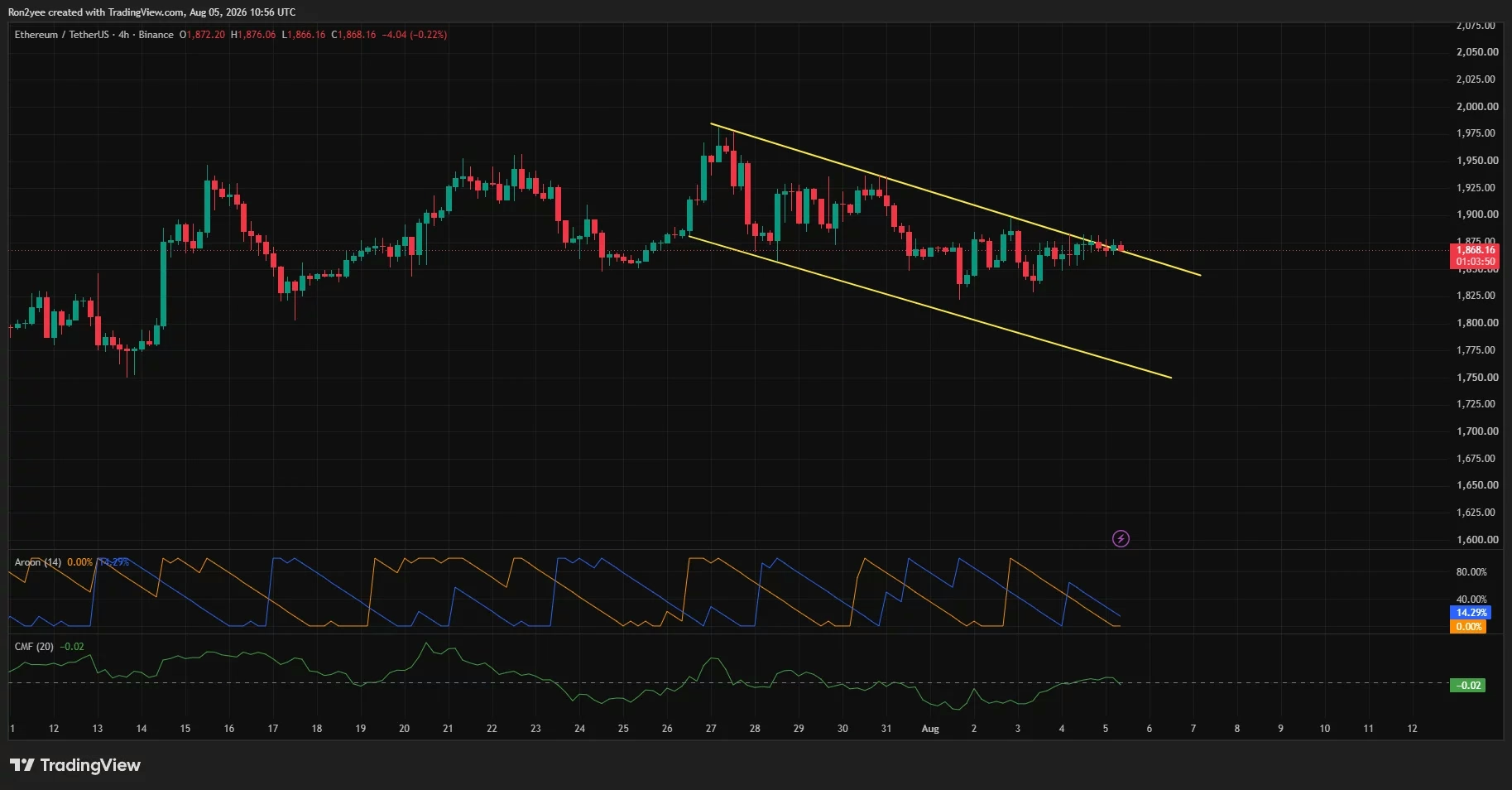
A successful 4-hour close above this channel, combined with a daily move through the $1,918 to $1,940 resistance range, would represent a critical turning point. Such a breakout could trigger short liquidations and open the pathway toward retesting $1,975 and ultimately the $2,000 target.
However, momentum indicators suggest caution. The Aroon Up reading stands at just 14.29%, while Aroon Down registers at 0%. Both readings near the bottom of their range indicate that neither buyers nor sellers have established a strong short-term trend. This indecision reflects genuine uncertainty about Ethereum's near-term direction.
The Chaikin Money Flow indicator, currently at minus 0.02, points to modest net selling pressure. More importantly, it reveals that ETH has yet to attract the sustained capital inflows necessary for a clean technical breakout. Without institutional or retail demand stepping in decisively, price action may remain range-bound.
Liquidation Clusters: The Hidden Price Magnets 💧
Beneath the surface of Ethereum's price chart lies another important dynamic—the distribution of leveraged positions that could accelerate price movements in either direction. CoinGlass data reveals significant liquidation clusters that deserve careful attention.
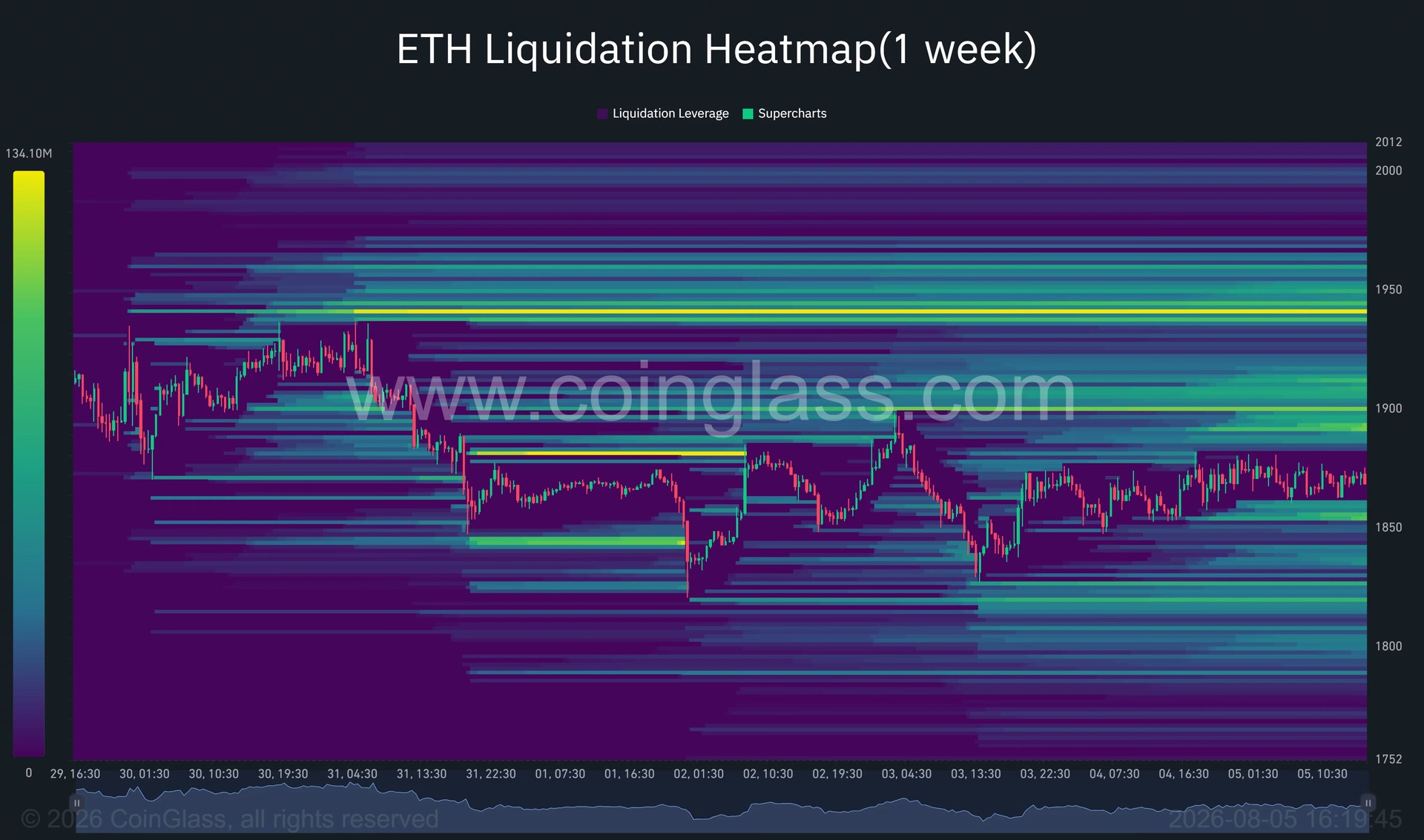
Liquidity has accumulated around $1,890 to $1,905, but a much larger concentration exists near $1,940. These levels function as short-term price magnets—if ETH breaks above its descending trendline, these liquidation clusters could be quickly swept, propelling price toward $1,975 and potentially $2,000. A move through $1,940 would represent a critical technical victory.
Conversely, downside protection appears more fragmented. Liquidation pools exist around $1,850, $1,820, and $1,800. A rejection below $1,900 could trigger long liquidations and pull ETH toward these lower clusters before another recovery attempt materializes. Notable analyst Michaël van de Poppe has identified $1,800 as the decisive support level, suggesting that a break above $2,000 could place $2,300 to $2,500 within reach.
EIP-8361: When Philosophy Meets Price Action 🔥
While technical factors dominate short-term price movements, a more significant debate is unfolding within Ethereum's development community—one that could reshape the network's economics and, by extension, its long-term value proposition. The emergence of EIP-8361 represents far more than a minor protocol adjustment; it reflects fundamental disagreements about Ethereum's future direction.
EIP-8361, submitted by six authors including Ethereum Foundation researcher Justin Drake on August 4, proposes a gradual reduction in validator rewards as the staking ratio increases. Specifically, the proposal would progressively burn a larger share of validator rewards, reaching a 100% burn rate once the staking ratio reaches 50%. At that threshold, all newly issued consensus rewards would be burned rather than distributed to validators. Transaction fees and maximal extractable value would remain as separate income sources.
This represents a philosophical shift in how Ethereum manages its issuance policy. Rather than implementing a hard cap on staking, EIP-8361 seeks to remove the issuance-based incentive to continue staking once the ratio approaches 50%. The proposal remains under discussion and has not yet been approved for a network upgrade, but its implications are significant.
The Community Divide 🌍
The proposal has fractured the Ethereum ecosystem into distinct camps. Aave founder Stani Kulechov argued that developers should prioritize privacy and Ethereum's role in the financial system rather than adjusting staking issuance. This perspective reflects a belief that Ethereum's competitive advantage lies elsewhere—in its ability to serve as financial infrastructure, not in tweaking validator incentives.
Ted Pillows echoed this sentiment, emphasizing that Ethereum should focus on capturing more value and scaling the network rather than spending development resources on reducing staking fees. From this viewpoint, the protocol should build a valuable, scalable flywheel rather than becoming consumed by validator economics.
These perspectives highlight a deeper tension within the Ethereum community. Developers and ecosystem participants are grappling with questions about what matters most: long-term supply sustainability, validator incentive alignment, network security, or user experience and adoption? Different stakeholders prioritize these concerns differently.
Price Implications: Short-Term Versus Long-Term 📈
The critical question for traders and investors is whether EIP-8361 provides an immediate price catalyst. The answer, at least for the near term, appears to be no. The proposal could support Ethereum's long-term supply outlook by limiting new issuance, but it does not offer an immediate driver for price appreciation.
Its near-term effect remains largely tied to market expectations and the broader debate over validator incentives. For US investors particularly, Ethereum's ability to reclaim $2,000 will depend far more on spot demand, broader risk appetite, and institutional flows than on EIP-8361 alone. The proposal may shape ETH's longer-term issuance policy, but price must first escape its short-term descending channel.
The Path to $2,000: Bullish and Bearish Scenarios ⛓️
Bullish Case
Ethereum's first bullish confirmation would require a 4-hour close above $1,885, followed by a daily move through the $1,918 to $1,940 resistance range. Clearing these levels could trigger short liquidations and allow ETH to retest $1,975 and $2,000. A sustained break above $2,000 would then bring the 200-day SMA at $2,074 into focus, opening the possibility of a more substantial rally.
This scenario depends on several factors aligning: increased institutional demand, broader market risk appetite, and technical confirmation across multiple timeframes. The liquidation clusters at $1,940 could actually accelerate upside momentum if broken, creating a self-reinforcing rally.
Bearish Case
The bearish scenario begins with another rejection below $1,900. Losing $1,850 would expose $1,820 and $1,800, while a daily close below the 50-day SMA at $1,788 would weaken the broader recovery structure established since June. Such a breakdown would suggest that the recovery from $1,500 has exhausted itself, potentially opening the door to a retest of lower levels.
What's Next for Ethereum? 🚀
Ethereum stands at a crossroads. Technically, the cryptocurrency faces a clear breakout opportunity in the $1,875 to $1,885 range on the 4-hour chart. Breaking above this level, combined with clearing the daily resistance at $1,918 to $1,940, could propel ETH toward $2,000 and beyond.
However, the technical setup alone doesn't guarantee success. Ethereum requires sustained capital inflows and renewed institutional interest to break through its current resistance structure. The Chaikin Money Flow indicator's slightly negative reading suggests that such inflows have not yet materialized.
Meanwhile, the EIP-8361 debate adds an interesting layer of complexity. While the proposal doesn't provide an immediate price catalyst, it reflects important conversations about Ethereum's future direction. The outcome of this debate—and how the community ultimately decides to manage validator incentives—could influence long-term adoption and value proposition.
For traders, the immediate focus should remain on technical levels. For longer-term holders, the philosophical questions raised by EIP-8361 deserve serious consideration. Ethereum's ability to balance innovation with stability, community consensus with technical necessity, will ultimately determine whether it can sustain its position as the leading smart contract platform.
Key Takeaways 📌
Technical Setup: Ethereum trades at $1,868 with clear resistance at $1,918 to $1,940 and support at $1,800. A 4-hour close above $1,885 could trigger upside momentum.
Liquidation Dynamics: Significant liquidation clusters near $1,940 could accelerate a move toward $2,000 if resistance breaks, but downside liquidations could intensify selling below $1,900.
EIP-8361 Impact: While the proposal could support long-term supply sustainability, it provides no immediate price catalyst. Price movement will depend more on spot demand and institutional flows.
Risk Management: The $1,800 level represents the decisive support. A break below this level would weaken the broader recovery structure and potentially expose lower targets.
Ethereum's path to $2,000 remains open but requires both technical confirmation and renewed market demand. The next few trading sessions will be critical in determining whether the $1,875 to $1,885 breakout level holds, setting the stage for either a significant rally or a pullback to lower support zones.
You May Also Like

Market Analysis
XRP Price Falls 5% as Leverage Hits Seven-Month High
August 26, 2026

Market Analysis
Crypto Market Hits Extreme Greed: What This Means for Bitcoin
August 26, 2026

Market Analysis
Ethereum Price Rally Overheats Below $2,550 Resistance
August 26, 2026

Market Analysis
Hyperliquid Price Rally: HYPE Targets $97 Amid $80 Support
August 25, 2026