Category:
Market AnalysisMEXC Stock Futures Trading Volume Surges 3,300% in Asia

The cryptocurrency exchange landscape is undergoing a remarkable transformation across Asia 🚀. What was once purely a digital asset trading domain has evolved into a comprehensive financial platform where traders seamlessly move between Bitcoin, traditional stocks, precious metals, and other real-world assets. This shift represents one of the most significant developments in centralized exchange (CEX) adoption patterns, particularly in how Asian users are approaching portfolio diversification.
MEXC, a major global cryptocurrency exchange, has emerged as a focal point in this transformation. The platform's average daily stock futures trading volume in Asia experienced an extraordinary surge of 3,308% quarter-over-quarter during the second quarter of 2026. This explosive growth signals a fundamental change in how crypto-native investors are accessing traditional financial markets.
The Dramatic Rise of TradFi Futures on Crypto Exchanges 📈
The momentum behind traditional finance (TradFi) futures trading on crypto platforms extends beyond simple market enthusiasm. According to research commissioned by MEXC Ventures and conducted by Blockworks Research, the average daily number of stock futures traders in Asia increased by 386% from Q1 to Q2 2026. This dual metric—both volume and user growth—demonstrates that the surge represents genuine market adoption rather than concentrated whale activity.
The regional breakdown reveals even more striking patterns. Southeast Asia experienced particularly explosive growth, with average daily stock futures volume climbing 6,648% and the number of active traders rising 399%. East Asia recorded a more modest but still impressive 1,957% increase in trading volume alongside a 465% rise in the trader count.
Momentum has continued accelerating into Q3. Through August 2026, MEXC's average daily stock futures volume across Asia had risen an additional 102% from Q2 levels, while the number of users increased 51%. East Asian volume climbed 186% compared to Q2, while Southeast Asia saw a 50% volume increase during the same comparison period.
Why Crypto Traders Are Flooding Into Traditional Assets 🌍
The migration of capital and attention from purely cryptocurrency markets to traditional assets isn't random. Several compelling factors are driving this transition:
Limited Market Hours: Traditional stock exchanges operate on fixed schedules—typically 9:30 AM to 4:00 PM in their respective time zones. This limitation creates significant friction for global traders, especially those in Asia who may be trading outside standard business hours. Crypto exchanges, operating 24/7/365, eliminate this constraint entirely.
Brokerage Costs: Traditional brokerages impose various fees—commission charges, account maintenance fees, and deposit/withdrawal costs. Centralized exchanges often feature more transparent and competitive fee structures, particularly for high-volume traders.
Unified Trading Experience: A user holding USDT (Tether stablecoin) on a crypto exchange can instantly move between Bitcoin, tokenized stocks, gold futures, and equity indices without initiating bank transfers or opening separate brokerage accounts. This frictionless experience represents a paradigm shift in financial market accessibility.
Stablecoin Infrastructure: The maturation of stablecoin ecosystems has created a stable value bridge between crypto and traditional finance. Asia accounts for approximately 30% of worldwide stablecoin activity, according to Organisation for Economic Co-operation and Development research, providing substantial liquidity for TradFi trading.
Regional Demand Signals Strong User Intent 💪
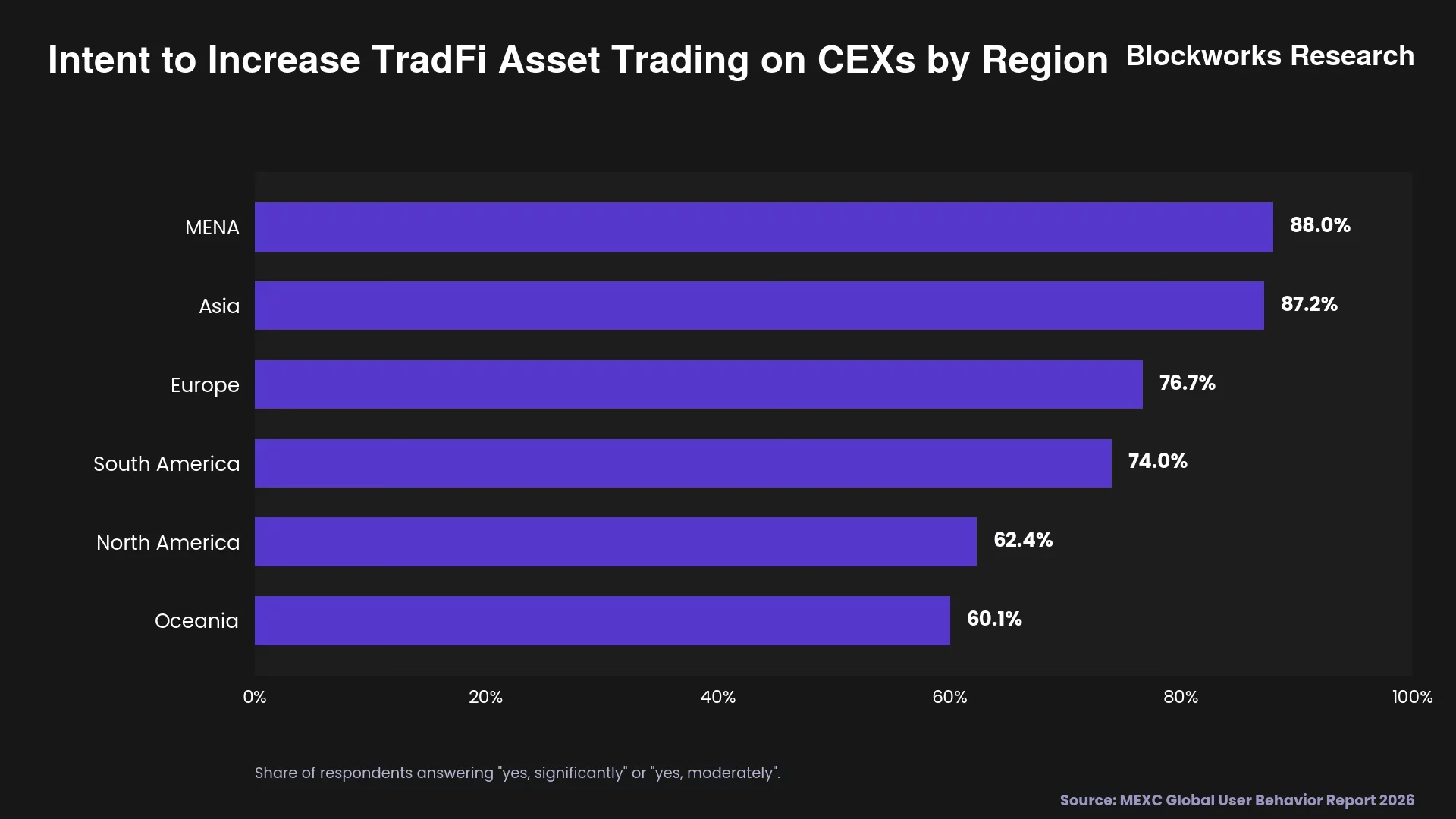
Survey data from MEXC users reveals compelling demand indicators across Asia. Among crypto-native Asian respondents, 87.2% indicated plans to increase their TradFi trading through centralized exchanges. This figure represents exceptional consensus around the value proposition of crypto-native platforms for traditional asset access.
Precious metals command particular interest in Asian markets. Among surveyed respondents, 62.6% reported primarily trading precious metals through centralized exchanges—the highest share among all regions studied. This preference reflects deep cultural and investment traditions around gold ownership in Asian societies, combined with the convenience of digital trading.
Spot trading in traditional assets is also gaining traction, though futures contracts dominate trading activity. In Southeast Asia, the average daily number of MEXC users trading spot stocks rose 153% during Q2, with average daily volume increasing 348%. The subsequent quarter showed continued momentum, with daily spot user counts growing another 159% and volume increasing 87%.
Futures Dominate Over Spot Products 📊
The data reveals a striking preference for leveraged futures contracts over spot purchases of traditional assets. Real-world assets, foreign exchange, and tokenized stocks account for less than 2% of monthly spot volume on centralized exchanges but exceed 12% of futures volume.
In July 2026, futures tied to these three categories generated close to $400 billion in trading volume—the highest monthly total in the reviewed period. Tokenized stock contracts supplied most recent growth, with Binance leading the segment and MEXC controlling approximately 20% of volume alongside competitor BingX.
This futures preference carries important implications. While perpetual futures enable users to take long or short positions without expiration dates, they also introduce leverage risks. Leveraged positions can amplify losses and expose traders to liquidation events when markets move unfavorably.
MEXC processed $427 million in spot tokenized-stock volume during July, placing it behind Bybit, Gate, and Binance. Combined spot trading in tokenized stocks, foreign exchange, and real-world assets reached approximately $9.5 billion—a significant decline from over $30 billion in October 2025. This gap underscores trader preference for leveraged exposure over direct asset ownership.
Market Performance Driving Asset Diversification 💰
Performance differentials across asset classes have influenced trading patterns. From January 2025 through the measurement period, Bitcoin declined 32%, while gold gained 64%, the Nasdaq-100-tracking QQQ rose 42%, and the S&P 500-tracking SPY added 32%. These divergent returns have motivated crypto-native investors to diversify beyond digital assets.
Gold deserves particular attention as an early success story. The World Gold Council reported that Asian gold exchange-traded funds received $25 billion in net inflows and added 215 metric tons during Q1 2026. On MEXC, average daily gold futures volume in Southeast Asia rose 18% quarter-over-quarter, while the number of daily users trading spot gold increased 42%—exceeding growth recorded in East and South Asia.
Product Coverage and Exchange Competition 🏆
MEXC has positioned itself competitively through extensive product offerings. The platform listed 199 real-world asset spot products and 159 TradFi perpetual contracts during the measured period, totaling 358 products. This comprehensive coverage ranked MEXC first for product diversity among major exchanges studied.
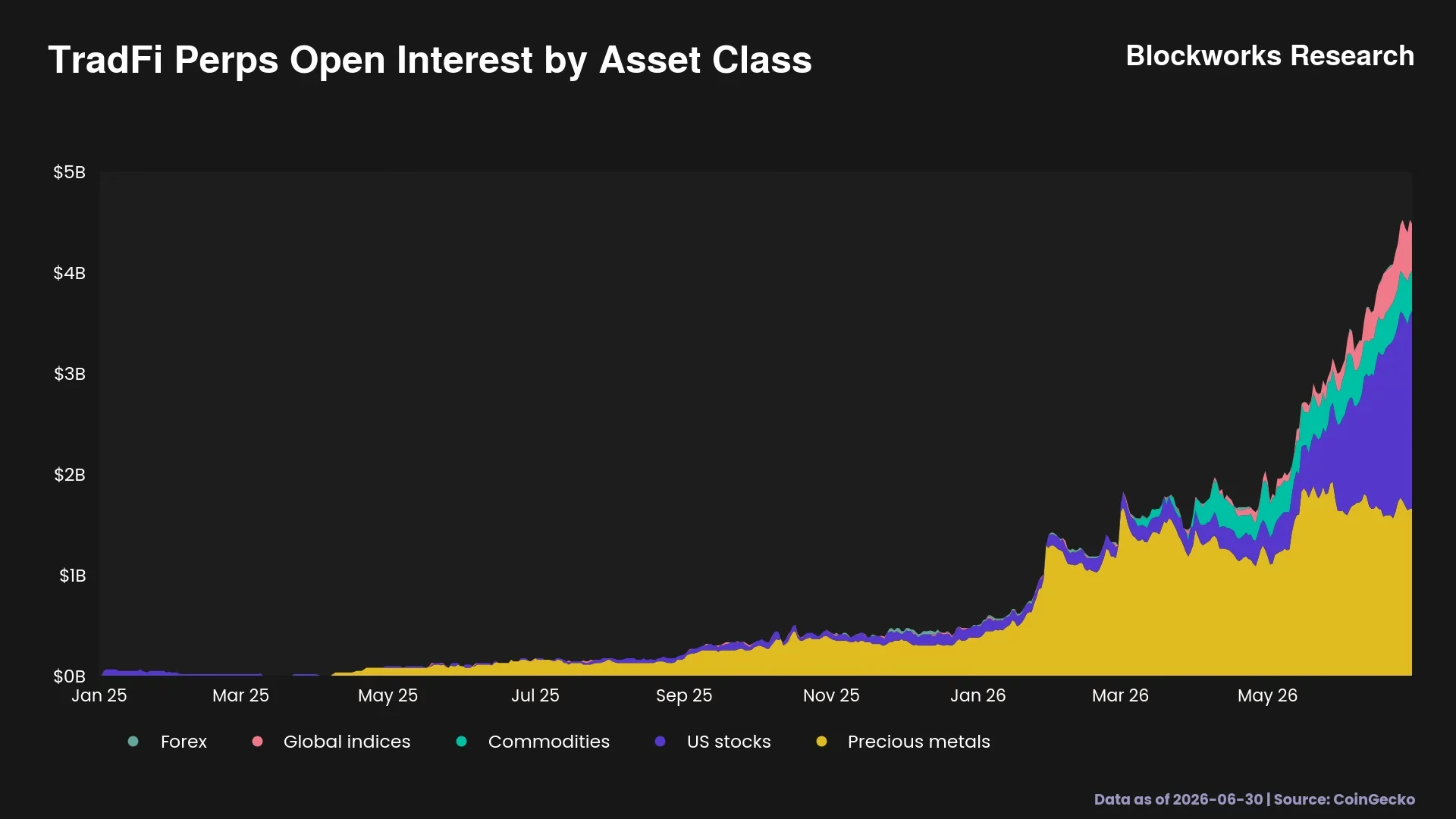
Additionally, a CoinGecko analysis ranked MEXC second in TradFi perpetual trading volume, with $323.86 billion recorded between January 2025 and May 2026. This standing reflects the exchange's significant market share in the rapidly expanding TradFi futures segment.
The Broader Blockchain Ecosystem Supporting Growth 🔗
The surge in TradFi trading on crypto platforms builds upon substantial underlying blockchain adoption in Asia. On-chain value received across the Asia-Pacific region increased 69% year-over-year during the 12 months ending June 2025—the fastest rate among regions compared.
Monthly on-chain value across Asia-Pacific climbed from approximately $80 billion in July 2022 to nearly $245 billion in late 2024. While this figure moderated to between $185 billion and $230 billion during the first half of 2025, the underlying infrastructure demonstrates mature, sustained adoption.
Among MEXC's Asian user base, 83.9% of respondents reported relying primarily on centralized exchanges for their cryptocurrency trading. This high concentration indicates that users are already accustomed to managing their digital assets through CEX platforms, making the transition to TradFi trading a natural extension rather than a behavioral leap.
What This Means for the Future of Finance 🔮
The 3,300% surge in MEXC stock futures trading volume represents more than an exchange-specific success story. It signals a fundamental restructuring of how global investors, particularly in Asia, access and manage diverse asset classes. The convergence of cryptocurrency infrastructure with traditional finance creates unprecedented opportunities for market participants seeking:
- 24/7 Trading Access: No more waiting for market opens or closing times
- Reduced Friction: Seamless movement between asset classes without intermediaries
- Lower Costs: Competitive fee structures compared to traditional brokerages
- Unified Accounts: Single platform for crypto, stocks, commodities, and forex
As regulatory frameworks mature and additional exchanges expand their TradFi offerings, this trend will likely accelerate. The question for traditional financial institutions is no longer whether crypto platforms will capture TradFi volume, but how quickly and at what scale this migration will occur.
For traders and investors, particularly those in Asia, the practical implication is clear: centralized exchanges have evolved from cryptocurrency-only platforms into comprehensive financial marketplaces. The 3,308% surge in MEXC's stock futures volume represents the early stages of a significant market restructuring that will reshape how global finance operates.
You May Also Like

Market Analysis
XRP Price Falls 5% as Leverage Hits Seven-Month High
August 26, 2026

Market Analysis
Crypto Market Hits Extreme Greed: What This Means for Bitcoin
August 26, 2026

Market Analysis
Ethereum Price Rally Overheats Below $2,550 Resistance
August 26, 2026

Market Analysis
Hyperliquid Price Rally: HYPE Targets $97 Amid $80 Support
August 25, 2026