Category:
Market AnalysisMicroStrategy Stock Plummets: Saylor Halts Bitcoin Buying Spree

The Bitcoin Play Hits a Speed Bump 📉
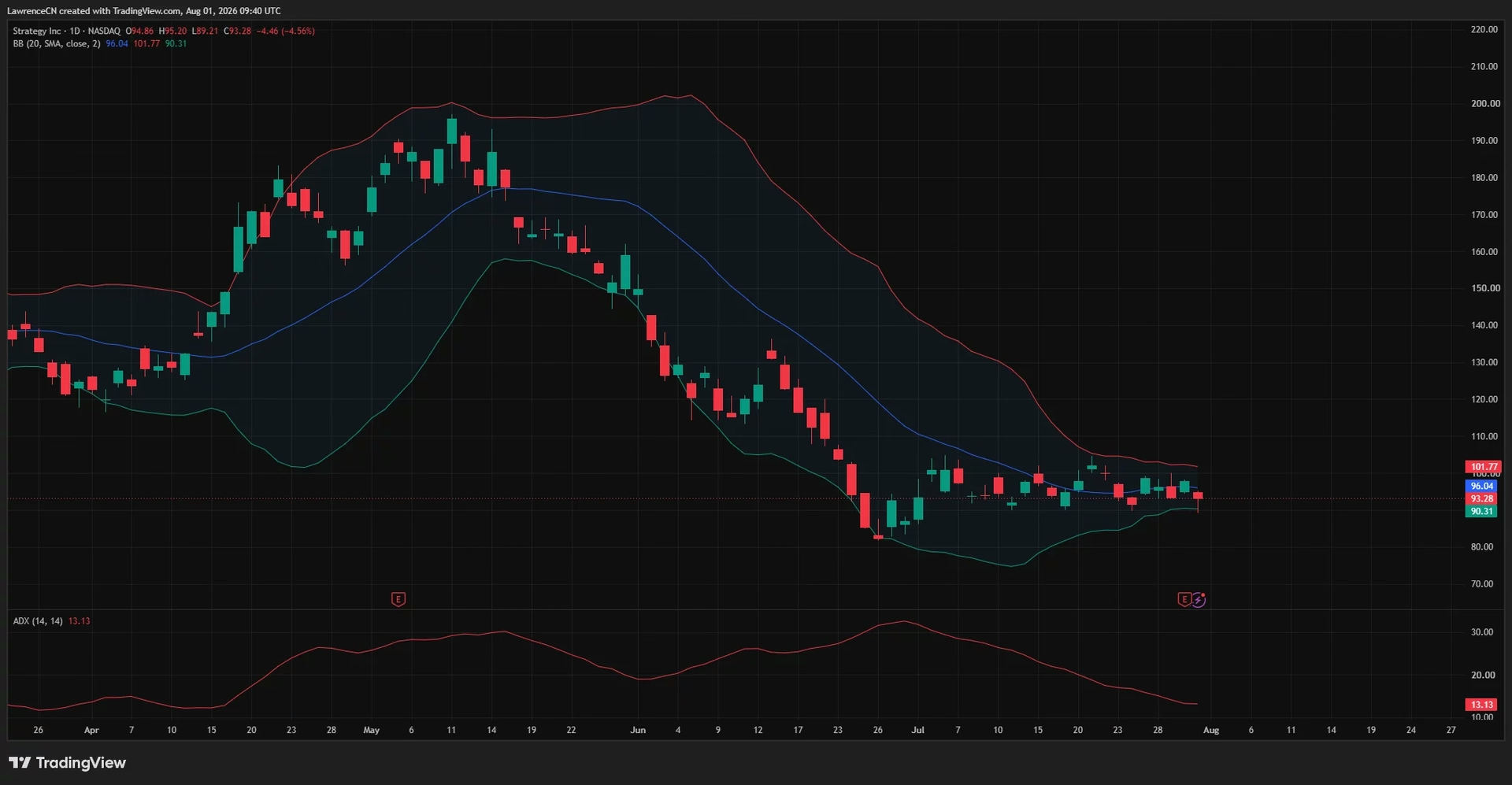
MicroStrategy's aggressive Bitcoin accumulation strategy just hit the brakes, and Wall Street took notice. The company's stock price tumbled 4.56% to close at $93.28 on July 31st, marking a significant pullback from its ambitious cryptocurrency acquisition plans. This unexpected pivot from one of the most prominent corporate Bitcoin holders signals a strategic recalibration that could reshape how institutional investors approach digital asset accumulation.
The selloff wasn't random market noise—it came directly after the company reported devastating quarterly results that exposed the inherent volatility of holding massive Bitcoin positions on a public company's balance sheet.
Understanding the $8.22 Billion Loss 💔
MicroStrategy's second-quarter earnings painted a sobering picture for shareholders. The company recorded an $8.22 billion net loss, driven primarily by an $8.32 billion unrealized loss on its Bitcoin holdings. This staggering figure highlights a critical vulnerability in the company's business model: when Bitcoin prices fluctuate, these unrealized losses flow directly through the income statement under fair-value accounting rules.
At quarter-end, MicroStrategy held an impressive 843,775 Bitcoin—representing a 25% increase from the start of the year. However, the company's average acquisition price of $75,476 per coin now looks considerably higher than current market valuations. The position's market value had contracted to approximately $54.77 billion, creating a $9 billion gap between cost basis and current value.
On a per-share basis, the quarterly loss reached $24.45, a figure that would concern any investor evaluating the company's financial health. Yet beneath these eye-watering numbers lies a more nuanced story about strategic positioning and long-term capital deployment.
The Saylor Pivot: A New Philosophy Emerges 🧠
Executive Chairman Michael Saylor used the earnings call to announce a fundamental shift in MicroStrategy's approach. Rather than deploying every available dollar into immediate Bitcoin purchases, the company would now maintain a balanced portfolio of both cash and cryptocurrency.
"Perhaps the best way to buy the most Bitcoin is not to buy the most Bitcoin immediately," Saylor stated—a striking reversal from the company's previous all-in mentality that had defined its strategy since 2020.
This philosophical shift suggests that Saylor and his team recognize the importance of timing, capital preservation, and maintaining flexibility during volatile market conditions. The company accumulated over $63.69 billion in Bitcoin purchases throughout its buying campaign, but this latest pause indicates management believes strategic patience might yield better long-term results than relentless accumulation regardless of price levels.
The STRC Preferred Stock Puzzle 🔧
Central to understanding MicroStrategy's current priorities is the company's variable-rate preferred stock (STRC), which closed July 31st at approximately $89—well below its $100 par value. Chief Executive Phong Le announced that the company would halt Bitcoin purchases until STRC returns to par, signaling that restoring investor confidence in the preferred securities takes precedence over continued cryptocurrency accumulation.
Between July 20 and July 24, MicroStrategy repurchased approximately $25 million of STRC while simultaneously raising $544 million through common stock sales. This two-pronged capital strategy reveals management's determination to stabilize the preferred shares, which have become integral to the company's broader capital-raising infrastructure.
Why does this matter? Preferred stock trades represent a sophisticated financing mechanism that allows MicroStrategy to raise capital without excessive dilution to common shareholders or reliance on traditional debt instruments. If STRC loses credibility with the investment community, the company loses a valuable tool for funding future Bitcoin acquisitions.
Technical Analysis: The Consolidation Zone 📊
From a technical perspective, MicroStrategy stock is trading within a tight consolidation range defined by Bollinger Bands. The lower band sits at $90.31, while the upper band extends to $101.77. Thursday's decline pushed the stock toward the lower band, suggesting potential weakness if selling pressure persists.
The Average Directional Index (ADX) reading of 13.13 indicates a lack of strong directional momentum—a sign that the stock remains trapped in consolidation despite the bearish session. A close below $90.31 could confirm renewed selling and expose the late-June low around $81 to $82, where the stock found support before its July stabilization.
On the upside, recovery above the $96.04 midpoint would be necessary to challenge the upper Bollinger Band. The relatively narrow distance between the bands suggests volatility has compressed following the stock's steep decline from its May high near $200—a drop that underscores the challenges of holding leveraged Bitcoin exposure during market corrections.
Wall Street Remains Cautiously Optimistic 🏢
Despite the recent selloff, major Wall Street analysts maintained their bullish stance on MicroStrategy, though with adjusted price targets that reflect current realities.
Benchmark's Assessment:
- Maintained a "buy" rating
- Reduced price target from $570 to $435
- Analyst Mark Palmer cited STRC restoration as a positive for future capital raising
H.C. Wainwright's View:
- Retained "buy" rating with $325 price target
- Highlighted the company's $3.75 billion cash reserve as a stabilizing factor
- Noted that STRC repurchases could strengthen the balance sheet and reduce debt needs
These targets imply substantial upside from current levels, though both analysts acknowledge that MicroStrategy's performance remains inextricably linked to Bitcoin's trajectory and the company's ability to issue securities on favorable terms.
The Cash Reserve: A Strategic Buffer 💰
One often-overlooked positive in MicroStrategy's financial profile is its substantial $3.75 billion cash reserve. This liquidity cushion provides the company with significant flexibility to cover dividend and interest obligations on preferred stock without forced Bitcoin sales during market downturns.
This cash position fundamentally changes the risk calculus for investors. Rather than a company desperately accumulating Bitcoin with borrowed money, MicroStrategy operates from a position of relative strength—able to weather extended bear markets and maintain its preferred stock obligations without distressed selling.
What Comes Next? 🔮
MicroStrategy's near-term stock performance will hinge on two critical factors:
- STRC Recovery: Can the preferred stock return to $100 par value, restoring management's ability to resume aggressive Bitcoin buying?
- Bitcoin Performance: Will Bitcoin recover above MicroStrategy's average acquisition cost of $75,476, validating the company's long-term thesis?
Management's decision to pause Bitcoin purchases should not be interpreted as abandonment of the cryptocurrency strategy. Instead, it represents a tactical pause—a recognition that supporting the financial infrastructure enabling future acquisitions takes precedence over immediate accumulation.
For US investors seeking leveraged Bitcoin exposure through a publicly traded vehicle, MicroStrategy remains a unique option. However, this exposure carries company-specific risks including preferred-share obligations, equity dilution, and earnings volatility driven by fair-value accounting adjustments on Bitcoin holdings.
Key Takeaways 🎯
- Strategic Shift: Saylor's emphasis on balanced cash and Bitcoin holdings marks a departure from relentless accumulation
- Financial Headwinds: The $8.22 billion quarterly loss underscores the volatility of holding massive Bitcoin positions
- Capital Preservation: STRC restoration now takes priority over immediate Bitcoin purchases
- Technical Setup: Stock consolidation between $90.31 and $101.77 suggests range-bound trading until momentum emerges
- Long-Term Thesis: Analyst support remains intact, with substantial upside targets despite near-term challenges
MicroStrategy's pause in Bitcoin buying represents a maturation of corporate cryptocurrency strategy—moving beyond "buy at any price" toward more sophisticated capital deployment. Whether this measured approach ultimately proves superior to aggressive accumulation will likely become clear as Bitcoin and broader market conditions evolve. 📈
You May Also Like

Market Analysis
XRP Price Falls 5% as Leverage Hits Seven-Month High
August 26, 2026

Market Analysis
Crypto Market Hits Extreme Greed: What This Means for Bitcoin
August 26, 2026

Market Analysis
Ethereum Price Rally Overheats Below $2,550 Resistance
August 26, 2026

Market Analysis
Hyperliquid Price Rally: HYPE Targets $97 Amid $80 Support
August 25, 2026