Category:
Market AnalysisRobinhood Stock Rebounds: Bernstein Targets 80% Upside

🚀 Robinhood's Surprising Recovery Signals Broader Market Confidence
Robinhood Markets has captured investor attention with a compelling rebound that extends far beyond typical trading fluctuations. Following the release of impressive second-quarter results, the fintech brokerage is positioning itself as more than just a stock and cryptocurrency trading platform—it's evolving into a diversified financial infrastructure powerhouse.
The stock's recent performance reflects a fundamental shift in how analysts view the company's long-term potential. Bernstein's maintained Outperform rating and $160 price target represent approximately 81% upside from recent trading levels, signaling that institutional investors see substantial value creation opportunities ahead. This bullish stance comes despite broader market volatility and challenges within the cryptocurrency trading sector.
📊 Second-Quarter Performance Exceeds Expectations
Robinhood delivered second-quarter net revenue of $1.31 billion, representing a robust 32% year-over-year increase from $989 million in the prior year period. This result surpassed analyst consensus estimates of approximately $1.26 billion, demonstrating the company's ability to execute across multiple business segments.
What makes this performance particularly noteworthy is the composition of revenue growth. Rather than relying solely on cryptocurrency trading—a sector experiencing cyclical weakness—Robinhood is successfully diversifying its income streams. This strategic expansion addresses investor concerns about over-dependence on volatile digital-asset markets.
Key financial highlights from Q2:
- Total net revenue: $1.31 billion (↑32% YoY)
- Revenue beat: $50 million above consensus
- Event contracts generated: $156 million
- Crypto trading revenue: $100 million
- Rothera exchange contracts processed: 3.5 billion cumulative
🎯 Prediction Markets: The Unexpected Revenue Powerhouse
Perhaps the most striking development is the emergence of prediction markets as Robinhood's fastest-growing revenue segment. Event-contract revenue reached $156 million during the quarter—surpassing cryptocurrency trading revenue and fundamentally reshaping the company's business model.
Robinhood's Rothera exchange, which launched in June, has already processed more than 3.5 billion contracts cumulatively. During Q2 alone, approximately 2.1 billion contracts traded on the platform, generating $17 million in revenue. Bernstein analysts identified Rothera as the third-largest U.S. exchange in its category—an extraordinary achievement for a platform that's been operational for mere months.
This success reflects growing mainstream interest in prediction markets as a legitimate asset class. Unlike traditional cryptocurrency trading, which remains subject to regulatory uncertainty and market cyclicality, prediction markets address a fundamental human need: the desire to quantify and trade on future outcomes. From political elections to sporting events to economic indicators, prediction markets democratize access to what was previously an exclusive institutional domain.
🔗 Tokenization: Building Infrastructure for the Next Decade
Beyond prediction markets, Robinhood is establishing itself as a critical infrastructure provider for tokenized assets—a market segment that could eventually dwarf traditional securities trading. Robinhood Chain has recorded over $12 billion in decentralized exchange volume and processed more than 150 million transactions since launch, demonstrating significant adoption among both retail and institutional participants.
The company's tokenized stocks initiative extends this vision globally. Through Robinhood Wallet, stock tokens are now available in more than 120 countries, giving international investors blockchain-based exposure to listed securities. This approach circumvents traditional regulatory barriers while maintaining compliance with local jurisdictions.
Tokenization ecosystem components:
- Robinhood Chain: $12B+ DEX volume
- 150M+ transactions processed
- Robinhood Wallet: 120+ countries
- Robinhood Earn: $200M+ deposits
- Stock token availability: Global expansion
Robinhood Earn has attracted more than $200 million in deposits, indicating strong customer interest in yield-generating opportunities within the blockchain ecosystem. These products collectively create multiple revenue streams while expanding the company's addressable market beyond traditional brokerage services.
🤖 Agentic Trading: The AI-Powered Future of Investing
Robinhood recently opened its Agentic Trading platform to its entire customer base, introducing artificial intelligence-powered investment capabilities to retail investors. This platform allows customers to connect AI agents through Robinhood's Model Context Protocol server and assign specific investing tasks—essentially democratizing algorithmic trading strategies previously available only to sophisticated investors.
This innovation positions Robinhood at the intersection of fintech and artificial intelligence, two of the most transformative technologies of the decade. As AI becomes increasingly integrated into investment processes, early-mover advantages in this space could prove substantial.
💰 Analyst Perspectives: Bullish vs. Cautious
While Bernstein maintains its aggressive $160 target, other major analysts are adopting more measured stances. Goldman Sachs retained a Buy rating but reduced its 12-month price target from $137 to $118—still implying 33% upside but reflecting concerns about near-term growth sustainability.
This divergence reflects genuine uncertainty about Robinhood's ability to convert emerging revenue streams into durable, predictable earnings. Bernstein's bullish case rests on the assumption that prediction markets, tokenized stocks, and blockchain infrastructure will collectively offset weaker cryptocurrency trading revenue. Goldman's more conservative approach suggests skepticism about near-term execution risks.
Notably, Bernstein cut its 2026 cryptocurrency trading revenue estimate by 49%, acknowledging that digital-asset trading volumes have contracted significantly from their peaks. This reduction underscores why diversification beyond pure crypto trading is essential to Robinhood's investment thesis.
📈 Technical Analysis: Recovery Momentum Requires Confirmation
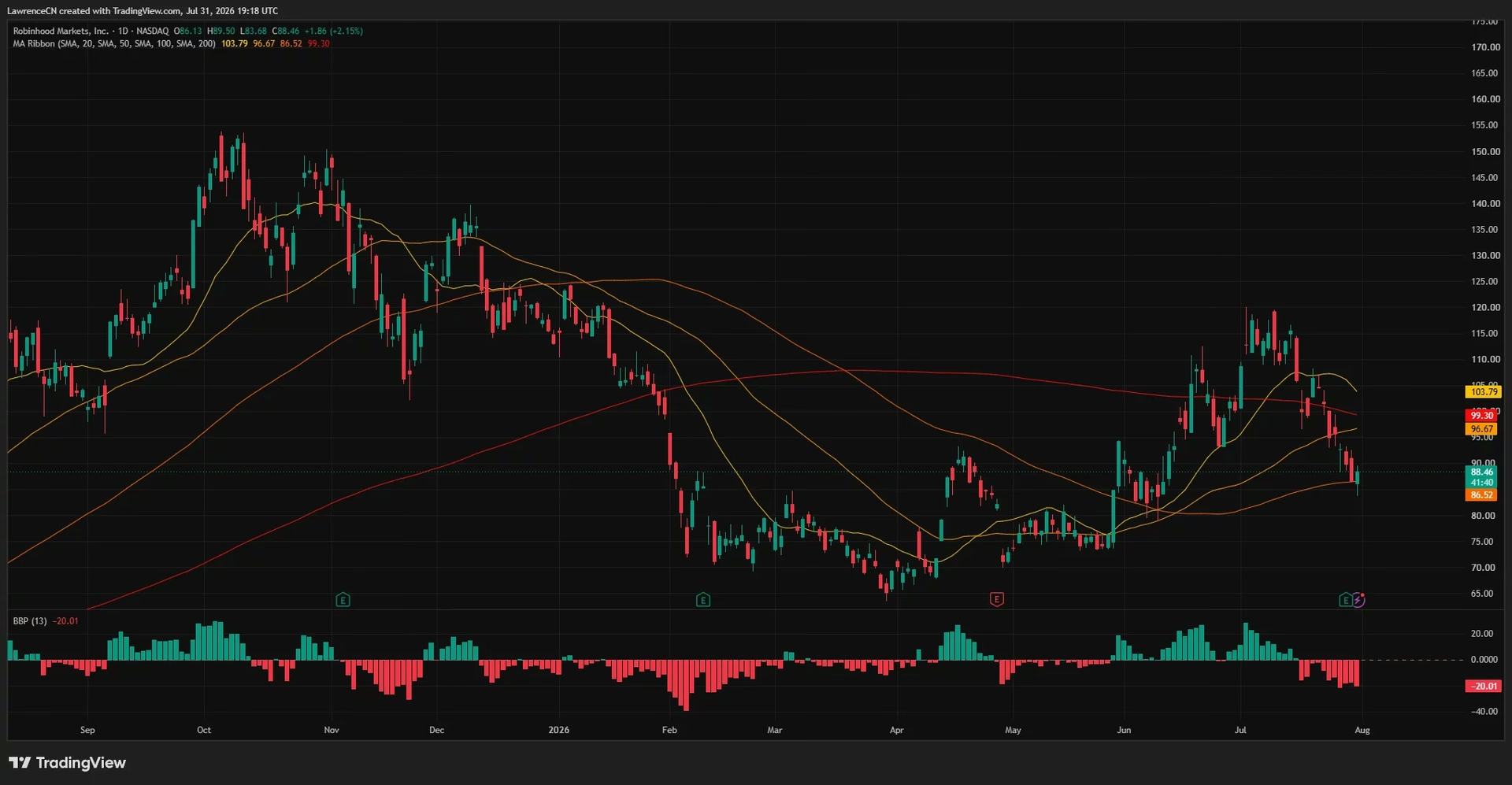
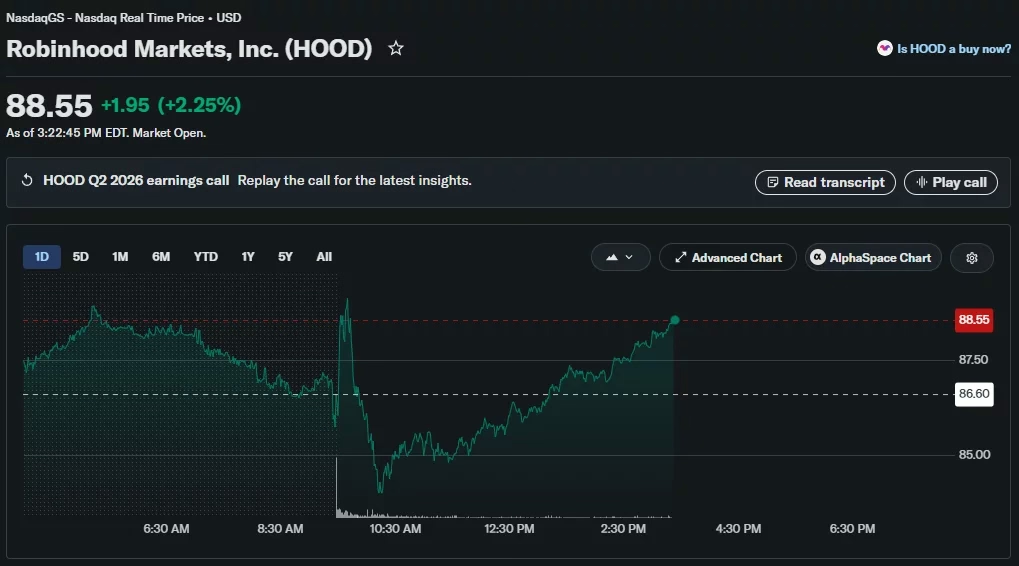
From a technical perspective, Robinhood's recent rebound remains fragile. The stock traded at $88.55 following Thursday's 2% recovery but remained significantly below key moving averages:
- 20-day moving average: $103.79 (resistance)
- 50-day moving average: $96.67 (critical resistance)
- 100-day moving average: $99.30 (resistance)
- 200-day moving average: $86.52 (support)
The stock remains approximately 26% below its July high near $120, indicating substantial selling pressure from investors who accumulated shares at higher valuations. For a meaningful recovery to develop, HOOD must reclaim the $96.67 level—the 50-day moving average—which would signal that buyers are regaining control.
Bear-bull power stood at minus 20.01, showing that sellers still maintain the near-term advantage. However, the stock's ability to hold above the 200-day moving average near $86.52 suggests that long-term institutional support remains intact.
🔮 Growth Drivers and Long-Term Optionality
Bernstein's $160 target depends critically on Robinhood successfully executing across multiple fronts simultaneously. Management expects prediction market flow to increasingly migrate toward Rothera over time while maintaining revenue from third-party exchange distributions. A future business-to-business offering could provide access to other futures commission merchants—though this remains a longer-term strategic option rather than an immediate revenue source.
The company is also exploring Robinhood Chain's potential as a broader infrastructure platform, potentially licensing its technology to other financial institutions. This B2B model could transform Robinhood from a consumer-facing brokerage into a critical infrastructure provider for the tokenized finance ecosystem.
⚠️ Regulatory Risks and Execution Challenges
While the growth narrative is compelling, investors should acknowledge significant execution and regulatory risks. Tokenized securities operate under different ownership, disclosure, and investor-protection rules across jurisdictions. Prediction markets continue facing scrutiny from U.S. federal and state authorities, creating potential regulatory headwinds.
Robinhood must navigate these complexities while maintaining compliance and investor protection standards. Any significant regulatory setback could materially impact the company's ability to scale these emerging business segments.
🎬 What's Next: Key Milestones to Monitor
Investors should focus on several critical developments in coming quarters:
- Rothera adoption trajectory – Can the exchange maintain its rapid growth trajectory and capture market share from competitors?
- Tokenization revenue acceleration – Will international stock token adoption translate into meaningful revenue?
- Crypto trading stabilization – Can Robinhood maintain crypto trading revenue despite broader market weakness?
- Regulatory clarity – Will prediction markets receive clearer regulatory frameworks from U.S. authorities?
- AI platform traction – Will Agentic Trading attract significant user adoption and generate meaningful revenue?
🌟 The Bottom Line: Evolution Over Disruption
Robinhood's recent rebound reflects investor recognition that the company is successfully evolving beyond its retail brokerage roots. While cryptocurrency trading revenue faces headwinds, emerging segments like prediction markets and tokenized assets offer substantial growth potential.
Bernstein's $160 target assumes successful execution across multiple growth initiatives—a challenging but achievable objective. For the bull case to materialize, Robinhood must demonstrate that prediction markets and tokenization can generate durable, predictable revenue streams that offset cryptocurrency trading cyclicality.
The technical recovery from $83.68 to $88.55 represents just the beginning of what could be a more substantial rebound if the company executes on its strategic initiatives. Investors should monitor the $96.67 level closely—a break above this resistance would signal renewed institutional buying and validate the bull thesis.
For long-term investors with conviction in the tokenization and prediction market narratives, Robinhood's current valuation presents an intriguing risk-reward opportunity. However, near-term volatility should be expected as the market digests the company's transformation from cryptocurrency trading specialist to diversified financial infrastructure provider.
You May Also Like

Market Analysis
XRP Price Falls 5% as Leverage Hits Seven-Month High
August 26, 2026

Market Analysis
Crypto Market Hits Extreme Greed: What This Means for Bitcoin
August 26, 2026

Market Analysis
Ethereum Price Rally Overheats Below $2,550 Resistance
August 26, 2026

Market Analysis
Hyperliquid Price Rally: HYPE Targets $97 Amid $80 Support
August 25, 2026